What is “ion” meaning in text?
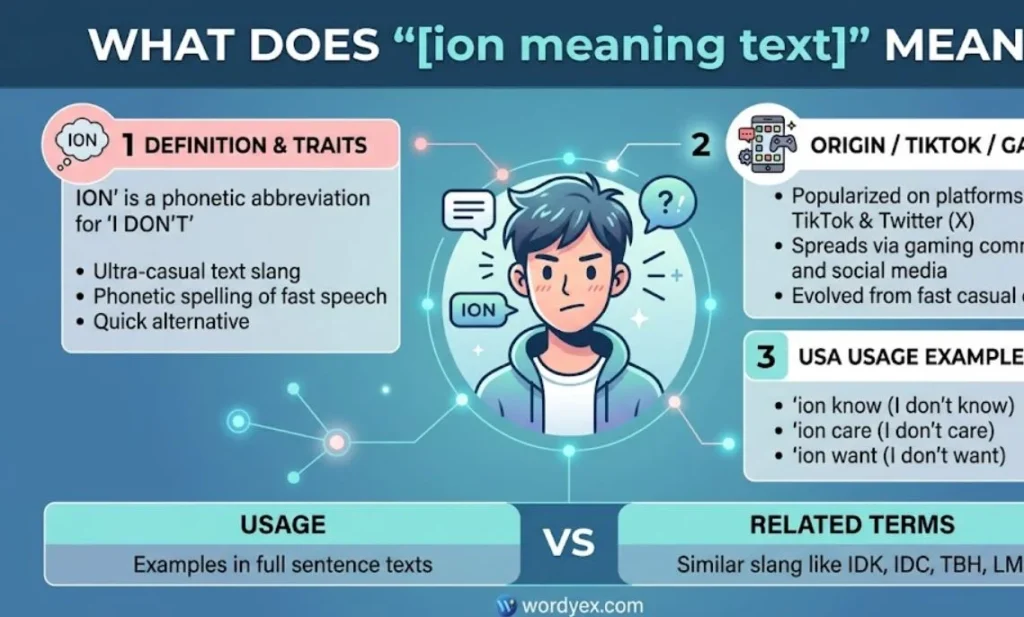
ion meaning text, In text messaging, “ion” is modern American internet slang that means “I don’t.” It is a fast, phonetic spelling of informal spoken English used in casual texts, social media posts, and online direct messages.
Why do people use “ion” in digital conversations?
- Saves time: Replaces a multi-word phrase with a quick 3-letter abbreviation.
- Mimics casual speech: Captures the natural, relaxed spoken cadence of everyday American English.
- Softens conversation tone: Feels lighter and less formal than typing out a rigid “I do not.”
- Signal of social comfort: Shows a friendly, relaxed connection between close friends, Gen Z, and Gen Alpha texters.
Understanding the Rise of “ion” in Texting
Have you ever been scrolling through your messages or looking at a TikTok comment section and felt completely thrown off by a single tiny word? You are definitely not alone. Language evolves at a breakneck speed, especially across American digital spaces where efficiency and casual tone rule the day.
When people search for “ion meaning text,” they are usually trying to bridge the gap between traditional English and modern informal communication. It clears up the confusion caused by auto-correct, phonetic spelling, and modern digital dialects. Understanding these terms keeps your everyday chats flowing smoothly without awkward pauses.
“ion” – Quick Meaning
Simply put, “ion” is a casual contraction that stands for “I don’t.” It captures the spoken cadence of fast, relaxed speech and translates it directly into written text.
- Primary Definition: Short for “I don’t”
- Tone: Ultra-casual, relaxed, informal
- Usage: Text messages, social media posts, casual DMs
Here is how it looks in action:
“ion know what time the party starts tonight.”
“ion really care where we go for dinner, you pick.”
“ion think that is a good idea right now.”
Origin & Background
The slang term “ion” did not just appear out of nowhere overnight. Its roots trace back to African American Vernacular English (AAVE), where the phrase “I don’t” is often pronounced quickly as a smooth, two-syllable or single-syllable phrase sounding like “i-onn.”
As social media platforms like Twitter (X), Instagram, and TikTok expanded nationwide, phonetic text spelling blew up. Gen Z and Gen Alpha users began typing words exactly as they sound in casual conversation. Over the last few years, “ion” shifted from a regional spoken accent to a staple of global internet culture, heavily influencing how Americans communicate online today.
If you enjoy staying up to date on evolving vocabulary, check out WordyEx for detailed breakdowns of modern slang and language trends.
Real-Life Conversations
To really catch the vibe of how “ion” works in daily American life, look at how real people use it across different platforms.
John: Are you coming to the basketball game after school?
Tony: ion know man, I have so much homework to catch up on.
John: Same here, but you should still come for a bit!
Maya: Did you see what Sarah posted on her story?
Chloe: No, ion really check Instagram during the day. What happened?
Maya: I will screenshot it and send it to you right now!
Marcus: Bro, did you understand anything from that math lecture?
Devon: ion even know where to start, that exam is going to be tough.
Elena: We are grabbing tacos at 7, want us to save you a seat?
Jordan: ion think I can make it by 7, but save me a spot just in case!
Why is it so viral? It saves keystrokes and instantly shifts the vibe of a conversation from formal to effortlessly cool.
Emotional & Psychological Meaning
Using “ion” instead of a rigid “I do not” carries subtle psychological weight. It acts as an emotional softener. Typing “I don’t care” can sometimes sound cold, blunt, or passive-aggressive. On the flip side, sending “ion care” feels lighter, more relaxed, and detached from unnecessary drama.
It expresses a sense of casual ease, low effort, and social comfort. When you use it with someone, you are subconsciously signaling that you feel relaxed enough around them to drop formal grammar rules.
I remember the first time a younger cousin texted me “ion like that place.” At first glance, my brain automatically read it as a science term regarding charged particles. But once I realized the context, the casual warmth of the phrase clicked immediately.
Usage in Different Contexts
On social media platforms like TikTok, X, and Instagram, “ion” is everywhere. It shows up in video captions, quick commentary, and meme culture to create an approachable tone.
Between close friends, romantic partners, and family members of similar ages, “ion” is ideal for casual chatter. It keeps the energy light and spontaneous.
In professional environments, emails, Slack channels, or client presentations, you should avoid “ion” completely. Stick to standard English like “I don’t” or “I do not” to maintain professionalism and clarity.
In casual settings, “ion” feels natural. In serious, high-stakes, or emotionally heavy conversations, standard spelling is better so your message is taken seriously.
When NOT to Use It
Knowing when to leave slang out of your vocabulary is just as important as knowing what it means.
Avoid using “ion” in professional communications, job interviews, academic papers, or official emails. Using standard grammar ensures your message remains clear and professional across all age groups and backgrounds. For guidelines on formal writing standards, you can consult authoritative guides like Merriam-Webster.
It is also wise to skip it when speaking with older individuals or non-native English speakers who might take the word literally as a scientific term, leading to unnecessary confusion.
Common Misunderstandings
The most common mix-up with “ion” comes from its literal definition in chemistry, where an ion is an atom or molecule with a net electric charge. Context is always your best friend here; if it appears in a text message rather than a science textbook, it means “I don’t.”
Another mistake is confusing “ion” with “I’m on” or “iron.” Misreading the tone can also lead to minor mix-ups, though the overall meaning usually stays clear within the flow of the conversation.
Comparison Table
| Slang / Term | Meaning | Tone Level | Typical Context |
| ion | I don’t | Ultra-casual | Texting, DMs, Social Media |
| idk | I don’t know | Casual | Quick answers, messaging |
| idc | I don’t care | Casual / Blunt | Direct responses |
| I do not | Standard expression | Formal / Neutral | Professional, Academic |
Key Insight: While traditional abbreviations like “idk” focus on shortening specific phrases, “ion” changes the actual spelling of words to match natural speech patterns.
Variations and Related Internet Slang
- ion know – Short for “I don’t know,” used when you lack an answer.
- ion care – Short for “I don’t care,” expressing apathy or chill indifference.
- ion think so – Short for “I don’t think so,” signaling mild doubt.
- ion even – Short for “I don’t even,” used to express shock or disbelief.
- ion want – Short for “I don’t want,” stating a clear preference.
- ion mind – Short for “I don’t mind,” expressing easy agreement.
- ion get it – Short for “I don’t get it,” showing confusion.
- ion like – Short for “I don’t like,” sharing a simple dislike.
- ion feel like – Short for “I don’t feel like,” turning down an invitation gently.
- ion remember – Short for “I don’t remember,” showing a blank memory.
How to Respond When Someone Uses It
Casual Replies
- “All good, no worries!”
- “Haha same here honestly.”
Funny Replies
- “Did your keyboard lose a few letters there?”
- “Fair enough, ion blame you!”
Direct Replies
- “Got it, let me know if things change.”
- “No problem, we can pick another time.”
Polite Replies
- “Thanks for letting me know!”
- “Understood, appreciate the quick reply.”
Regional & Cultural Usage
In modern Western culture, particularly across the United States, “ion” is widely recognized by younger generations as a standard piece of digital slang.
In international spaces across Asia, Europe, or the Middle East, “ion” is primarily understood by youth who consume American pop culture, gaming streams, and social media content. Outside those circles, it can cause confusion.
Generational differences are notable here. Gen Z and Gen Alpha use “ion” without thinking twice, while Millennials and Older Generations often prefer traditional abbreviations like “idk” or standard spelling.
Is It Safe for Kids?
Yes, “ion” is completely safe for kids and teenagers to use. It carries no inappropriate, explicit, or offensive meanings. It is simply a modern, phonetic shortcut for standard everyday words.
Frequently Asked Questions
What does “ion” stand for in a text message?
In text messages, “ion” stands for “I don’t.” It is a phonetic, casual abbreviation used in digital conversations.
Is “ion” a typo for “I’m on”?
No, it is rarely a typo. While it looks like it could mean “I’m on,” in modern slang it almost always means “I don’t.”
Where did the slang “ion” come from?
The term originated from African American Vernacular English (AAVE), mirroring the fast spoken pronunciation of “I don’t,” before spreading across social media platforms like Twitter and TikTok.
Is “ion” proper English?
No, “ion” is informal internet slang and is not considered standard English. It should be saved for casual conversations rather than professional or academic writing.
What is the difference between “ion” and “idk”?
“ion” means “I don’t,” whereas “idk” stands specifically for “I don’t know.” You can combine them into “ion know” to mean the exact same thing as “idk.”
Why do Gen Z write “ion” instead of “I don’t”?
Gen Z uses “ion” because it mimics the relaxed cadence of real-life speech, saves typing time, and creates an informal tone in text chats.
Final Thought
Language is constantly shifting, moving, and reflecting how we connect with one another in our fast-paced world. Slang terms like “ion” might feel unusual at first, but they showcase the creativity of modern communication. Embrace the shift, keep your texting light and confident, and enjoy staying connected with the evolving rhythm of daily speech.