What Is the MYF Meaning in Text?
In digital communication, the focus phrase myf meaning in text stands for “Miss Your Face.” This warm, affectionate shorthand and texting acronym serves as an informal lifestyle slang expression used among close friends, family members, or romantic partners to show deep, playful longing for someone’s physical presence.
Why Do People Use MYF Slang Instead of IMY?
Signals Safe Social Connection: It serves as a low-pressure social cue that instantly conveys platonic love, reassurance, and closeness within a relationship without requiring a lengthy, serious conversation.
Balances Vulnerability: Unlike the traditional “IMY” (I Miss You), which can carry a heavy or demanding emotional tone, this variation keeps digital communication lighthearted, casual, and stress-free.
Matches Modern Visual Culture: The expression aligns perfectly with an era dominated by platforms like Instagram, Snapchat, and TikTok, emphasizing the visual nostalgia of seeing a loved one in person.
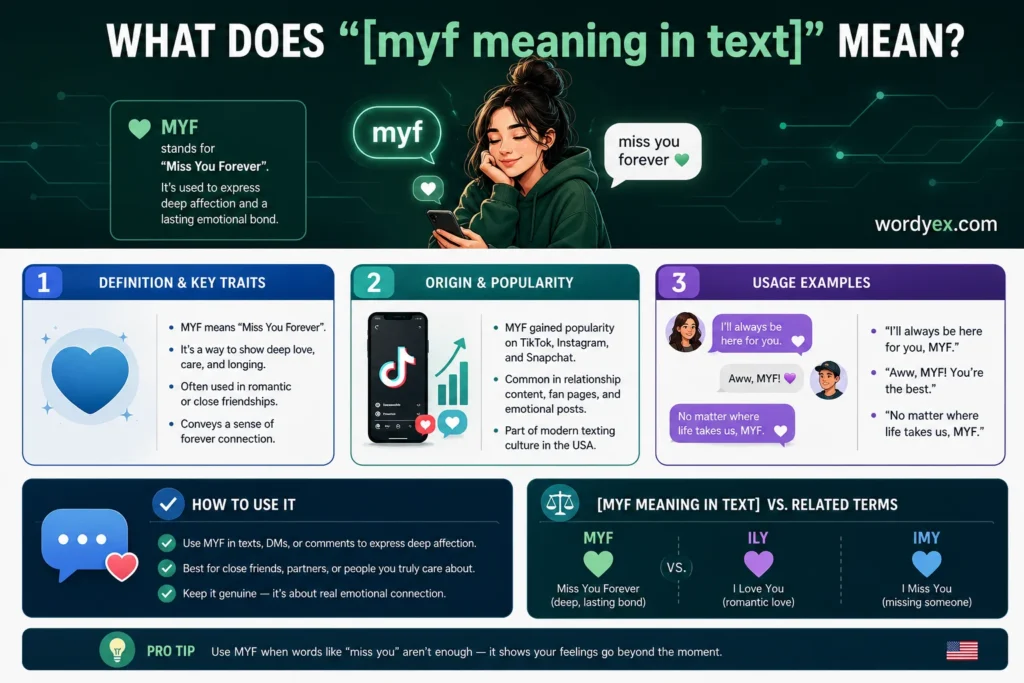
Why Everyone Is Searching for MYF Online
Digital communication moves at a breakneck pace, and text shorthand evolves before most people can keep up. If you just received a random message reading “MYF” from a close friend or a romantic interest, it is completely natural to feel a bit confused. People are constantly searching for this term because acronyms can carry multiple meanings depending on the context, and no one wants to misinterpret a heartfelt message.
Unraveling this specific slang solves the common confusion between a cold, robotic text and a warm, emotional expression. Instead of guessing whether the sender is upset or using technical jargon, knowing this acronym helps you instantly recognize a genuine gesture of connection. It bridges the gap between fast digital typing and real human emotion, turning a cryptic three-letter sequence into a meaningful moment.
MYF – Quick Meaning
At its core, MYF is all about expressing fondness and longing for someone’s physical presence without making the conversation feel overly heavy or dramatic.
- Primary Definition: Miss Your Face.
- Intent: To express affectionate longing for a friend, family member, or partner.
- Tone: Casual, warm, playful, and emotionally close.
“Just looking at our old vacation photos, MYF so much!”
“Hey! It has been way too long since our last coffee date, MYF!”
“Good luck with your exams this week, MYF and cannot wait to hang out next weekend.”
Origin & Background of MYF
While many people assume that every piece of text slang originates on TikTok or among Gen Alpha creators, MYF actually has deeper roots in early mobile texting and microblogging culture. It initially gained traction during the era of character limits on SMS and Twitter, where saving space was essential. Over the years, the phrase transitioned smoothly into platforms like Instagram, Snapchat, and TikTok, where visual communication reigns supreme.
The cultural influence of this slang relies heavily on the visual nature of modern communication. In an era dominated by FaceTime, video essays, and photo sharing, missing someone’s actual face holds more weight than simply missing their text replies. The social media impact of the phrase grew as users began posting throwback photos of friends with the caption “MYF.” Over time, the meaning evolved from a literal statement about physical appearance into a broader, cozy expression of deep emotional connection and platonic love.
Real-Life Conversations
To truly understand how this slang operates in day-to-day American culture, it helps to see it used across different digital platforms by real people.
WhatsApp Message
Chris: Hey man, are you coming back to town for the summer break? Brandon: Yeah, I land on Friday afternoon! Chris: Let us go! MYF bro, we need to hit up the usual diner ASAP.
Instagram DM
Ashley: I just saw the story you posted from our high school graduation, we looked so young! Jessica: Right? Time flies so fast. Ashley: Seriously. MYF! We need a reunion FaceTime session this week.
TikTok Comment
Ryan: (Posts a video montage of funny moments with college roommates) Tyler: (Comments) Missing these chaotic days so much. MYF guys!
Text Message
Amanda: Good morning! Just wanted to say good luck with your big presentation today. Sarah: Thank you so much, I am honestly sweating bullets over here. Amanda: You are going to crush it. Text me the second you are done, MYF!
Why is it Viral?
This acronym is trending heavily in American culture right now because it perfectly balances vulnerability with casual digital culture. Modern youth culture often shies away from overly formal or intensely emotional declarations, preferring expressions that feel lighthearted yet sincere. Saying “I miss you” can sometimes carry a heavy emotional weight or imply an expectation, whereas “miss your face” keeps the vibe relaxed, fun, and easygoing. It allows people to show they care without making the conversation feel awkward or overly serious.
Emotional & Psychological Meaning
Psychologically, using this acronym reveals a lot about how people navigate modern relationships through screens. It expresses a specific type of sensory nostalgia—the longing to see someone’s expressions, share a physical space, and experience real-time human interaction. It is a soft emotional cue that signals safety and closeness in a relationship, assuring the recipient that they are valued and remembered even during busy periods of life.
In my years tracking communication patterns, I remember a specific instance where a close friend of mine moved across the country for a demanding graduate program. Our daily hour-long chats dwindled into quick updates, and the distance felt noticeable. One evening, out of nowhere, she sent a blurry photo of a coffee mug we bought together, accompanied by a simple “MYF.” That tiny acronym instantly broke through the digital distance, conveying months of unspoken friendship and reassurance in just three letters. It proved that brief text shorthand can still carry profound emotional depth.
Usage in Different Contexts
Understanding where and when to deploy this slang ensures your digital communication remains effective and socially appropriate.
Social Media
On platforms like Instagram, Snapchat, and TikTok, the term is highly effective. It fits perfectly under photos, within short video captions, or inside fast-paced comment sections to publicly acknowledge a bond with someone.
Friends & Relationships
This is the absolute sweet spot for the phrase. It functions beautifully between best friends, long-distance romantic partners, or family members who share a playful, affectionate relationship. It reinforces connection without requiring a lengthy, serious conversation.
Work & Professional Settings
It is highly recommended to avoid this term in professional settings. Sending this acronym to a supervisor, corporate client, or new colleague can easily appear unprofessional, overly familiar, or confusing. Stick to formal language like “I look forward to our next meeting” in these environments.
Casual vs. Serious Tone
The phrase is built for a casual, uplifting tone. If someone is going through a profound personal crisis or a solemn life event, using an abbreviation like this might seem dismissive or insensitive. Reserve it for lighthearted moments of affectionate longing.
When NOT to Use It
There are clear boundaries where this slang can cause misunderstandings or feel entirely out of place. Do not use it when communicating with individuals who are unfamiliar with modern text jargon, as they might misinterpret the letters as something aggressive or confusing.
It is also wise to avoid using it in initial dating phases if you have not yet established a comfortable, casual rapport, as it might come across as overly intense or presumptive. Keeping your language aligned with the current comfort level of your relationship prevents social awkwardness.
Common Misunderstandings
The most common mistake people make with this acronym is misinterpreting the word “face” as a literal critique or hyper-fixation on physical appearance. Some individuals unfamiliar with the slang assume it is a superficial comment, rather than an idiom for the whole person.
Another misunderstanding involves tone confusion, where a recipient might read the fast abbreviation as a lazy or hurried response instead of the warm, affectionate sign-off it is meant to be. Distinguishing between a figurative expression of love and a literal statement is key to smooth digital interactions.
Slang Comparison and Contrast
| Slang Term | Core Meaning | Emotional Tone | Best Used For |
|---|---|---|---|
| MYF | Miss Your Face | Playful, warm, affectionate | Close friends, family, partners |
| IMY | I Miss You | Direct, standard, sincere | Anyone you have a bond with |
| LYSM | Love You So Much | High energy, enthusiastic | Best friends, romantic partners |
| WYD | What You Doing? | Casual, conversational | Starting a quick conversation |
| TIA | Thanks In Advance | Practical, functional | Casual workplace or logistical texts |
Key Insight
While terms like IMY offer a direct and traditional declaration of absence, MYF adds a layer of visual warmth and casual charm that makes the statement feel less demanding and much more spontaneous.
Variations and Secondary Meanings of MYF
While “Miss Your Face” is the reigning definition in American lifestyle and pop culture text streams, acronyms frequently shift shapes across specialized niches.
- Move Your Feet: Used frequently in dance communities, fitness groups, and sports coaching to encourage fast movement.
- Meet Your Friends: A logistical phrase used when planning group outings or coordinating meetup locations.
- Music You Feel: A popular phrase among indie playlist curators and music enthusiasts to describe deeply emotional songs.
- Make Your Future: An inspirational phrase used in youth mentorship programs and motivational content.
- Mind Your Finances: A common shorthand used in personal budgeting forums and casual wealth-building communities.
- Marry Your Friend: A relationship concept discussed in dating advice blogs regarding long-term romantic success.
- Managing Your Fears: A term found in casual mental wellness discussions and self-help social media circles.
- Most Yielding Future: A technical finance variation used occasionally when discussing investment projections.
- Melt Your Fat: A blunt marketing phrase used in old school gym culture and fitness challenge group chats.
How to Respond When Someone Uses MYF
Your response can match the exact energy of the sender, depending on your personal style and relationship dynamic.
Casual Replies
- “Aw, miss yours too! Let us hang out soon.”
- “Same here! We need to link up this week.”
- “I know, it has been way too long!”
Funny Replies
- “Of course you do, it is a great face!”
- “Miss your face too, even if it is a goofy one.”
- “Sending a selfie right now to cure your sadness!”
Mature Replies
- “I really appreciate that. I have been thinking about you too and hope you are doing well.”
- “Thank you! Let us definitely plan a meaningful catch-up session when things quiet down.”
Respectful Replies
- “That is so kind of you to say. I look forward to seeing you at the next group gathering.”
- “Thank you for the warm note. I hope all is well on your end as well.”
Regional & Cultural Usage
The reception of this text slang varies noticeably across geographical regions and generational divides.
Western Culture
In the United States and Canada, the phrase is widely understood and embraced as a sign of healthy, platonic affection. It fits perfectly into the fast-casual lifestyle of American youth culture, where shortening phrases is a standard form of socialization.
Asian Culture
In many traditional Asian cultures where communication is more indirect, a direct translation or usage of “miss your face” might feel slightly unusual or overly casual. However, among English-speaking youth in urban centers, the term is viewed as a trendy piece of Western internet culture.
Middle Eastern Culture
Similar to Asian regions, traditional communication in the Middle East often relies on deeply respectful and expressive linguistic structures. While globalized youth online utilize the term freely, it is rarely used outside of close, peer-to-peer English-speaking circles.
Global Internet Usage
Across the broader web, the term functions as a universal currency for digital closeness. It transcends specific borders because the feeling of missing a friend’s physical presence is a universal human experience.
Generational Differences
There is a distinct divide between how generations handle this phrase. Gen Z and younger Millennials use it effortlessly, viewing it as a natural extension of their texting vocabulary. Older generations, such as Baby Boomers, often look at the acronym with confusion, requiring a quick explanation that it is a kind sentiment rather than a strange technical error.
To discover more about how generational divides shape the way we speak online, you can read our deep dive into modern internet acronyms at wordyex.com to stay completely ahead of the curve.
Is It Safe for Kids?
Yes, this acronym is entirely safe for children and teenagers to use. It carries no inappropriate hidden meanings, derogatory angles, or adult connotations. It is a wholesome, positive expression of friendship that parents do not need to worry about when monitoring family text safety.
Frequently Asked Questions
Is MYF considered a romantic term?
Not exclusively. While you can certainly use it with a romantic partner, it is incredibly common among platonic friends and family members who simply miss each other.
Can I use MYF in an email to my teacher or professor?
It is best to avoid it. Academic correspondence requires professional language, and using casual text slang can look unprofessional.
What is the difference between MYF and IMY?
IMY stands for “I Miss You,” which is direct and traditional. MYF stands for “Miss Your Face,” which carries a lighter, more playful, and visually affectionate tone.
Does MYF have any negative meanings?
In standard text messaging and social media, no. It is overwhelmingly used as a positive, loving statement between people who care about each other.
How old is the slang term MYF?
While it has surged in popularity recently due to visual social platforms, the phrase has been floating around since the early days of character-limited SMS texting.
Final Thought
Modern communication changes every day, but the core human desire to stay connected remains exactly the same. Acronyms like MYF show how language adapts to keep conversations fast, fun, and deeply affectionate even when we are miles apart.
Now that you know exactly what it means, where it comes from, and how to use it safely, you can confidently drop it into your next chat session. Go ahead and tell a close friend that you miss their presence, it takes just three letters to brighten someone’s entire day.