What Does Twitter Slang Mean?
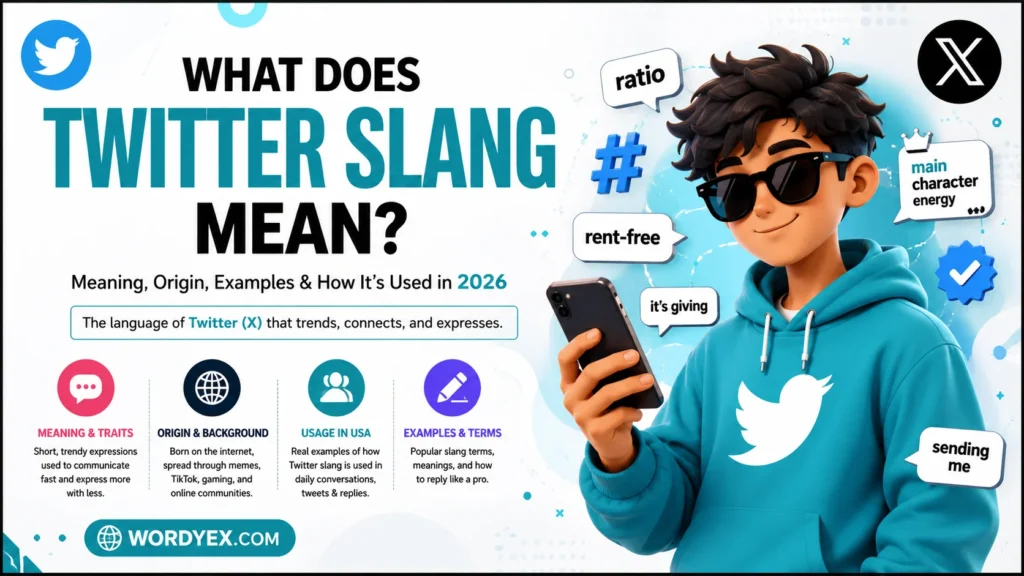
Twitter slang refers to the unique words, abbreviations, hashtags, memes, and internet expressions commonly used on Twitter (now known as X) to communicate quickly, humorously, or emotionally.
These terms help users share opinions, react to trends, and participate in online conversations using a shorthand style that has become part of modern digital culture.
Twitter slang
If you’ve ever scrolled through Twitter and felt like everyone was speaking a different language, you’re not alone.
From abbreviations like “ICYMI” and “TL;DR” to viral expressions such as “ratio,” “main character,” and “rent-free,” Twitter slang has created its own communication system.
Every day, millions of users use these expressions to share jokes, reactions, opinions, and emotions in a fast-moving social environment.
People search for Twitter slang because social media trends move quickly. A word that seems confusing today may suddenly appear everywhere tomorrow. Understanding these terms helps users stay connected, avoid misunderstandings, and participate confidently in online discussions.
Whether you’re new to social media or simply trying to keep up with current internet culture, this guide explains everything you need to know about Twitter slang in 2026.
Twitter Slang – Quick Meaning
Twitter slang is the collection of internet-based words, abbreviations, and expressions used primarily on Twitter/X.
Common characteristics include:
- Short and fast to type
- Often humorous or sarcastic
- Influenced by memes and viral trends
- Constantly evolving
- Popular among Gen Z and Millennials
Examples:
“That tweet got ratioed.”
“I’m living for this update.”
“This meme is sending me.”
Each example communicates emotion, reaction, or social context in just a few words.
Origin & Background
Twitter slang emerged shortly after Twitter launched in 2006. The platform’s character limits encouraged users to shorten phrases and create efficient ways of communicating.
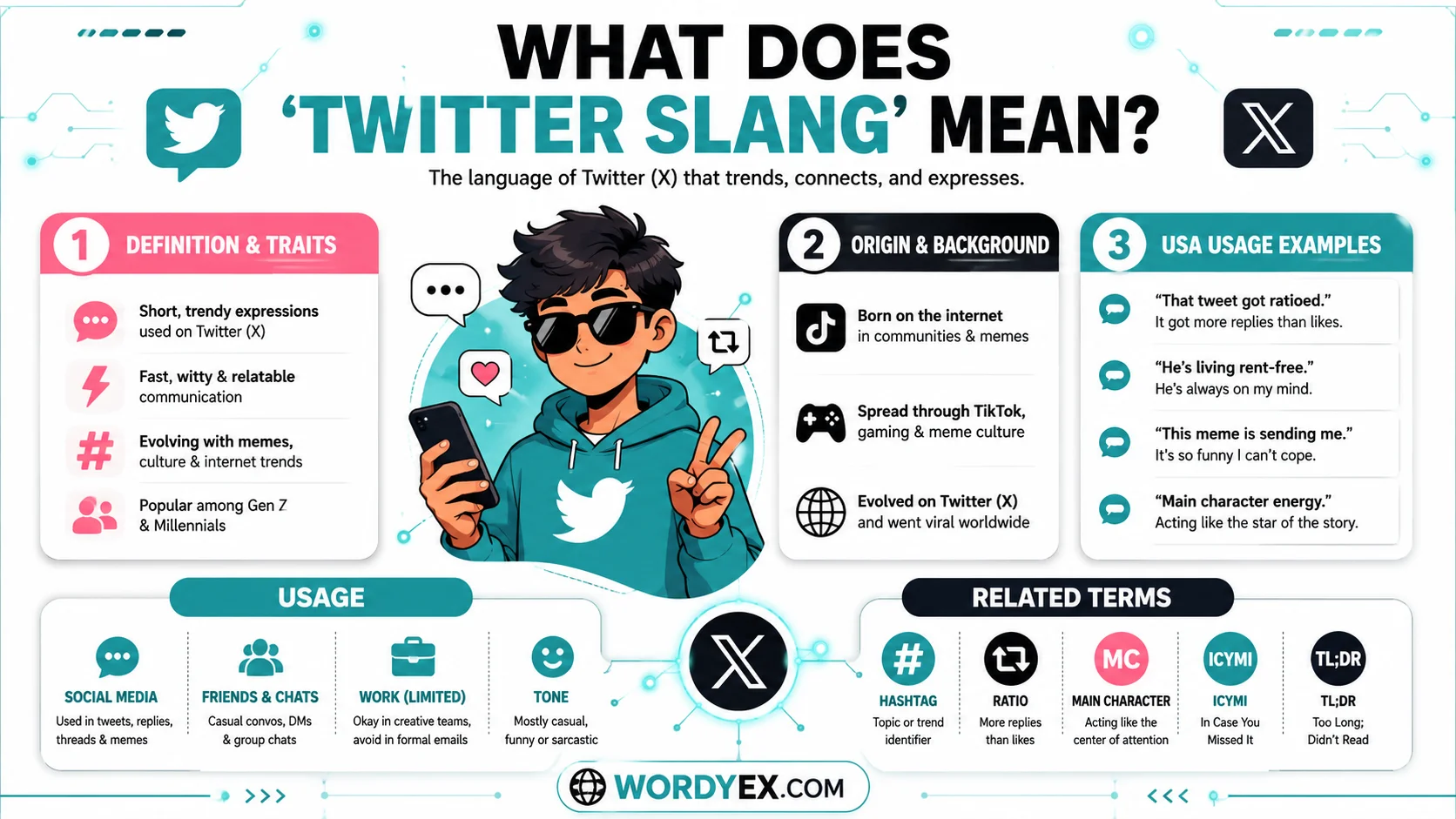
Over time, internet communities, celebrities, journalists, gamers, and meme creators contributed new expressions that spread rapidly across the platform.
Many Twitter slang terms originate from:
- Online gaming communities
- Black internet culture
- Meme culture
- Gen Z social media trends
- Pop culture fandoms
- TikTok and Instagram crossovers
The rise of viral hashtags accelerated the spread of new expressions. A phrase can appear in a single tweet and become global within hours.
As social media platforms became interconnected, Twitter slang started influencing conversations across TikTok, Instagram, Reddit, YouTube, and messaging apps.
For readers interested in understanding more internet expressions, explore additional slang guides on Wordyex.
For broader insights into internet language trends, the Merriam-Webster Dictionary regularly documents emerging online vocabulary.
Real-Life Conversations
WhatsApp Conversation
John A:
Did you see Sarah’s tweet?
Tony B:
Yeah, she totally got ratioed.
John A:
The replies are wild.
Tony B:
People aren’t holding back today.
Instagram DM
Emily A:
That celebrity apology is trending again.
Rachel B:
Twitter is roasting him nonstop.
Emily A:
Honestly, the memes are funnier than the apology.
TikTok Comments
Jake A:
Twitter found this video already.
Mason B:
Nothing escapes Twitter.
Jake A:
Facts. They discover everything.
Text Message
Sophia A:
Why is everyone saying “main character”?
Olivia B:
It’s Twitter slang.
Sophia A:
Makes sense now.
Olivia B:
You’ll see it everywhere this week.
Why Is It Viral?
Twitter slang becomes viral because it allows people to express complicated emotions quickly. Users enjoy being part of shared cultural moments, and slang creates a sense of belonging.
A catchy phrase can summarize an entire experience in just a few words, making it perfect for social media communication.
Emotional & Psychological Meaning
Twitter slang isn’t just about saving characters.
It reflects emotions, identity, humor, and social awareness.
People use these expressions because they:
- Feel relatable
- Create group identity
- Add humor
- Express emotions efficiently
- Signal cultural awareness
Imagine seeing a funny post after a stressful day and replying, “This is sending me.”
Instead of writing a long explanation, the slang instantly communicates amusement and emotional connection.
Modern communication increasingly values speed and shared understanding, which is why Twitter slang continues to thrive.
Usage in Different Contexts
Social Media
Twitter slang is most common in tweets, replies, threads, memes, and viral discussions.
Example:
“That take is not it.”
Friends & Relationships
Friends frequently use Twitter slang in casual chats.
Example:
“You’re living rent-free in my head.”
Work & Professional Settings
Some mild expressions may appear in creative industries, but excessive slang can seem unprofessional.
Example:
Avoid writing:
“This presentation is giving CEO vibes.”
In formal workplace communication.
Casual vs Serious Tone
Twitter slang generally creates a casual tone.
In serious discussions involving business, education, healthcare, or legal matters, traditional language is usually more appropriate.
When NOT to Use It
Twitter slang isn’t suitable everywhere.
Avoid using it:
- During formal job interviews
- In professional reports
- In academic assignments
- In legal communication
- With audiences unfamiliar with internet culture
Some slang can also be misunderstood across age groups or cultural backgrounds.
Context always matters more than trendiness.
Common Misunderstandings
Many people misunderstand Twitter slang because they interpret expressions literally.
Examples:
- “Rent-free” doesn’t involve actual rent.
- “Ratio” isn’t a mathematical calculation.
- “Main character” doesn’t mean someone is literally in a movie.
Tone confusion is another common issue.
A sarcastic Twitter comment may appear serious to readers unfamiliar with online humor.
Understanding context helps avoid unnecessary misunderstandings.
Comparison Table
| Expression | Meaning | Similarity |
|---|---|---|
| Twitter Slang | General internet language used on Twitter | Main term |
| Internet Slang | Online language across platforms | Similar |
| Meme Speak | Language inspired by memes | Related |
| Formal Language | Professional communication | Opposite |
| Texting Slang | Mobile messaging abbreviations | Similar |
| Social Media Jargon | Platform-specific terminology | Related |
Key Insight
Twitter slang changes faster than traditional language. Understanding the culture behind the words is often more important than memorizing definitions.
Variations and Types of Twitter Slang
1. Ratio
When replies receive more attention than the original tweet.
2. Main Character
Someone acting as the center of attention.
3. Rent-Free
Constantly occupying someone’s thoughts.
4. TL;DR
Too long; didn’t read.
5. ICYMI
In case you missed it.
6. Stan
A highly devoted fan.
7. Mid
Average or unimpressive.
8. Based
Authentic and confident.
9. Ate
Performed exceptionally well.
10. Delulu
Delusional in a humorous way.
How to Respond When Someone Uses It
Casual Replies
- “I get what you mean.”
- “That’s accurate.”
- “Facts.”
Funny Replies
- “Twitter never misses.”
- “I’m crying.”
- “Not the ratio.”
Mature Replies
- “Interesting perspective.”
- “I understand your point.”
Respectful Replies
- “Thanks for explaining.”
- “That’s helpful to know.”
Regional & Cultural Usage
Western Culture
Twitter slang is widely integrated into everyday online communication.
Asian Culture
Users often blend Twitter slang with local expressions and internet trends.
Middle Eastern Culture
Many users adopt global Twitter slang while combining it with regional phrases.
Global Internet Usage
Popular expressions quickly spread beyond English-speaking communities.
Gen Z vs Millennials
Gen Z typically adopts new Twitter slang faster.
Millennials often use established internet expressions but may be slower to embrace newer trends.
Both generations actively contribute to online language evolution.
Is It Safe for Kids?
Most Twitter slang is harmless and simply reflects internet culture.
However, parents should understand the context behind trending terms because meanings can evolve quickly. Awareness helps children navigate online conversations responsibly and avoid misunderstandings.
FAQs
What is Twitter slang?
Twitter slang is a collection of internet expressions, abbreviations, and cultural phrases commonly used on Twitter/X.
Why do people use Twitter slang?
It helps communicate emotions, reactions, humor, and opinions quickly.
Is Twitter slang only used on Twitter?
No. Many terms spread to TikTok, Instagram, Reddit, YouTube, and messaging apps.
Does Twitter slang change often?
Yes. New expressions emerge constantly as online culture evolves.
Is Twitter slang appropriate at work?
Usually not in formal communication, though some creative workplaces may use limited slang casually.
What age group uses Twitter slang most?
Gen Z is the largest adopter, but Millennials and older users also use many popular expressions.
Can Twitter slang have multiple meanings?
Yes. Context often determines the intended meaning.
Final Thought
Twitter slang is more than internet shorthand. It reflects how people connect, joke, react, and build communities in the digital age. These expressions capture emotions and cultural moments in ways traditional language sometimes cannot.
The key isn’t memorizing every trending phrase. It’s understanding the context, humor, and social signals behind the words. Once you recognize how Twitter slang works, navigating online conversations becomes much easier and more enjoyable.
As internet culture continues evolving throughout 2026 and beyond, Twitter slang will keep shaping the way people communicate, share experiences, and participate in the global conversation.