What Does ONG Mean?
What Is the ONG Slang Meaning?
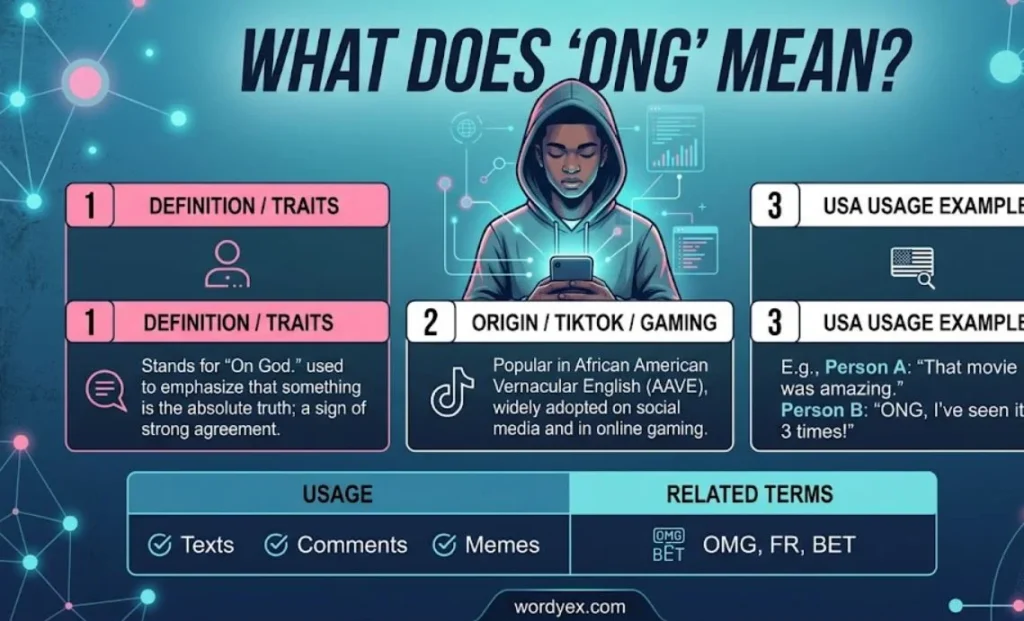
ong slang meaning, The ong slang meaning stands for “On God,” a popular digital oath used in text messages and social media. It functions as a modern synonym for “I swear” or “for real,” signaling absolute honesty, deep conviction, or intense agreement during online conversations.
Why Do People Use ONG in Digital Communication?
- Establishes Instant Trust: It replaces missing facial expressions and vocal tones, acting as an emotional intensifier that proves a sender is being completely serious.
- Streamlines Texting Efficiency: It condenses a traditional, powerful verbal vow into a lightning-fast, three-letter shorthand ideal for character limits on TikTok, Instagram, and group chats.
- Signals Cultural Alignment: Using this term demonstrates active digital literacy and connection to modern American youth culture, particularly within Gen Z and Gen Alpha speech patterns.
Why “ONG” Rules Our Text Threads
Language changes faster than ever, and keeping up with the shifting digital vocabulary can feel like a full-time job. One minute you are mastering one set of initials, and the next, your screen is flooded with a whole new shorthand. If you have noticed the letters ONG popping up in your group chats or comment sections lately, you are far from alone. Thousands of people search for this term every day because its meaning changes entirely depending on the context and tone of the message.
The real confusion usually stems from how much weight this tiny, three-letter acronym carries. It is not just a casual placeholder like “LOL” or “BRB.” Instead, it bridges the gap between old-school vows of honesty and the lightning-fast pace of modern mobile communication. Understanding this term helps clear up the conversational static, ensuring you never misread a close friend’s passionate outburst or a sibling’s absolute declaration of truth.
ONG – Quick Meaning
At its core, ONG is an intensifier used to validate a statement or show intense agreement. Think of it as the ultimate digital punctuation mark for honesty.
- Primary Meaning: “On God” (Swearing to the truth of a statement).
- Secondary Meaning: “No lie” or “I strongly agree with what you just said.”
- Core Purpose: To add emotional weight, urgency, or absolute certainty to text-based communication.
“That exam was the hardest thing I’ve ever taken ong.”
“I would never betray your trust like that, ong.”
“The new season of that show is a masterpiece ong.”
Origin & Background
While ONG feels like a product of the smartphone era, its roots actually run much deeper into the fabric of American regional speech. The phrase “on God” has been a staple of African American Vernacular English (AAVE) and street culture for decades. Long before it ever touched a keyboard, people used the spoken phrase to swear on their life, their honor, or their spiritual beliefs during intense conversations.
The transition into the digital space accelerated heavily during the mid-2010s on platforms like Twitter and early TikTok. As character limits pressured users to shorten their thoughts, “on God” naturally condensed into ONG. The acronym quickly migrated from hip-hop lyrics and gaming lobbies into mainstream internet culture.
By the time Gen Z and Gen Alpha fully adopted it, the term had evolved from a literal religious oath into a flexible cultural marker. Today, it circulates across millions of daily TikTok videos, fashion forums, and everyday text streams, serving as a core pillar of the modern American lexicon.
Real-Life Conversations
To truly understand how this slang functions in daily American life, it helps to see it in action across different digital platforms.
WhatsApp Group Chat
Malik: Are we still on for the basketball court at 6?
Jordan: Yeah, but someone told me they locked the gates for maintenance.
Malik: Nah, I just walked past it five minutes ago and it’s open ong.
Jordan: Bet, I’ll grab my sneakers right now.
Instagram DMs
Chloe: Look at this thrift store jacket I found for five dollars!
Maya: Wait, there is no way that is real vintage leather.
Chloe: It is ong! The tag says 1994 on it.
Maya: Keeping my fingers crossed that you let me borrow that next weekend.
TikTok Comments
User A: This burger place in downtown Chicago has the best fries in the entire state.
User B: Ong someone finally said it! Their truffle sauce is unbelievable.
Apple iMessage
Ethan: Man, I am so stressed about this chemistry final tomorrow.
Lucas: You studied for three days straight, you’re going to ace it ong.
Ethan: I appreciate you saying that, I really need the confidence boost.
Why is it Viral?
The word is trending so heavily in American culture because digital text inherently lacks tone of voice. Without facial expressions or vocal inflections, it is incredibly easy for sincerity to get lost in translation. Dropping this specific acronym signals instant, unambiguous vulnerability or passion, giving young Americans a shorthand way to inject absolute conviction directly into a cold glass screen.
Emotional & Psychological Meaning
Using this slang reveals a lot about how modern communication has adapted to fill emotional voids. Because we spend so much time interacting through text, we have developed a psychological need for words that establish immediate trust. When someone types these letters, they are attempting to lower the recipient’s defenses and create a shared moment of absolute certainty.
It expresses feelings of deep conviction, relief, validation, or solidarity. It strips away the casual irony that defines so much of internet culture and replaces it with something raw and definitive.
Consider a personal scenario: Imagine a friend text messages you at midnight to say, “I’m going to quit my job tomorrow ong.” That tiny acronym changes the entire gravity of the message. It tells you this isn’t a passing complaint after a rough shift; it is a calculated, deeply felt decision. It alerts the brain to pay close attention and offer real, grounded support.
Usage in Different Contexts
Navigating when and where to use this slang is crucial for maintaining your social footing.
Social Media
On platforms like TikTok, Instagram, and X, the word is used with total freedom. It appears in captions, comment sections, and video overlays to voice hot takes, praise creators, or validate popular opinions. It is highly casual and universally understood in these spaces.
Friends & Relationships
Among close peers, the term serves as a powerful tool for bonding. It reinforces trust when sharing secrets or validates a friend’s feelings when they are venting about life. It creates an atmosphere of “I have your back, and I am being completely transparent with you.”
Work & Professional Settings
This is a major boundary line. You should never use this slang in a professional email, Slack channel, or corporate meeting. Using it with a manager or client can come across as highly unprofessional, overly casual, and potentially disrespectful depending on the workplace culture. For a deeper look at navigating professional communication vs. casual internet trends, you can explore detailed slang breakdowns on WordyEx.
Casual vs. Serious Tone
The word is unique because it effortlessly flips between lighthearted exaggeration and dead-serious honesty. If a friend says a new chicken sandwich is “the best thing on earth ong,” it is a fun hyperbole. If they say “I didn’t take your money ong,” the tone instantly shifts to a serious defense of their character.
When NOT to Use It
While the acronym is incredibly popular, there are distinct environments where it can cause friction or offense.
- Formal/Academic Settings: Avoid this in essays, cover letters, and formal presentations.
- Religious Environments: Because the acronym literally stands for “On God,” some deeply religious individuals or traditional communities view it as taking a holy name in vain or swearing flippantly. Using it in traditional spaces can accidentally cause genuine offense.
- Serious Medical or Legal Crises: If you are communicating critical, life-altering information to a family member or authority figure, rely on clear, standard English to avoid sounding trivial.
Common Misunderstandings
The most frequent mistake people make is confusing ONG with OMG (Oh My God). While they look nearly identical, their meanings are entirely separate. OMG expresses shock, surprise, or disbelief (“Oh my god, I can’t believe that happened!”). ONG, on the other hand, expresses affirmation, truth, and certainty (“I am telling the truth, on God”).
Another point of confusion is literal vs. figurative interpretation. Older generations reading the text might assume the sender is making a literal religious vow or starting a theological discussion, completely missing the fact that it is simply used as emotional emphasis by younger speakers.
Slang Comparison
| Expression | Core Meaning | Intensity Level | Best Context |
| ONG | On God / I swear it’s true | High | Deep agreement or absolute truth |
| FR | For Real | Medium | Casual validation or questioning truth |
| No Cap | No lie / Not exaggerating | High | Emphasizing a wild or hard-to-believe fact |
| Period | That is the final word | Medium | Ending a debate or standing firm on a point |
| Wallah | I swear by God (Islamic origin) | High | Absolute oath used heavily in urban areas |
Key Insight: While “FR” and “No Cap” deal with the factual accuracy of a statement, “ONG” invokes a sense of personal honor and intense emotional alignment, making it the heaviest hitter among modern truth-telling slang.
Variations & Types
To use or read this slang naturally, you need to recognize its different structural variations.
- ong: The standard lowercase version, used for casual, everyday emphasis in fast texting.
- ONG: Full uppercase, signaling high volume, intense passion, or an urgent need to be believed.
- ong fr: A double-whammy combination meaning “On God, for real,” used when single emphasis isn’t enough.
- ong no cap: Merging two massive truth slang terms to signal absolute, undeniable honesty.
- I’m ong: A variation meaning “I am locked in” or “I am completely committed to this stance.”
- Deadass ong: Combining New York heritage slang with modern text slang to indicate maximum seriousness.
- On god though: Spelled out completely to slow down the reader and add rhythmic weight to a sentence.
- On the dead homies: A heavier, highly localized street variation that should be approached with extreme cultural awareness.
How to Respond When Someone Uses It
Your response depends entirely on the energy of the initial message.
Casual Replies
- “I already know!”
- “Facts, honestly.”
- “RT (Retweet), you’re speaking the truth.”
Funny Replies
- “Please don’t bring the heavens into this fast-food debate.”
- “It’s never that deep, but I respect the energy.”
- “Not you putting your soul on the line for a movie review!”
Mature Replies
- “I appreciate you being real with me about this.”
- “Thank you for the honesty, it means a lot.”
- “I trust your word, we don’t even need to stress it.”
Respectful Replies
- “Understood, I hear you loud and clear.”
- “I completely value your perspective on this.”
Regional & Cultural Usage
The global internet has turned local slang into a worldwide phenomenon, but geographic nuances still exist. For a broader look at how modern culture shifts across borders, the Pew Research Center offers fascinating data on global digital adoption and communication trends.
Western Culture
In the United States and Canada, the term has completely saturated youth culture. It transcends racial and economic boundaries in digital spaces, though its usage remains heavily anchored in urban music, gaming communities, and casual peer-to-peer texting.
Asian & Middle Eastern Culture
When used by English speakers in Asian or Middle Eastern contexts, the acronym is frequently adopted purely through internet exposure. However, in regions with deep religious traditions, young people often substitute or compare it to native cultural equivalents (such as “Wallah” in Arabic-speaking communities) to carry that same heavy weight of swearing an oath.
Generational Differences
The divide between Gen Z and Millennials on this term is noticeable. Millennials are far more likely to type out “For real” or stick to classic acronyms like “SRSLY.” Gen Z and Gen Alpha use the term as a default setting, treating it as a natural extension of their daily vocabulary rather than a trendy word they are trying out.
Is It Safe for Kids?
From a safety and digital monitoring perspective, the acronym is entirely benign. It does not hide any reference to illicit substances, dangerous online challenges, or explicit behavior. It is a purely expressive linguistic tool.
The only conversation parents might want to have with younger children revolves around situational appropriateness and religious values. If your family holds strict boundaries against using faith-based terms casually, it is worth reminding children of the literal meaning behind the letters so they can navigate their texts with intention.
FAQs
What does ONG stand for in a text message?
It stands for “On God,” which translates to “I swear to God” or “I am telling the absolute truth.”
Is ONG the same thing as OMG?
No. OMG means “Oh My God” (used for shock or surprise), while ONG means “On God” (used to emphasize honesty and agreement).
Where did the slang term ONG originate?
It originated within African American Vernacular English (AAVE) as a spoken phrase before condensing into a three-letter acronym on social media platforms like Twitter and TikTok.
Is using ONG considered disrespectful?
It can be viewed as disrespectful or inappropriate in highly formal settings, workplaces, or within deeply traditional religious communities who dislike casual references to the divine.
How do you use ONG in a sentence?
You place it at the end of a thought for emphasis, such as: “That was the best pizza I’ve ever had ong.”
Final Thought
At the end of the day, language is a living, breathing entity that adapts to the tools we use to express it. Slang like this isn’t destroying modern communication; it is simply upgrading it to handle the speed and emotional demands of our digital lives. By learning how to recognize, decode, and naturally deploy these terms, you keep your digital literacy sharp and ensure your conversations remain genuinely connected. Use it when you want your voice heard with absolute clarity, and embrace the colorful, evolving landscape of modern American speech.