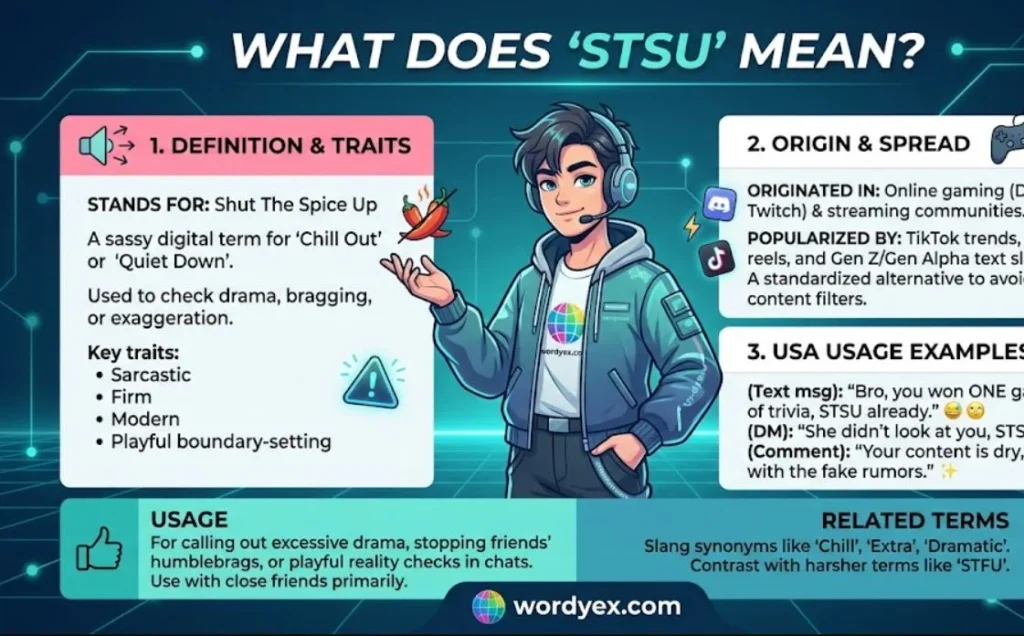
what does stsu mean, The world of digital communication moves at a breakneck pace, and staying updated with the latest internet shorthand can feel like a full-time job. If you have recently spotted the acronym “STSU” landing in your direct messages or lighting up a comment section, you are certainly not alone in wondering what it stands for. This viral piece of American text slang is rapidly reshaping how we set conversational boundaries online.
What does STSU mean?
STSU is a trending American internet acronym that stands for “Shut The Spice Up.” It is used as a modern, text-based alternative to harsher phrases, serving as a playful yet firm digital communication tool to tell someone to tone down their drama, attitude, or bragging.
Why use the acronym STSU online?
- Bypasses social media filters: Serves as a sanitized alternative to explicit text slang, preventing automated content moderation flags.
- Sets conversational boundaries: Offers an immediate digital reality check to friends acting “extra” or overly dramatic in group chats.
- Lightens tense interactions: Replaces aggressive verbal shutdowns with a sarcastic, food-coded metaphor that maintains a casual, modern tone.
STSU – Quick Meaning
At its core, STSU is used to tell someone to quiet down, stop bragging, or tone down their attitude when they are bringing too much “spice” or drama to a conversation.
- Tone: Sassy, urgent, mildly confrontational, or deeply playful depending on the friendship dynamic.
- Primary Function: To cap a conversation that has become too heated, dramatic, or boastful.
“Bro, you won one game of local trivia, STSU already.”
“STSU with those wild rumors, you know that didn’t happen!”
“Please STSU before you get us both kicked out of this group chat.”
Origin & Background
The phrase rooted itself deeply within the gaming communities of Discord and Twitch before spilling over into mainstream TikTok trends and Instagram reels over the last year. Gen Z and Gen Alpha users wanted an acronym that bypassed strict social media content filters while retaining the heavy impact of a classic conversational shutdown.
By replacing a traditional curse word with “spice,” internet culture transformed an aggressive command into a stylized piece of modern vocabulary. It reflects a broader cultural shift where American youth repackage intense emotions into colorful, food-coded metaphors. The term evolved from a niche gaming insult into a widely accepted response to anyone acting “extra” online.
Real-Life Conversations
To truly understand how this slang functions in daily American life, look at how it plays out across different communication channels.
WhatsApp Text Message
Liam: I am telling you, my new workout routine is going to have me looking like a literal movie star by next month. I am built different.
Noah: STSU man, you have been on the couch eating potato chips all morning.
Instagram DMs
Chloe: Did you see how she looked at me when I walked into the party? She is completely obsessed with my outfit, obviously.
Maya: STSU, she was literally just looking for the bathroom behind you!
TikTok Comments
Jordan: This creator is completely falling off, their content has zero original ideas left.
Tyler: STSU, they literally just posted a viral video that got five million views yesterday.
Casual iMessage
Ethan: I might just drop out of college and become a professional poker player, I made fifty bucks last night.
Lucas: STSU and go finish your homework, you lost a hundred dollars last week.
Why is it Viral?
This acronym is trending heavily in American culture because it perfectly encapsulates the current online mood: fast-paced, highly reactive, and deeply sarcastic. It gives users a way to voice disagreement or exhaustion without triggering automated content moderation flags. It allows people to express genuine skepticism with a touch of humor.
Emotional & Psychological Meaning
Using STSU expresses a specific mixture of exhaustion, amusement, and boundary-setting. When someone types these four letters, they are psychologically signaling that the other person has crossed a line into unnecessary bravado, exaggeration, or drama.
Modern digital spaces are crowded with loud opinions and constant self-promotion. STSU serves as a psychological relief valve. It allows friends to police each other’s egos in a way that feels culturally current and lighthearted, preventing interactions from becoming genuinely hostile.
Imagine a situation where you are sitting at a diner with a close friend who keeps loudly bragging about how they could easily beat a professional athlete in a match. You love them, but your social battery is draining. Saying STSU out loud or texting it across the table acts as an affectionate reality check. It says, I love you, but you are talking absolute nonsense right now.
Usage in Different Contexts
On social media platforms like TikTok, Instagram, and X, STSU is a public tool for calling out bad takes, overly confident influencers, or dramatic commentary. It acts as a digital eye-roll in the comments section.
Among close friends, the phrase is a badge of intimacy. It is used casually to mock a friend’s dramatic stories or minor complaints. However, in romantic relationships, the tone must be monitored carefully. A playful “STSU” can easily be misread as genuine dismissal if the emotional foundation isn’t completely secure.
In professional or workplace environments, STSU is entirely inappropriate. Sending this to a manager or a client—even if you think you have a casual relationship with them—violates basic standards of corporate decorum. Stick to professional phrasing like “Let’s focus on the data” instead.
When NOT to Use It
Avoid using this term during genuine, high-stakes emotional conflicts where a friend or partner is expressing deep vulnerability or pain. Using internet slang during a serious conversation can make you appear dismissive, cold, and emotionally immature.
Be mindful of the setting. It should never be used in formal letters, academic writing, or when communicating with individuals who are not native English speakers or are from older generations, as the meaning will be completely lost or misinterpreted as aggressive.
Common Misunderstandings
The most frequent error people make is assuming the second ‘S’ stands for an explicit curse word. This causes older adults or outsiders to overreact when they see it used, assuming a major argument is happening when it is actually just light banter.
Another common issue is tone blindness. Because text messages lack facial expressions and vocal inflections, a figurative, joking STSU can easily look like a literal, angry demand for silence if it isn’t accompanied by the right emojis or context.
Slang Comparison
| Term | Core Meaning | Intensity Level | Best Context |
| STSU | Shut the spice up | Medium | Playful reality checks, calling out drama |
| STFU | Shut the f*** up | High | Genuine anger, severe frustration |
| Chill out | Calm down | Low | De-escalating a tense situation |
| Say less | I understand completely | Low | Agreeing with a plan or idea |
Key Insight
While older expressions of dismissal rely on raw aggression or formal politeness, STSU carves out a middle ground. It uses humor and contemporary phrasing to manage conversational boundaries without destroying the social connection.
Variations & Types
- STSU rn: “Shut the spice up right now” – Adds immediate urgency to the request.
- Please STSU: A sarcastic way to soften the blow of a conversational shutdown.
- STSU bro: Used specifically between male friends to maintain a casual, brotherhood dynamic.
- Time to STSU: Indicated that a group chat has gotten far too chaotic and needs to quiet down.
- STSU with that: Directed at a specific piece of gossip or fake news.
- Gently STSU: Used when you want to tell someone they are being extra, but you want to keep it soft.
- STSU already: Expresses that the listener has run completely out of patience for the speaker’s bragging.
- Big STSU: Used in comment sections to show massive disagreement with a creator’s controversial opinion.
How to Respond When Someone Uses It
Casual Replies
- “Alright, alright, I’m done!”
- “My bad, I’m turning the spice down.”
- “Fair enough, I’ll chill.”
Funny Replies
- “Never! The kitchen stays spicy.”
- “You can’t handle this much flavor anyway.”
- “The truth hurts, doesn’t it?”
Mature Replies
- “I didn’t realize I was being overwhelming, let’s change the subject.”
- “Got it, let’s keep things focused.”
Respectful Replies
- “Understood, my apologies for coming on too strong.”
- “Thanks for the check, I’ll tone it down.”
Regional & Cultural Usage
In American youth culture, STSU is a staple of urban and suburban digital communication. However, its reception changes drastically across global lines.
In conservative linguistic environments like parts of the Middle East or traditional households in South Asia, direct commands to stop talking—even when wrapped in internet slang—can be viewed as deeply disrespectful to authority figures and elders.
Generationally, Gen Z uses the phrase with total comfort, seeing it as standard social maintenance. Millennials often view it with mild amusement, preferring their own older acronyms, while Baby Boomers generally find it entirely confusing or abrasive. To learn more about how internet terms shift across different demographics, check out the deep-dive language analysis resources available at Wordyex.
Is It Safe for Kids?
Yes, STSU is generally safe for teenagers and older children. Because it replaces explicit profanity with the word “spice,” it represents a cleaner alternative to standard street slang. Parents should view it as a normal part of the evolving digital landscape rather than a sign of behavioral issues, provided it isn’t being used for targeted cyberbullying.
Frequently Asked Questions
Is STSU an insult?
It can be, but it is most frequently used as a sarcastic, lighthearted reality check between close friends rather than a malicious insult.
Does STSU mean the same thing as STFU?
It shares the same basic structural framework, but STSU substitutes explicit language for “spice,” making it less offensive and more playful.
Can I use STSU in a professional email?
No, using informal internet acronyms in corporate communications is unprofessional and can damage your workplace reputation.
Where did STSU originate?
The term gained its initial traction within online gaming spaces and Discord servers before transitioning to TikTok and mainstream texting.
Is STSU considered a curse word?
No, it intentionally avoids profanity, which is why it is highly popular for bypassing social media content filters.
Final Thought
Navigating modern American slang doesn’t have to feel like translating a foreign tongue. Terms like STSU show how remarkably creative internet culture can be when it comes to reinventing communication styles. By understanding the balance of wit and boundary-setting behind these four letters, you can navigate your next group chat with complete confidence. For a broader perspective on language evolution and global communication standards, you can read the comprehensive digital dictionary overviews hosted on the Oxford English Dictionary platform. Embrace the shift, keep your conversations lively, and don’t be afraid to tell someone to drop the spice when things get a little too extra.