What is the slang meaning of PMO?
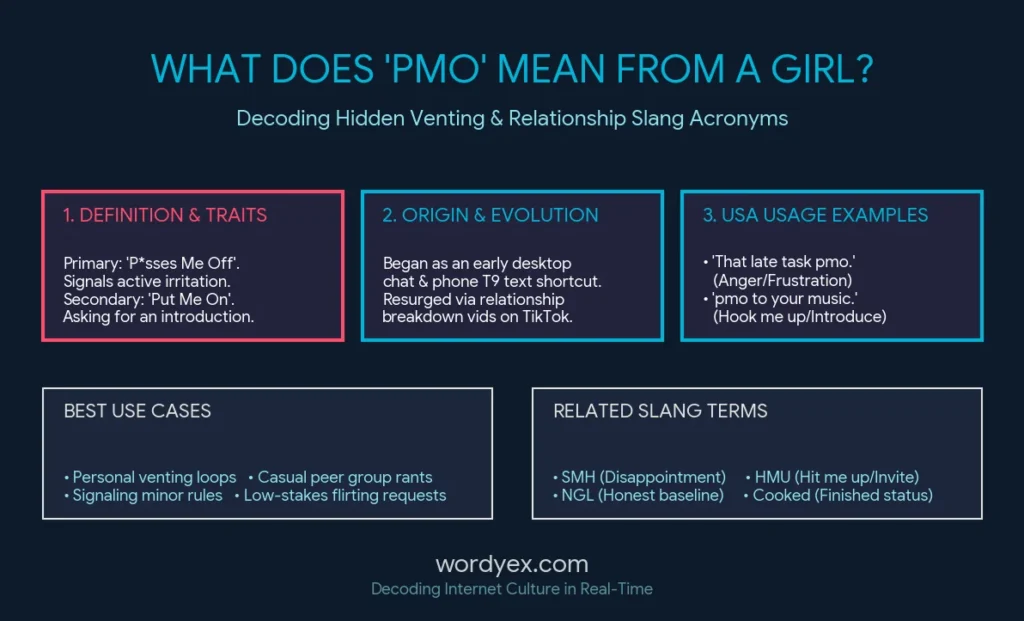
pmo meaning text from a girl, When a girl texts “pmo,” she almost always means “pissing me off,” a shorthand for frustration or annoyance about something happening right now. A rarer second meaning, “put me on,” is used to ask for a recommendation.
Why choose to use PMO in digital messaging?
- Vents frustration fast: Three letters express real irritation without writing out a whole angry paragraph.
- Softens the intensity: An abbreviation feels lighter on the page than the spelled-out phrase, even when the feeling is real.
- Invites sympathy: Dropping “pmo” into a text is often an easy way to signal “vent with me” and get a supportive reply.
- Fits fast-paced chats: It keeps a rant readable in a group thread instead of derailing the conversation with a wall of text.
Introductory Analysis
A text lands that just says “pmo” with no other context, and suddenly you’re left guessing whether it’s about you, her day, or something totally unrelated. That blank-slate quality is exactly why this three-letter acronym causes so much second-guessing.
People search this term because PMO carries real emotional weight but almost never arrives with an explanation attached. Reading it right means understanding both of its meanings and paying close attention to whatever comes right before or after it.
PMO – Quick Meaning
- Primary Definition: “Pissing me off” (or “pisses me off”), used to express annoyance, frustration, or irritation about a person or situation.
- Secondary Meaning: “Put me on,” a request to be introduced to something good, like a song, brand, or show.
- Conversational Tone: Can range from playful venting between friends to a genuinely sharp signal that something is wrong.
“He left me on read all day and it’s pmo fr.”
“This wifi keeps dropping mid call, so pmo right now.”
“That new playlist you posted is fire, pmo with more like it.”
Because one acronym can swing between two very different meanings, keeping a quick reference like Wordyex open makes it much easier to catch which one applies before replying. A crowd-sourced slang dictionary entry is a useful second check when the context still feels unclear.
Origin & Background
The “pissing me off” meaning dates back further than most people assume, first showing up in online slang references in the mid-2000s and circulating steadily through Twitter and texting culture for years afterward. It stayed relatively low-key until it exploded in popularity again in late 2024 and into 2025, when TikTok users adopted it as a rapid-fire way to vent in captions and comments.
The second meaning, “put me on,” has roots in African American Vernacular English, where “putting someone on” to a song, trend, or opportunity has long meant introducing them to something good. That version went viral on TikTok a couple of years earlier, and both meanings now circulate side by side, which is exactly why context matters so much.
Real-Life Conversations
TikTok comment:
Ava: this trend where people fake propose at work is so pmo
Noah: fr it’s not funny anymore lol
Instagram DM:
Liam: you good? you’ve been quiet today
Sophie: my sister borrowed my car without asking, pmo ngl
Standard text message:
Emma: hey can you send the notes from class?
Jack: yeah one sec, professor changed the deadline again and it’s pmo
Group WhatsApp thread:
Mia: does anyone know a good playlist for the road trip?
Chloe: pmo with your Spotify wrapped, need new music lol
Ben: same, send it over
Why is it viral? PMO thrives because it does double duty, working as both a venting tool and a compliment request, which means it fits into almost any conversation. Its flexibility, combined with its punchy three-letter delivery, keeps it circulating across captions, comments, and group chats.
Emotional & Psychological Meaning
“Pmo” gives people a way to name a frustration out loud without turning it into a full confrontation. It signals “I need this acknowledged” more than “I need this fixed,” which is a subtle but important difference in how people process small daily irritations together.
Picture a friend group chat where someone types “traffic is so pmo rn.” Nobody expects a solution; everyone just responds with a supportive “same” or a laughing emoji, and the moment passes. That quick, low-stakes validation is a big part of why the term keeps getting used.
Usage in Different Contexts
- Social Media: Common in captions and comments to react to minor annoyances or to request music, style, or content recommendations.
- Friends & Relationships: Used to vent about a partner, sibling, or friend without escalating into a full argument.
- Work/Professional: Best avoided entirely; it reads as unprofessional and the vulgar root phrase makes it a poor fit for any workplace channel.
- Casual vs. Serious: Works well for small, everyday frustrations, but using it about a genuinely serious issue can make the concern seem smaller than it is.
When Not to Use It
Skip it around parents, teachers, coworkers, or anyone in a formal role, since the phrase it stands for is mildly crude even abbreviated. It’s also worth avoiding in a genuinely serious argument, since reducing real hurt to “pmo” can come across as dismissive right when the other person needs to feel heard.
Common Misunderstandings
Because PMO carries two completely different meanings, mixing them up is the most common mistake: reading a “put me on” request as anger, or a genuine complaint as a request for recommendations. Outside of texting, the same three letters also stand for “Project Management Office” in business settings, and a handful of unrelated, adult-only communities use the acronym for something else entirely, so the surrounding conversation always decides which one applies.
Comprehensive Comparison
| Term | Direct Meaning | Conversational Tone | Typical Context |
|---|---|---|---|
| PMO | Pissing me off, or put me on | Frustrated or eagerly curious | Venting, requesting recommendations |
| IRRITATED | A direct, formal statement of annoyance | Plain, unambiguous | Clear complaints, professional contexts |
| CHILL | Calm, relaxed, unbothered | Laid-back, opposite of frustrated | Describing an easygoing mood |
| PUT ME UP ON | A longer version of “put me on” | Friendly, curious | Asking for music or style recs |
Key Insight
Reading the sentence around “pmo” is the fastest way to tell its two meanings apart: complaints and negative details point to frustration, while mentions of music, fashion, or recommendations almost always point to “put me on.”
Variations & Types
- pmo fr: Adds “for real” to stress the frustration is genuine, not exaggerated.
- pmo ngl: Pairs with “not gonna lie” to admit the irritation honestly.
- ts pmo: Combines with “this” to intensify a complaint about a specific situation.
- lowkey pmo: Softens the frustration into a minor, low-stakes annoyance.
- pmo rn: Specifies that the irritation is happening in this exact moment.
- pmo with that: The “put me on” version, asking to be introduced to something good.
- so pmo: Adds emphasis to make an everyday annoyance sound bigger for comedic effect.
- pmo af: An intensified version signaling real, heightened frustration.
How to Respond When Someone Uses It
- Casual Replies: “Ugh, that’s annoying, what happened?”
- Funny Replies: “Say less, sounds like a certified pmo moment.”
- Mature Replies: “That sounds frustrating, want to talk through it or just vent?”
- Respectful Replies: “I’m sorry that’s bothering you, let me know if I can help.”
Regional & Cultural Usage
In American internet culture, PMO circulates heavily on TikTok, Twitter/X, and Instagram, with the “put me on” meaning tracing directly back to AAVE and hip-hop culture before spreading more broadly. International audiences in Western Europe, Asia, and the Middle East mostly pick it up secondhand through TikTok trends, so the “pissing me off” meaning tends to travel faster than the “put me on” one, which relies more on cultural context to land.
Gen Z and Gen Alpha use PMO constantly and switch between both meanings without thinking twice, while older Millennials and Gen X are far more likely to only recognize “pissing me off,” if they recognize the term at all, making this one of the sharper generational gaps in current slang.
Is It Safe for Kids?
PMO sits in a gray area: the abbreviation itself is mild, but it stands for a phrase that includes a swear word, so some parents may prefer their kids avoid it in writing even though it’s rarely spelled out in full. It’s also worth knowing that in a small number of unrelated adult forums, the same three letters are used for a completely different topic; that usage doesn’t come up in normal teen texting, but it’s a reasonable thing for parents to be aware of.
Frequently Asked Questions
What does it mean when a girl texts PMO?
It almost always means something is frustrating her right now, which may or may not be about you, so it’s worth asking what’s going on rather than assuming.
Does PMO always mean someone is angry?
No. It can also mean “put me on,” a friendly request to be introduced to a song, trend, or recommendation, so tone and context decide which meaning applies.
Is PMO considered a swear word?
The abbreviation itself isn’t explicit, but it stands for a mildly crude phrase, so it’s best avoided in formal or professional writing.
How do I know if PMO is about me?
Look at what comes right before or after it in the message; if there’s no direct reference to you, it’s very likely about something unrelated.
Where did “put me on” come from?
It comes from African American Vernacular English, where introducing someone to good music, fashion, or opportunities is described as “putting them on.”
What’s the best way to respond to PMO?
A short, sympathetic reply like “that’s so annoying, what happened?” works well for the frustration meaning, while asking “put you on with what?” clarifies the recommendation meaning.
Final Thought
Three letters, two very different moods, and one simple rule: let the sentence around “pmo” do the talking. Once that clicks, decoding a text that just says “pmo” stops being a guessing game and starts making perfect sense.