We have all been there. You are in the middle of a fast-paced text conversation, and someone hits you with a three-letter reply: “wtv.” If you do not know the exact vibe behind it, those three letters can feel like a riddle. Is the person mad at you? Are they genuinely relaxed about the situation? Or did they just completely check out of the conversation?
Navigating modern text language can feel like decoding a shifting matrix. Slang evolves overnight on social media feeds, leaving a massive gap between what words literally mean and how they actually feel in a text bubble. People constantly search for these terms because digital communication lacks tone of voice, facial expressions, and body language. Missing the subtle shift behind a three-letter acronym can instantly turn a casual chat into an accidental misunderstanding.
What does wtv mean in slang?
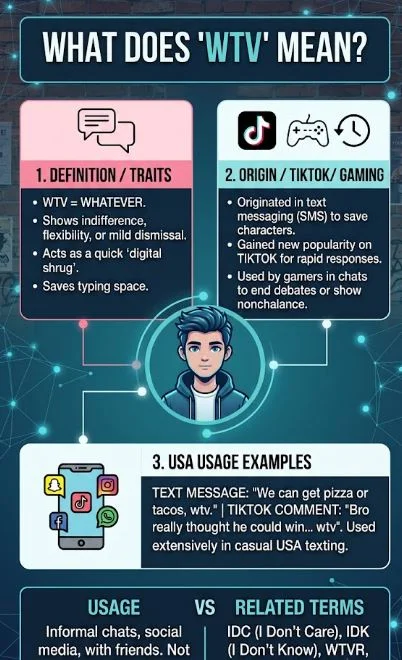
In digital slang, wtv is a popular text shorthand and internet acronym for “whatever.” It is commonly used in messaging to express casual indifference, flexibility, or a mild dismissal without needing to type out the full whatever abbreviation.
How is the wtv slang term used in texting?
- Expressing Indifference: Acts as a quick digital shrug to show you have no strong preference between options.
- Closing Discussions: Serves as a casual, low-effort tool to quickly end circular debates or minor arguments.
- Social Signaling: Projects a highly relaxed, “go with the flow” vibe in fast-paced group chats and social media comments.
WTV – Quick Meaning
At its core, the acronym serves as a digital shrug. It allows the sender to bypass typing out the full word while maintaining a casual, low-effort energy.
- It signals that the speaker has no strong preference.
- It can act as a quick tool to end a circular argument.
- It often reflects a relaxed, “go with the flow” attitude.
“We can get tacos or burgers, wtv you want.”
“I tried to explain it to him, but wtv.”
“Wtv happens tomorrow, we’ll handle it.”
Origin & Background
The roots of this abbreviation stretch back to the early days of mobile communication. Long before the era of smartphones, users faced character limits on SMS text messages and had to navigate old T9 predictive text keypads. Every single keystroke mattered, which forced younger generations to strip vowels and extra letters out of common English words.
As internet culture migrated from old desktop chat rooms to early mobile platforms, the abbreviation quietly cemented its place in the digital lexicon. However, its modern viral resurgence belongs entirely to the algorithms of TikTok, Snapchat, and Instagram.
On these highly visual platforms, speed is everything. Content creators, Gen Z, and Gen Alpha users rely heavily on rapid-fire typing to keep up with the pace of live comment sections and group chats. Over time, the term evolved from a simple time-saving utility into a distinct cultural vibe. Today, it does not just save space; it actively projects an aura of casual detachment that defines modern youth communication in the United States.
Real-Life Conversations
To truly understand how this slang operates in day-to-day American life, you need to see it functioning in its natural environment. The meaning changes dramatically based on who is talking and where the message is sent.
Scenario 1: Instagram DMs
Chloe: Are we still going to the mall at 4 PM or are you staying late at practice?
Maya: Practice might run over a few minutes wtv works best for your schedule!
Scenario 2: TikTok Comments
Mason: Bro really thought he could beat that level on the first try lol
Liam: Wtv I still made it further than you did on your stream
Scenario 3: WhatsApp Group Chat
Noah: Should we order the large pepperoni pizza or the combo deal?
Elijah: Wtv is fine with me as long as we get it before the game starts.
Scenario 4: Direct Text Messages
Emma: You forgot to return my blue hoodie again.
James: Oh my bad I’ll bring it tomorrow wtv.
Why Is It Viral?
The persistent popularity of this slang across the USA stems from a broader cultural shift toward hyper-efficiency in communication. In a world dominated by instant notifications, young adults and teens experience communication fatigue. Typing out full, grammatically perfect sentences can sometimes feel overly formal or emotionally exhausting.
Using short abbreviations allows users to protect their social energy. It acts as a safety valve in peer-to-peer interactions, giving people a way to participate in conversations without overcommitting emotionally or intellectually to every minor decision.
Emotional & Psychological Meaning
Beneath the surface of simple text abbreviation lies a fascinating layer of digital psychology. Choosing to use a shorthand term like this conveys a specific emotional state. Most often, it indicates a desire to minimize friction or lower the stakes of a conversation. It tells the recipient that the topic at hand is not worth a long, drawn-out discussion.
However, there is a psychological double edge to this brevity. Because it requires so little effort to type, receiving it can occasionally trigger minor social anxiety. The human brain naturally tries to fill in missing context. When someone receives a short, unpunctuated reply, they might wonder if the sender is secretly annoyed, bored, or passive-aggressive.
I remember a week when a close friend of mine started ending multiple texts with this exact term. My immediate instinct was to look back at our recent interactions to see if I had upset them. When we finally spoke on the phone, I realized they were just completely overwhelmed with final exams and were typing with one hand while studying. It was a clear reminder of how easily short text can mask a person’s actual reality.
Usage in Different Contexts
The appropriateness of this abbreviation relies entirely on your social arena. It is a highly adaptable chameleon, but using it in the wrong room can cause instant professional or personal friction.
In casual social media spaces and close friendships, the term is standard currency. It keeps the dialogue light, breezy, and entirely informal. It is the perfect tool for deciding on movie titles, video game strategies, or weekend hangout times where no one wants to take the lead.
Conversely, introducing this acronym into a professional or workplace environment is highly risky. Sending a message containing casual abbreviations to a supervisor, client, or university professor projects a distinct lack of respect, maturity, and attention to detail. It can easily look like you simply do not care about the quality of your work or your professional relationships.
| Slang / Phrase | Core Meaning | Emotional Vibe |
| WTV | Whatever | Indifferent, casual, or mildly dismissive |
| IDC | I don’t care | Direct, blunt, sometimes confrontational |
| IDK | I don’t know | Uncertain, seeking information, neutral |
| NBD | No big deal | Reassuring, relaxed, highly positive |
| Aight | All right | Agreeable, compliant, ready to move on |
Key Insight: While many internet abbreviations seem interchangeable at a glance, each carries a distinct emotional weight that alters the temperature of a text message thread instantly.
When NOT to Use It
There are specific boundaries where this shorthand should be completely avoided. You should never use it during serious emotional discussions, relationship conflicts, or when someone is sharing vulnerable information with you. In those delicate moments, replying with a casual acronym feels incredibly dismissive and cold. It signals to the other person that their feelings are a minor inconvenience to you.
Furthermore, it is wise to avoid this term when precise clarity is required. If a plan needs a firm commitment or a specific time lock, an indifferent response creates needless confusion and forces other people to do the heavy lifting of planning.
Common Misunderstandings
The single biggest mistake people make with this acronym is misreading the sender’s tone. Text messages do not have a soundtrack. A completely harmless, relaxed response meant to mean “I am totally flexible” can easily be read by a stressed recipient as “I do not care about this at all.”
People also frequently confuse literal indifference with passive aggression. It is vital to look at the surrounding conversation history before assuming someone is pushing you away with short answers.
Variations & Types
The online world has created several spin-offs of this term, each with a micro-twist on the original meaning.
- Wtv tf: A much more aggressive, vulgar variation used to show intense frustration or disbelief.
- Wtvrr: Dragging out the last letters to mimic a spoken, sarcastic sigh.
- Wtv works: A collaborative version used exclusively to expedite group planning.
- Wtv lol: Adding a laugh at the end to ensure the message does not sound too angry.
- Idc wtv: Combining two terms to emphasize a total lack of preference or complete exhaustion.
- Wtv next: Used in gaming or fast environments to focus on the immediate future task.
- Fr wtv: Expressing a genuine, honest surrender to a chaotic situation.
- Wtv floats your boat: A digital spin on the classic idiom celebrating personal choice.
How to Respond When Someone Uses It
Your reply should always match the context and the specific relationship dynamic you share with the sender.
If you want a casual approach, you can keep the momentum going by locking in a final choice yourself. For instance, replying with a quick “Sounds good, let’s do 7 PM then” takes the pressure off the other person.
If you are dealing with a close friend and want to inject some humor, you can tease them about their low-effort typing. A funny response like “Wow, don’t wear out your thumbs typing all those letters at once!” keeps the interaction playful.
When the conversation requires a more mature or definitive direction, you can gently steer the topic back to clarity. Try saying, “Since you don’t mind either way, I’ll make the final executive decision so we can get this sorted.”
Regional & Cultural Usage
While the acronym is globally recognized wherever English internet culture thrives, its specific social rules shift across geographical and generational lines.
In mainstream American internet spaces, the term is highly integrated into daily speech patterns. However, in many international contexts where English is a secondary language, text slang is often interpreted far more literally. A user outside the USA might view the shorthand as explicitly rude or dismissive because they lack the cultural context of American youth culture’s casual, low-stakes communication style.
Generational divides within the USA are equally pronounced. Millennials generally use the term sparingly, often preferring to type out full words to avoid any risk of sounding unprofessional or overly detached. For Gen Z and Gen Alpha, however, the term is an effortless baseline component of their digital vocabulary. They do not view it as a violation of grammar rules; they view it as a natural extension of how people talk online.
Is It Safe for Kids?
From a digital safety perspective, this term is completely benign. It does not inherently carry hidden vulgar meanings, dark double endings, or malicious intent. It is a simple tool for everyday text simplification.
That said, parents should encourage kids to understand the nuances of digital etiquette. Teaching younger users that short acronyms can sometimes sound dismissive to older relatives or teachers is a great way to build strong, real-world communication skills for the future.
FAQs
Is WTV a rude acronym to use in a text?
It is not inherently rude, but it can easily be interpreted that way if sent during a serious conversation or as a one-word answer to a detailed question.
What is the difference between WTV and IDC?
The abbreviation “wtv” implies flexibility or an open mind toward options, whereas “idc” stands for “I don’t care,” which carries a much more blunt and occasionally uncooperative tone.
Can I use WTV in a work email?
No, you should never use informal slang or short text abbreviations in professional emails as it looks unprofessional and careless to colleagues and clients.
Why do girls use WTV so much in text?
Young individuals use the term at similar rates across social media to maintain a casual, effortless tone in fast group chats and comment sections.
Does WTV mean “What TV”?
While it can technically mean that in very specific discussions about home entertainment, in 99% of modern online conversations and text threads, it means “whatever.”
Final Thought
Mastering the unspoken rules of digital communication is all about learning to balance speed with empathy. Modern expressions like “wtv” are incredibly convenient tools that help us keep pace with a fast-moving online world, but their true power lies in how we apply them. By staying aware of the subtle emotional signals your texts send, you can communicate across social platforms with total confidence, clarity, and genuine connection. For more deep dives into the shifting world of modern language and pop culture trends, explore our comprehensive collection of guides right here on Wordyex. If you want to expand your digital vocabulary even further, check out the official Merriam-Webster dictionary overview of how contemporary pop culture continuously reshapes the English language we use every single day.




1 thought on “What Does WTV Mean in Slang? Slang Meaning & Origin (2026 Guide)”