Decoding the Subtle Language of Modern Texts
Have you ever been in the middle of a perfectly normal text conversation when a three-letter acronym drops like a tiny, confusing anchor? You’re scrolling through your DMs, someone says something slightly bold or hilarious, and the reply is just: “smt.”
If you’ve found yourself staring at your screen wondering if they’re talking about a “Simultaneous Multithreading” computer process or a “Social Media Team,” you aren’t alone. In the world of digital communication, context is everything.
The smt meaning in text has nothing to do with technology and everything to do with human emotion. It is a linguistic shortcut that bridges the gap between what we say and how we feel. Understanding it is like learning to read the digital room—it prevents awkward silences and helps you connect more deeply with the person on the other side of the glass.
smt meaning in text – A Quick Meaning
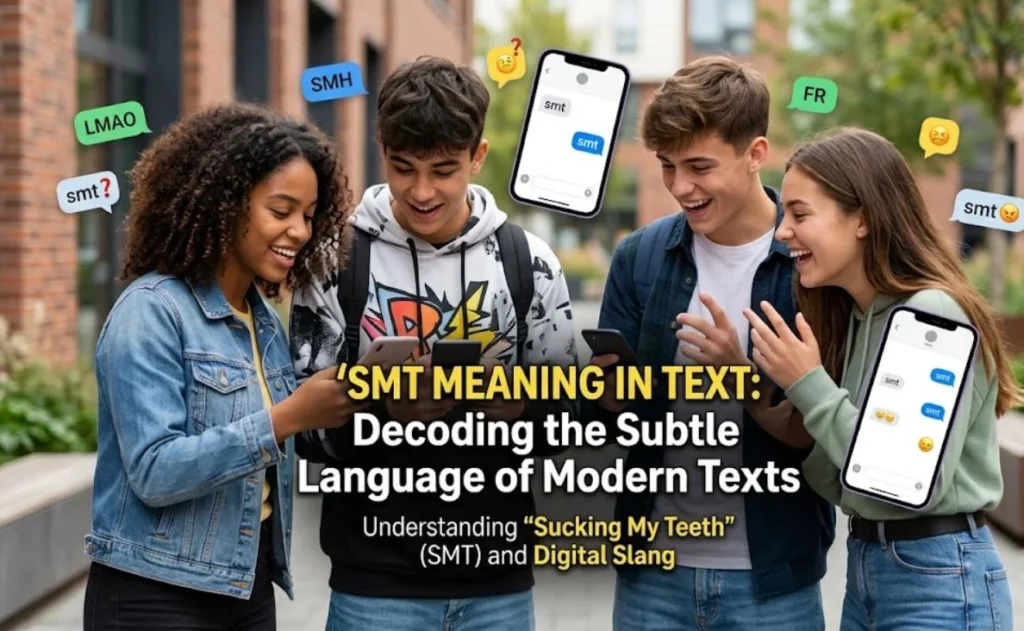
At its most fundamental level, SMT stands for “Sucking My Teeth.”
It is the written representation of a specific oral sound—that sharp, clicking noise made by pulling air through the teeth, often accompanied by a slight head shake. Depending on the context, it can signal:
- Disapproval: A silent “I can’t believe you just said that.”
- Annoyance: A digital eye-roll.
- Skepticism: When something sounds too good (or too ridiculous) to be true.
- Playful Teasing: A “stop being so extra” among friends.
“He really wore socks with sandals to the wedding? smt.”
“I told her I’d be five minutes late and she’s been calling me for twenty. smt.”
Origin & Background
The roots of smt are deeply cultural. While it has become a staple of global internet slang, its origins lie in African, Caribbean, and Black American cultures, where “sucking your teeth” (often called “steupsing” in the Caribbean) is a well-defined non-verbal gesture.
From Physical to Digital
In these cultures, the physical act of sucking your teeth is a powerful social tool. It communicates a wealth of emotion without a single word. As communication migrated to cell phones and social media platforms like Twitter (now X) and Instagram, users needed a way to translate this specific physical reaction into text.
Social Media Impact
TikTok and Twitter acted as the primary catalysts for making smt mainstream. It evolved from a niche cultural expression into a universal shorthand for “shaking my head” (SMH), but with a sharper, more visceral edge. It adds a layer of “attitude” that standard emojis sometimes fail to capture.
Real-Life Conversations
To see the smt meaning in text in action, you have to look at the emotional stakes of the conversation.
Scenario 1: The Frustrated Best Friend (WhatsApp)
Person A: “I accidentally liked my ex’s photo from 2018 at 3 AM.”
Person B: “smt… delete your account and move to a different country immediately.”
Scenario 2: The Sarcastic Comment (Instagram DMs)
Person A: “I think I’m going to start a fitness journey tomorrow. I just bought three boxes of donuts to celebrate.”
Person B: “smt. Your dedication is truly inspiring.”
Scenario 3: The Skeptical Observer (TikTok Comments)
Person A (Video Creator): “I found a way to make $10,000 a week by only working 5 minutes a day!”
Person B: “smt. Why is everyone on this app lying for views?”
Scenario 4: The Annoyed Partner (Text Message)
Person A: “Hey, I know I said I’d pick up dinner, but I’m still at the office. Can you handle it?”
Person B: “smt. This is the third time this week. Fine.”
Emotional & Psychological Meaning
Why do we use smt instead of just typing “I’m annoyed”?
Psychologically, using an acronym like smt provides a “safe distance.” It allows the sender to express a negative emotion or a judgment without being overly confrontational. It is a form of emotional shading.
In modern communication, we often fear being “too much.” Typing out a long paragraph about why you’re disappointed feels heavy. Sending “smt” conveys the exact same sentiment but keeps the vibe casual. It reveals a modern preference for subtext over literalism.
A Personal Perspective:
I remember a time when a colleague suggested a totally impractical “fix” for a project we had been working on for months. My first instinct was to write a long email explaining why it wouldn’t work. Instead, in our casual chat, I just sent “smt.” It immediately signaled my disagreement in a way that felt authentic to our relationship, without starting a formal argument. It saved time and preserved the peace.
Usage in Different Contexts
Social Media
On platforms like TikTok or X, smt is often used as a “call out.” It’s the digital equivalent of a “huff.” You’ll see it under posts that are controversial or blatantly incorrect.
Friends & Relationships
This is where smt is most common. It functions as a playful reprimand. However, be careful—if you use it too much with a partner, it can start to feel dismissive or “passive-aggressive” rather than cute.
Work / Professional Settings
Avoid this. In a professional environment, sucking your teeth (physically or via text) is often seen as unprofessional or disrespectful. If you disagree with a boss, “smt” is a one-way ticket to an awkward HR meeting.
Casual vs. Serious Tone
In a casual tone, it’s a joke. In a serious conversation, it’s a signal that the sender is reaching their limit. Pay attention to whether there is a period at the end—a lone “smt.” usually carries more weight than a lowercase “smt.”
When NOT to Use It
Understanding the smt meaning in text also means knowing when to keep it in your pocket.
- Professional Correspondence: As mentioned, it’s too informal and carries a negative connotation of “attitude.”
- During Serious Conflict: If someone is pouring their heart out about a tragedy or a deep insecurity, “smt” is incredibly cold and dismissive.
- With People Who Don’t Know Slang: Using it with a grandparent or a non-native speaker might lead them to think it’s a typo or a technical term, leading to “communication static.”
Common Misunderstandings
The biggest mistake people make is confusing SMT with SMH (Shaking My Head).
While they are cousins, they aren’t twins. SMH is more about disappointment or disbelief. SMT is more about the sound of annoyance. It is sharper.
People also frequently mistake it for “Send Me That” or “Smiling To Myself.” If you reply “smt” to a beautiful sunset photo thinking you’re being sweet, the other person might think you’re annoyed by their photography!
Comparison Table: SMT vs. Related Expressions
| Expression | Primary Emotion | Best Use Case |
| SMT | Annoyance / Disapproval | When someone says something ridiculous. |
| SMH | Disappointment | When someone does something foolish. |
| LMAO | Humor | When the “annoyance” is actually funny. |
| K | Dismissiveness | When you want to end a conversation. |
| FFS | Extreme Frustration | When you’ve completely lost your patience. |
Key Insight: SMT is the “middle ground” of internet reactions. It’s more intense than a simple “lol” but less aggressive than a direct insult. It allows you to vent frustration while keeping the conversation moving.
Variations & Types of SMT
- SMTT: Sucking My Teeth Today (For persistent annoyance).
- SMT fr: Sucking my teeth “for real” (Deeply genuine annoyance).
- Big smt: Reserved for massive mistakes or blatant lies.
- Internal smt: When you can’t say it out loud, but you’re feeling it.
- SMH/SMT combo: The ultimate sign of “I’m done with this.”
- smt…: The ellipsis adds a lingering sense of disbelief.
- SMT!: An explosive reaction to something shocking.
- Little smt: A soft, playful “stop it” between friends.
How to Respond When Someone Uses It
If you receive an smt, your response should match the “vibe” of the sender:
- Casual: “Don’t smt at me! You know I’m right.”
- Funny: “I can hear that click through the screen.”
- Mature: “I know it’s frustrating, let’s talk about it.”
- Respectful: “My bad, I didn’t mean to annoy you.”
If you find yourself constantly confused by modern linguistic shifts, visiting a resource like Wordyex can help you stay ahead of the curve in both professional and casual English communication.
Regional & Cultural Usage
- Western Culture: Heavily influenced by the African Diaspora; used as a mark of authenticity and “realness.”
- Asian Culture: Less common in traditional settings, but rapidly rising among English-speaking youth who follow Western social media trends.
- Middle Eastern Culture: Often translated through similar physical gestures (like the “tsk” sound), making the digital “smt” easy for youth to adopt.
- Generational Differences: For Gen Z, smt is second nature. For Millennials, it’s a learned behavior. For Boomers, it’s usually a mystery.
Is It Safe for Kids?
In terms of “content,” smt is completely safe. It contains no profanity and isn’t inherently “adult.” However, it is a tool for expressing “attitude.” Parents should be aware that if a child is using it frequently, they may be adopting a more dismissive or sarcastic communication style, which is worth a conversation about digital etiquette.
FAQs
Q: Does SMT mean “Send Me That”?
A: Occasionally in very specific buying/selling groups, but in 99% of social media and texting contexts, it means “Sucking My Teeth.”
Q: Is “smt” rude?
A: It can be. It’s meant to show annoyance, so use it with people who understand your sense of humor.
Q: Why don’t people just use an emoji?
A: Sometimes an emoji feels too “fixed.” smt feels more like a raw, human sound.
Q: Is it written in caps or lowercase?
A: Usually lowercase (“smt”) for casual use. All caps (“SMT”) implies you are very annoyed.
Q: Can I use it in an English exam?
A: No. It is strictly informal slang.
Conclusion
Modern communication is a dance of subtext. The smt meaning in text is a perfect example of how we’ve adapted our physical selves to fit into a digital world. We aren’t just sending letters; we’re sending sounds, sighs, and clicks.
Embracing these terms doesn’t mean you’re “losing” proper English—it means you’re becoming a more versatile communicator. Use smt to add flavor to your chats, but always keep an eye on the person you’re talking to. After all, the best communication isn’t just about the words you use; it’s about the connection you keep. Stay curious, stay empathetic, and don’t be afraid to click those digital teeth every once in a while.