Decoding the Digital Shorthand
Have you ever stared at a text notification, brow furrowed, trying to decipher a three-letter acronym? You aren’t alone. Digital communication moves at lightning speed, and slang terms often emerge and evolve before we can even add them to our mental dictionaries.
The acronym “WYF” is one of those fleeting, yet highly common, expressions you will likely encounter in casual digital chatter. It is a shorthand designed for brevity, allowing users to convey curiosity or check-in status without typing out a full sentence.
People search for this term because the context of digital conversation is often ambiguous. Misinterpreting slang can lead to awkward moments or unnecessary confusion. Understanding these small linguistic shortcuts helps us feel more connected to the pulse of current online social interaction.
WYF – Quick Meaning
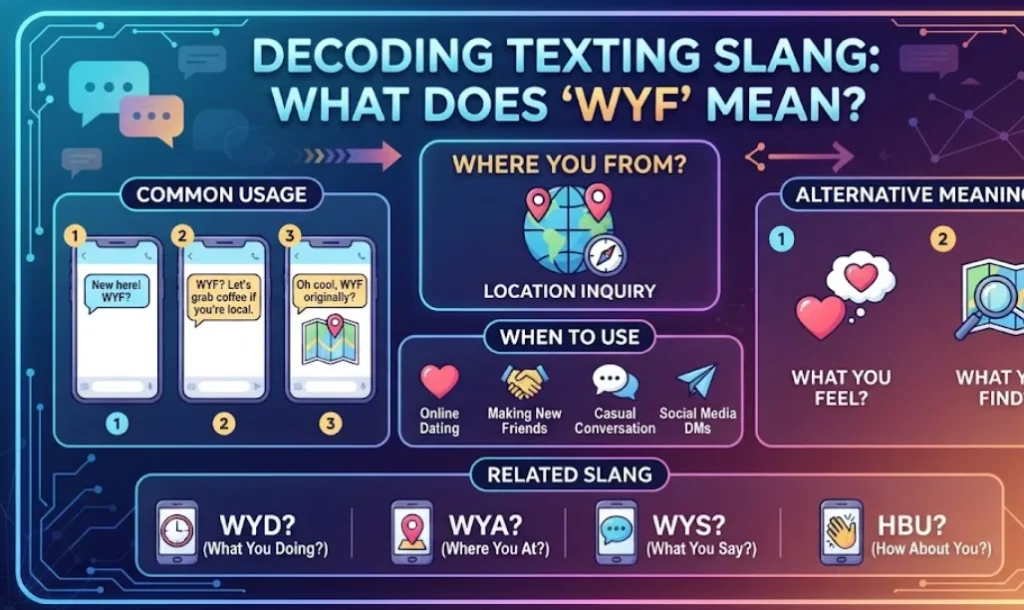
At its core, WYF stands for “Where You From?” or sometimes “What You Feel?” depending entirely on the context of the conversation. Most frequently, it acts as a direct inquiry regarding someone’s origin or location.
- Location Inquiry: Used to establish where a person lives or was raised.
- Conversational Opener: Often used in dating apps or initial DMs to break the ice.
- Vibe Check: Occasionally used to ask about a person’s current emotional state or perspective.
Examples of Usage
“Hey, cool profile! WYF?”
“I just moved to the city. WYF?”
“Everyone is talking about this movie. WYF about it?”
Origin & Background
The rise of mobile messaging apps necessitated a new form of “text-speak.” When character limits were strict or typing on a T9 keypad was a chore, abbreviations became a survival mechanism.
The Evolution of Internet Slang
WYF grew out of this culture of extreme efficiency. As social media platforms like Twitter (now X) and early chat rooms prioritized short, punchy communication, users naturally gravitated toward acronyms that shaved seconds off their typing time.
Over the years, this term transitioned from specialized gaming forums and early messaging boards into the mainstream lexicon of Instagram and WhatsApp. It is no longer just for tech-savvy teens; it has been adopted by a broad demographic seeking quick, informal rapport in digital spaces.
Real-Life Conversations
Seeing how this term plays out in the wild is the best way to master its nuance. These snippets reflect the casual, often rapid-fire nature of modern digital exchanges.
Person A: So, did you end up moving to the suburbs?
Person B: Not yet, still downtown for now. WYF?
Person A: Oh, I’m still out in the West End.
Instagram DMs
Person A: Your photography is amazing. Are you local?
Person B: Thank you! I’m actually visiting for the week.
Person A: Nice! WYF originally?
TikTok Comments
Person A: This song is such a vibe.
Person B: Totally. WYF? I’m from California.
Emotional & Psychological Meaning
Using acronyms isn’t just about saving time; it’s about establishing a specific social rhythm. When someone uses “WYF,” they are often signaling that they want to cut through formalities.
The Psychology of Speed
By choosing an abbreviation, the sender is essentially saying, “I want to keep this flow going.” It removes the perceived weight of a formal question, making the interaction feel lower stakes and more approachable.
I remember once meeting someone on a travel forum. We were discussing a local spot, and they sent a quick “WYF?” during the exchange. It didn’t feel rude; it felt like a shortcut to finding common ground. We quickly realized we were both from the same small town, turning a digital stranger into an instant acquaintance.
Usage in Different Contexts
Context is everything. While the term is universally understood in casual settings, its reception changes based on the platform and your relationship with the recipient.
When to Use It
- Casual Friendships: It is perfectly acceptable when chatting with friends or acquaintances where the tone is relaxed.
- Dating Applications: It is a standard icebreaker that skips the “How are you doing?” monotony.
- Social Media Comments: A great way to engage with creators or fellow commenters in a non-intrusive way.
Professional Settings
Avoid using it in the office. If you are emailing a client or messaging a boss, stick to full sentences. Using “WYF” in a professional capacity can come across as dismissive or unprofessional.
When NOT to Use It
While it is a handy tool, there are moments where brevity is not your friend.
Sensitive Conversations
If a friend is venting about a personal struggle, sending a three-letter acronym can make you appear uncaring or distant. During meaningful, deep, or emotional conversations, always use full sentences to show you are paying attention.
Cultural Barriers
If you are speaking with someone who may not be a native speaker or someone from a much older generation, they likely won’t recognize the term. In these cases, it is better to ask “Where are you from?” to avoid confusion.
Common Misunderstandings
The biggest issue with WYF is the lack of tone. Without voice inflection, a simple question can sometimes feel like an interrogation.
Literal vs. Figurative
Sometimes, a person might read “WYF” as a demand for information rather than a friendly gesture. If the context is already heated, the brevity of the acronym can exacerbate the tension. Always consider the state of the conversation before firing off an acronym.
Comparison Table
| Term | Typical Meaning | Vibe |
| WYF | Where you from? | Casual/Inquisitive |
| WYA | Where you at? | Immediate/Planning |
| WYD | What you doing? | Boredom/Initiation |
| WYS | What you say? | Agreement/Casual |
Key Insight
While these terms look similar, they serve different social functions. WYF establishes background and commonality, whereas WYA and WYD are focused on the immediate present.
Variations & Types
- WYF@: Used when asking about someone’s specific neighborhood.
- WYF-R: A slightly more formal inquiry asking, “Where are you from, really?”
- WYF-B: Asking where someone was born.
- WYF-L: Asking where someone is currently living.
- WYF-I: Asking what someone’s opinion is on a specific topic.
- WYF-T: Asking what someone’s thoughts are regarding a situation.
- W/Y/F: A stylized version using slashes to emphasize the letters.
- WYF?!!: Added punctuation to show intense interest or surprise at a shared location.
How to Respond When Someone Uses It
You want to match the energy of the conversation. Here are a few ways to handle it:
- Casual: “I’m from Chicago, hbu?”
- Funny: “I’m from the moon! Just kidding, currently based in Texas.”
- Mature: “I’m originally from Seattle, though I’ve been living in Miami for a few years.”
- Respectful: “That’s a great question, I’m from London! Where are you based?”
Regional & Cultural Usage
The term is predominantly used in English-speaking digital circles, particularly in the United States and Canada.
Global Perspectives
In many Asian or Middle Eastern countries, English slang is often adopted, but the usage might be limited to specific platforms like Instagram or gaming servers. Generational gaps are the biggest factor; Gen Z uses these terms as second nature, while many Millennials may use them occasionally, and older generations might find them completely foreign.
Is It Safe for Kids?
Yes, it is generally safe. There is nothing inherently offensive or harmful about the term. However, parents should monitor social media interactions to ensure that communication remains respectful and that their children understand how to spot potential red flags from strangers, regardless of the acronyms being used.
FAQs
Is WYF considered rude?
No, it is not inherently rude, but it can seem lazy if you are in the middle of a serious conversation.
Can WYF mean anything else?
On rare occasions, in specific online communities, it might be an abbreviation for a niche phrase, but 99% of the time, it refers to origins or opinions.
Do I have to respond to WYF?
You are under no obligation to respond to any message. If the person seems like a stranger or is making you uncomfortable, you can ignore the message.
Should I capitalize it?
It does not matter. Most people type in lowercase on mobile anyway, so wyf and WYF are treated the same.
Is this used on LinkedIn?
Absolutely not. Keep it strictly to casual platforms like Snapchat, Instagram, and texting.
Conclusion
Understanding “what does wyf mean in texting” is more than just learning a new definition; it is about mastering the evolving language of human connection. We use these small tools to build bridges, start conversations, and navigate the digital landscape with confidence. While language changes, the underlying human desire to connect remains constant. Use this slang wisely, keep your tone friendly, and enjoy the ease of modern communication.