Decoding the Digital Shorthand
what does ttly mean in text, We have all been there. You are mid-conversation, fingers flying across the screen, when a string of letters appears that stops you in your tracks. “TTLY” is one of those classic acronyms that occasionally leaves even the most plugged-in users pausing to interpret its intent.
Searching for the meaning of this term usually stems from a desire to communicate more effectively or simply to keep pace with the rapidly evolving language of social media. This acronym is a time-saver, a way to add emotional texture to a message without typing out a longer, more formal phrase.
By understanding the nuance behind it, you bridge the gap between simple text and genuine connection. Let’s peel back the layers of this popular shorthand to see exactly how it shapes our digital lives.
TTLY – Quick Meaning
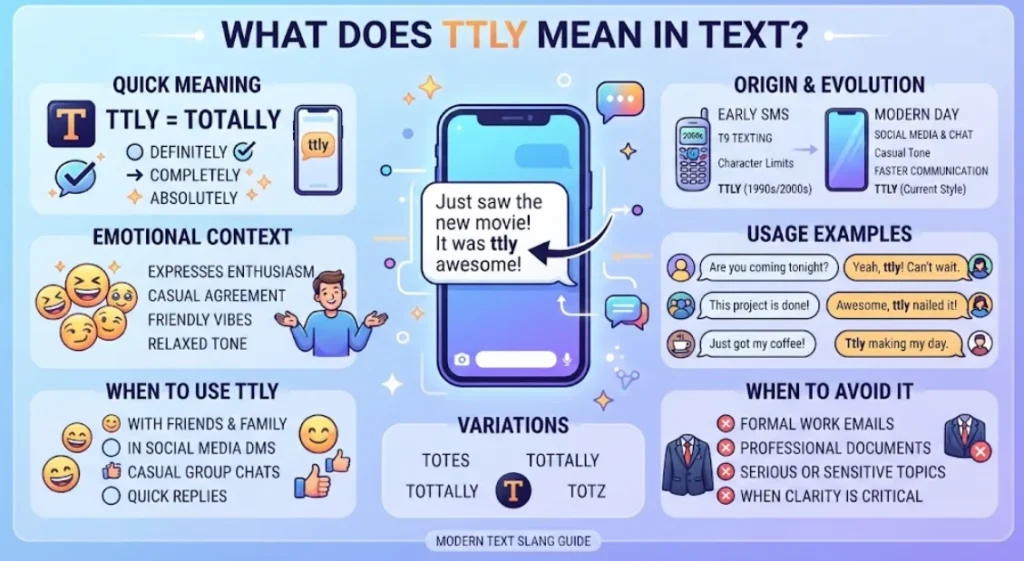
At its most basic level, “TTLY” is an abbreviation for the word “totally.” It is rarely used as a standalone sentence but instead functions as an adverbial intensifier.
- Core Definition: It serves as a replacement for “totally,” “completely,” or “absolutely.”
- Primary Function: It adds emphasis to an agreement, a realization, or an emotional state.
Common Examples of Usage
- “I ttly forgot to send that email, I’m so sorry!”
- “Are we still going to the movies? I ttly want to go.”
- “That new restaurant is ttly the best spot in town.”
Origin and Background
The rise of character limits in the early days of mobile messaging necessitated a shift toward brevity. While we now have larger screens and faster processors, the habit of using shorthand has become deeply embedded in our linguistic culture.
The Evolution of Texting Culture
In the era of T9 predictive texting and early SMS, every keystroke counted. Removing vowels became a standard practice to save time and effort. “Totally” became “ttly” not just for speed, but to fit within the small character buffers of older phone interfaces.
As social media platforms like Twitter, Instagram, and TikTok took center stage, this form of typing transitioned from a necessity to a stylistic choice. It signals a relaxed, informal tone—a digital version of casual, spoken-word inflection.
Real-Life Conversations
Seeing how people use these terms in the wild makes the concept click instantly. Here are a few snapshots of how “ttly” finds its way into our daily threads.
WhatsApp Exchange
Person A: Are you sure you can handle the project deadline?
Person B: Yeah, I ttly have it under control. Don’t worry!
Instagram DM
Person A: I can’t believe how stressful this week has been.
Person B: I know, I’m ttly over it. Let’s get coffee soon.
TikTok Comment Section
User 1: This video is so relatable, honestly.
User 2: It is ttly me every single morning.
Emotional and Psychological Meaning
When we type, we often struggle to convey the tone of our voice. Acronyms like “ttly” serve as emotional anchors. By choosing to truncate a word, you are signaling to the receiver that you are comfortable with them.
Why We Use It
Using this shorthand creates an atmosphere of casual intimacy. It tells the other person that you aren’t trying to write a formal document; you are trying to share a moment.
A Personal Observation
I remember messaging a friend who was having a rough day. Instead of sending a stiff “I understand completely,” I typed “I ttly get it.” That subtle shift in phrasing made the conversation feel less clinical and more human. It turned a robotic acknowledgement into a genuine show of empathy.
Usage in Different Contexts
Context is everything when it comes to slang. Using a term at the wrong time can sometimes undermine your message.
Social Media and Relationships
In comments, DMs, or quick status updates, “ttly” is perfectly at home. It fits the rapid-fire, low-stakes environment of digital social interactions where personality is more important than perfect grammar.
Professional Settings
Here is the caution: in a corporate environment, avoid using it. While you might feel close to a coworker, text-based work tools like Slack or email require a bit more professional polish. Using “totally” in full preserves your credibility, whereas “ttly” might come across as overly casual or dismissive of the task at hand.
When NOT to Use It
Knowing when to refrain is just as important as knowing when to use a word.
- Formal Correspondence: Never use it in emails to clients, professors, or supervisors.
- Serious Discussions: If you are discussing something sensitive, medical, or legal, stick to full, clear words. You don’t want to risk being misunderstood when clarity matters most.
- Cultural Sensitivity: If the person you are messaging does not speak English as a first language, abbreviations can create confusion. Use full words to ensure your meaning is clear.
Common Misunderstandings
Because “ttly” is informal, it can sometimes be read with the wrong tone.
- The Sarcasm Trap: If you say “That’s ttly great” in response to bad news, it might be interpreted as sarcasm.
- The Lazy Label: Some people view abbreviations as a sign of intellectual laziness. While this is rarely the case, be aware of who you are talking to and how they perceive digital slang.
Comparison Table
It helps to see how “ttly” stacks up against other ways we express agreement.
| Term | Context | Tone |
| Totally | Formal/Casual | Standard |
| TTLY | Very Casual | Relaxed |
| Def | Casual | Confident |
| For sure | Casual | Friendly |
| Absolutely | Formal/Strong | Professional |
Key Insight
The primary difference between these terms is the “weight” of the agreement. While “totally” is an affirmative statement, “ttly” acts as a shorthand for casual agreement, softening the intensity of the sentiment.
Variations and Types
The internet thrives on variations. Here are other ways people express the same idea.
Totes
A very common, playful way of saying “totally.”
Tottally
Adding an extra ‘t’ often emphasizes the sentiment even further.
Totz
A Gen Z and late-Millennial variation, often used in a joking or ironic way.
T
Sometimes people just use a single letter to signify an agreement in high-speed chats.
Totallys
Used when someone is being overly dramatic about how much they agree.
Ttlyyyy
Stretching the letters signals high enthusiasm or excitement.
Totes mcgoats
An older, campy slang variation that emphasizes extreme agreement.
Totally agree
Often used as a non-abbreviated, clear alternative when the slang might feel too risky.
100%
The numerical equivalent of “totally,” often used for absolute certainty.
How to Respond When Someone Uses It
If someone sends you “ttly,” you can match their energy with ease.
- Casual: “Right? I knew you’d agree.”
- Funny: “I’m glad we’re on the same page, ttly.”
- Mature: “I appreciate the support.”
- Respectful: “Glad to hear we see it the same way.”
Regional and Cultural Usage
Language is rarely static. It shifts based on where you live and when you grew up.
Generational Differences
Millennials were the pioneers of text-speak, often using it to save money on SMS charges. Gen Z has taken these abbreviations and injected them with more irony and specific aesthetic intent. For Gen Z, using “ttly” might even be used to mimic the way older generations text, creating a layer of internet humor.
Global Internet Usage
In Western cultures, the term is well-understood. However, in non-English speaking regions, English slang is often adopted as a “global internet language.” If you are communicating with someone in Asia or the Middle East, they may recognize the term, but it will almost always be used in a casual, social context rather than a professional one.
Is It Safe for Kids?
From a safety standpoint, “ttly” is harmless. It is a benign abbreviation without hidden or predatory meanings. However, as an educator, I would encourage young writers to learn the full version of words first. Knowing how to write “totally” correctly is essential for academic development, while “ttly” should be saved for private, casual communication.
FAQs
Is it rude to use “ttly” in a text?
It is generally not rude, provided you are talking to a friend or family member. It is simply a sign of an informal relationship.
Can I use “ttly” in a job application?
Absolutely not. Keep your professional communication formal and free of text slang to ensure you are taken seriously.
Does “ttly” mean the same thing as “totes”?
Yes, they are essentially interchangeable. “Totes” often feels a bit more playful, while “ttly” feels like a direct abbreviation.
Why do people write “ttlyyy” with extra letters?
The extra letters are a way to convey vocal inflection. It suggests that the person is saying the word with excitement or high energy.
Is “ttly” dying out?
Language is constantly shifting, but as long as people want to type quickly, these types of abbreviations will likely remain a part of our digital vocabulary.
Conclusion
“TTLY” is a small but powerful example of how our language adapts to the digital age. It serves as a bridge between the efficiency we need and the emotional connection we crave. While it shouldn’t replace formal vocabulary in serious settings, it adds a layer of warmth and casual ease to our everyday conversations.
The next time you see it pop up on your screen, remember that it is just a person on the other end trying to connect with you. Use it confidently, keep it casual, and enjoy the ease it brings to your digital dialogue. Language is meant to be flexible—have fun with it.