What Does WYF Mean?
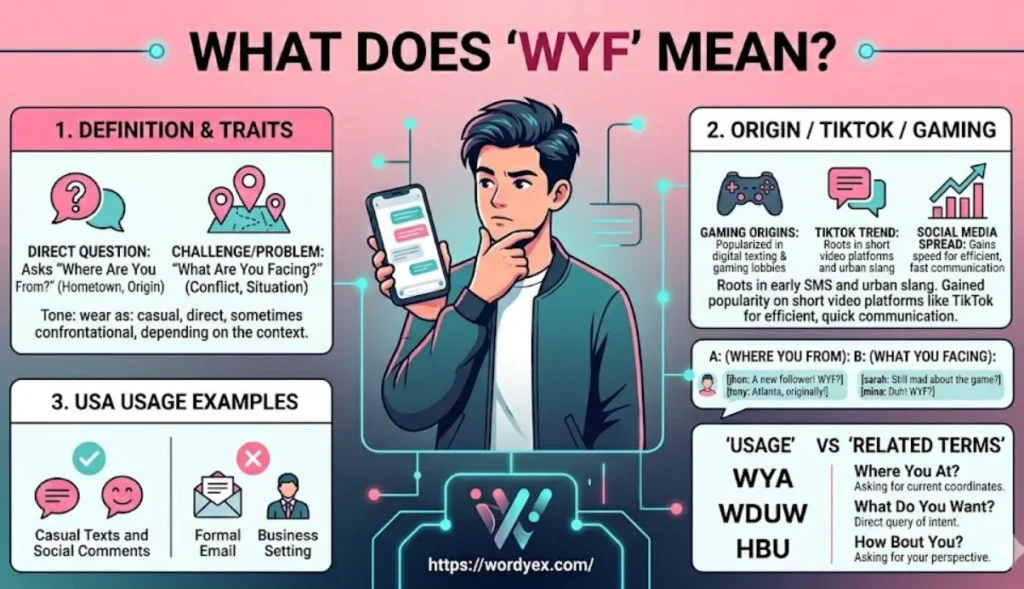
The acronym WYF stands for “What You Facing” or, more commonly in casual digital conversation, “Where You From.” It is a shorthand term used primarily in fast-paced texting and social media comments to quickly gather information about someone’s location or current predicament.
Understanding the Digital Shorthand
If you have spent any time scrolling through TikTok comments or glancing at a busy Instagram DM inbox lately, you have likely tripped over the letters WYF. In our fast-moving culture, we are constantly looking for ways to trim the fat off our sentences. Why type out four words when three letters can get the job done?
People search for this term because digital slang evolves faster than most dictionaries can keep up with. One day, you are familiar with all the acronyms, and the next, you are staring at a screen wondering if someone is asking you a question or throwing shade. This guide clears up the confusion so you can type with confidence.
WYF – Quick Meaning
At its core, WYF is a rapid-fire inquiry. Depending on the context, it functions as a digital shortcut for two very distinct questions.
- Where You From? (Used to establish someone’s background, hometown, or current city).
- What You Facing? (Used in urban or slang-heavy contexts to ask someone what their problem is or what they are dealing with).
Examples of the term in action:
“I see you repping that jersey, WYF?”
“You look stressed in that video, WYF?”
Origin & Background
Like most modern slang, WYF didn’t arrive with a press release; it emerged from the necessity of speed. Its roots are deep in early 2010s SMS culture, where characters were limited and typing out full sentences felt clunky. As social media platforms like Urban Dictionary often track, slang usually migrates from inner-city vernacular into gaming lobbies, and eventually, into the mainstream consciousness of platforms like TikTok and X.
The term gained significant momentum with the rise of short-form video content. When creators interact with hundreds of people in a comment section, they don’t have the time to type out “Where are you from?” every time a new fan appears. WYF became the universal shorthand for curiosity.
Real-Life Conversations
Seeing how people actually speak makes all the difference. Here is how you might see this pop up in your own messages:
Jhon A: Just moved to Chicago, looking for a new crew.
Tony B: Nice! WYF originally?
Sarah: I can’t believe he actually said that to you at the party.
Mina: I know, right? I was like, WYF? (What you facing/What is your problem?)
TikTok Commenter: That view looks confusing. WYF?
Creator: I’m in Dubai!
Leo: Are you coming to the game tonight?
Sam: Maybe, WYF right now? (Where are you located right now?)
Why is it Viral?
WYF is trending because it perfectly mirrors the American desire for efficiency. We are a culture that values directness. In a world of infinite scrolling, we want to get to the point. Whether it’s an icebreaker in a dating app or a challenge in a heated argument, WYF allows a person to pivot the conversation instantly without the formality of proper grammar. It is trendy because it feels like an “insider” term—if you know what it means, you are part of the conversation.
Emotional & Psychological Meaning
Using slang like WYF often signals a sense of casual comfort. When someone uses this term, they are dropping their guard and skipping the “small talk” phase of a conversation. It reveals a person who is direct, perhaps a bit impatient, and focused on gathering facts quickly.
I remember a time I was navigating a new city and someone messaged me on a local forum using WYF. It immediately felt less like a police interrogation and more like a casual nudge between peers. It signals that the speaker wants to connect without the fluff, showing a preference for “real” talk over polite scripts. You can find more insights on communication trends here to keep your vocabulary sharp.
Usage in Different Contexts
In social media comments, WYF is almost always harmless curiosity. If someone posts a sunset, you might see “WYF?” asking for the location. However, when used in a one-on-one text during an argument, “What you facing?” carries a sharper edge. It is a confrontational way of asking, “What is your issue?”
In professional settings, you should avoid this entirely. It is too informal and risks sounding dismissive. Keep it for your inner circle and your social feeds.
When NOT to Use It
Context is everything. You should avoid using WYF when:
- Communicating with a boss, professor, or client.
- Discussing serious or sensitive topics where tone might be misinterpreted.
- Talking to someone significantly older who may not be familiar with internet slang.
- In situations where you want to show respect and depth; using an acronym can make you seem uninterested or lazy.
Common Misunderstandings
The biggest issue is the dual meaning. If you ask “WYF?” to a stranger on the internet, they might think you are being aggressive (“What’s your problem?”) when you are actually just asking where they live (“Where you from?”). Always check the tone of the conversation before firing off this acronym.
Comparison Table
| Term | Meaning | Tone |
| WYF | Where you from? / What you facing? | Casual/Direct |
| WYA | Where you at? | Casual |
| WDUW | What do you want? | Direct/Confrontational |
| HBU | How ’bout you? | Conversational |
Key Insight: The ambiguity of WYF is both its greatest strength and its biggest weakness. Use it when you want to be quick, but be prepared to clarify if the person on the other end seems confused by your intent.
Variations & Types
- WYF-D: Where you from, dude? (Very casual, friendly).
- WYF-Actually: A way to push for a specific answer if someone is being vague.
- WYF-Right-Now: Asking for current coordinates rather than hometown.
- WYF-Tho: A slightly more aggressive version of the “What is your problem?” usage.
- WYF-Man: Used to express frustration in a peer-to-peer setting.
- WYF-Bro: Often used in gaming to call out a teammate for making a bad play.
- WYF-Girl: A common variant used in female-to-female text threads.
- WYF-Yall: Used when addressing a group of people in a comment section.
How to Respond When Someone Uses It
If a friend sends you “WYF?”, keep your reply matchy-matchy.
- Casual: “NYC! You?”
- Funny: “I’m facing a serious lack of caffeine today.”
- Mature: If you feel they are being rude, simply say, “I think there is a misunderstanding. Are you asking where I am?”
- Respectful: “I’m based in Chicago, how about you?”
Regional & Cultural Usage
In the United States, usage varies by coast. On the West Coast, WYF often leans toward the “Where you from?” inquiry, serving as a social bridge. In more aggressive urban hubs, the “What you facing?” meaning is more common. Internationally, the term is less recognized, so if you are chatting with someone in Europe or Asia, they may genuinely think you are confused or misusing English. It is a very American-centric piece of internet slang.
Is It Safe for Kids?
WYF is generally safe, but parents should be aware of the “What you facing?” meaning. If a child is using it to start arguments or in a confrontational way, it could be a sign of social friction. As always, keeping an eye on the context is key to understanding how they are interacting with peers online.
Frequently Asked Questions
Is it rude to ask WYF?
Usually no, but it depends on the context. If you are a stranger, it can seem blunt, so consider a more polite phrasing if you want to make a good impression.
Does WYF always mean Where You From?
No. It is frequently used to ask “What is your problem?” (What you facing). Always look at the surrounding conversation.
Can I use WYF in an email?
It is not recommended. Emails, even casual ones, tend to benefit from complete sentences to avoid sounding unprofessional.
Why do people use WYF instead of WYA?
WYA usually asks for a current location (Where you at?), whereas WYF is more often used to ask about a place of origin or to challenge someone’s behavior.
Is this slang going to disappear in 2027?
Slang has a shelf life, but acronyms like this tend to stick around in the digital lexicon for a long time because they serve a functional purpose in fast-paced texting.
Final Thought
At the end of the day, WYF is just another example of how we are evolving our language to fit the speed of our lives. While it lacks the poetry of a full sentence, it captures the essence of digital efficiency. Use it when you want to cut to the chase, keep it casual, and always keep an eye on the context to make sure your message hits the mark. The beauty of language is that it is always changing—own your style and communicate in a way that feels natural to you.