Decoding the Digital Shorthand: Why Everyone Is Asking About “Wsp”
wsp meaning in text, Have you ever looked at a text message from a friend or a younger sibling and felt like you needed a Rosetta Stone to decipher it? You are definitely not alone in that feeling. Digital communication moves at lightning speed, and keeping up with the ever-evolving vocabulary of text slang can feel like a full-time job.
One abbreviation that has completely taken over our screens is “wsp.” It pops up in casual group chats, Instagram direct messages, and comment sections across every major social platform. If someone sends you a three-letter message consisting only of “wsp,” it might look like a typo or a random accidental keystroke at first glance.
Understanding this term is about more than just translating letters into words. It is about understanding the underlying social cue, the casual tone, and the modern vibe of contemporary digital culture. Let us peel back the layers of this popular slang term so you can navigate your next text conversation with absolute confidence.
Wsp Meaning in Text – The Quick Definition
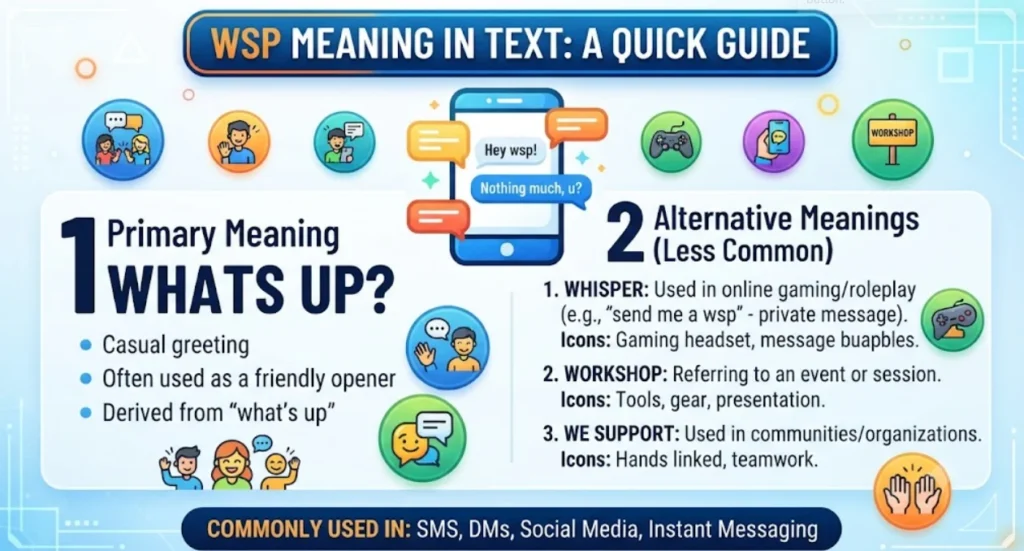
At its core, wsp is the ultra-shortened, lowercase abbreviation for “What’s up?”
It serves as a casual, low-effort greeting used to initiate a conversation, check in on someone, or ask what they are currently doing. Think of it as the digital equivalent of a quick nod of the head when you pass someone in a hallway.
Key Characteristics of Wsp
- Function: Casual greeting and open-ended question.
- Tone: Highly informal, relaxed, and deeply familiar.
- Intent: Checking in or starting a low-stakes conversation.
“Wsp bro, you trying to hit the gym later?”
“Wsp! Haven’t heard from you all weekend.”
“Hey, wsp? Did you finish the history assignment yet?”
The Origin and Cultural Background of Wsp
The phrase “What’s up?” has been a staple of the English language for decades, tracking back long before smartphones existed. However, the transformation of this phrase into “wsp” is a direct product of early texting limitations and the rapid growth of social media platforms.
The Evolution of Texting Shortcuts
In the early days of mobile phones, character limits forced users to get creative with their thumbs. Words were chopped down to their bare essentials to save space and time. While abbreviations like “BRB” and “LOL” dominated the early 2000s, “wsp” gained massive traction a bit later as smartphone keyboards and instant messaging apps took over.
The Social Media Acceleration
The explosion of platforms like TikTok, Snapchat, and Instagram changed how we type. On these platforms, speed and brevity are highly valued. Gen Z and younger millennials adopted “wsp” as a way to maintain an effortless, laid-back aesthetic online. Typing out the full phrase “What is up?” started to feel too formal, almost sterile, whereas “wsp” hits the perfect note of casual coolness.
Real-Life Conversations: Wsp in Action
To truly master a slang term, you need to see how it lives and breathes in everyday digital interactions. Here are a few realistic scenarios showing how people use “wsp” across different digital platforms.
Scenario 1: The WhatsApp Catch-Up
Person A: Wsp! Been a minute since we hung out.
Person B: Hey! Not much, just working a ton. We definitely need to link up this weekend.
Person A: For sure, let’s grab food on Saturday.
Scenario 2: The Instagram DM Slide
Person A: Responds to a story 🔥 Wsp with that new jacket? Where’d you get it?
Person B: Haha thanks! Got it from that vintage shop downtown.
Person A: That’s clean, I need to check that place out.
Scenario 3: The TikTok Comment Section
Person A: Wsp with the background music in this video? It goes so hard.
Person B: It’s a leaked track by Carti, check Soundcloud!
Person A: Real one, thank you 🙌
Scenario 4: The Casual Text Message
Person A: Wsp, you awake?
Person B: Yeah, just watching a movie. What’s going on?
Person A: I left my keys in your car, can I come grab them?
The Emotional and Psychological Vibe of Wsp
Texting is not just about exchanging data; it carries deep emotional and psychological weight. When someone chooses to send “wsp” instead of a formal greeting, they are making a specific psychological choice about the dynamic of the relationship.
The Psychology of Low-Effort Communication
Sending a three-letter lowercase text indicates that you feel comfortable enough with the recipient to drop all formal etiquette. It signals a high level of psychological safety and social proximity. You do not feel the need to impress them with perfect punctuation or fully formed sentences.
The Tone of Cool Casualness
There is an emotional nonchalance attached to “wsp.” It says, “I am thinking about you, but I am keeping it completely relaxed.” It removes the pressure from the recipient, making it incredibly easy for them to respond whenever they have a free moment.
A Personal Scenario from the Field
A few months ago, a friend of mine went through a stressful career transition. Instead of sending a heavy, intense text like, “I am checking in to see how your mental health is doing during this difficult transition,” I simply sent, “Wsp, how you holding up?”
That tiny, casual opener gave him the space to open up without feeling overwhelmed by a heavy question. It allowed him to vent naturally because the entry barrier to the conversation felt incredibly low and safe.
How Wsp Adapts to Different Contexts
Context is absolutely everything when it comes to digital communication. The exact same acronym can be interpreted as friendly, lazy, or downright disrespectful depending entirely on who you are messaging.
Social Media Spaces
On public platforms like TikTok and Instagram, “wsp” functions as a conversational lubricant. It is used to interact with creators, comment on content, or start quick dialogues in public threads. In these spaces, it carries zero emotional risk and is universally understood as a friendly greeting.
Friends and Romantic Relationships
Among close friends, “wsp” is a daily staple. In romantic or flirtatious contexts, it is often used as a low-stakes way to see if the other person is free or thinking about you. It allows someone to test the waters of a conversation without making a massive emotional investment right out of the gate.
Professional Settings
This is where you must be incredibly careful. Sending “wsp” to your boss, a college professor, or a client is generally a massive misstep. It signals a lack of professionalism and can be perceived as flippant or disrespectful. In the workplace, stick to traditional greetings unless you are on a highly casual, internal team chat where slang is explicitly welcomed.
When You Should Absolutely Avoid Using Wsp
While slang is incredibly useful for building social bonds, using it in the wrong situation can backfire spectacularly. Recognizing when to keep your language formal is an essential communication skill.
High-Stakes Situations
If you are apologizing for a mistake, discussing a serious emotional issue, or dealing with a crisis, do not use “wsp.” It minimizes the gravity of the situation. Imagine receiving a text that says, “Wsp, sorry to hear about your dog.” It feels dismissive and lacks the empathy required for difficult moments.
Navigating Authority Dynamics
When communicating with people who belong to generations that did not grow up with digital slang, avoid these abbreviations. Older relatives or professional mentors may find the term confusing or assume you cannot be bothered to type out a proper sentence.
Common Misunderstandings and Tone Confusion
The greatest downside of text-based communication is the complete absence of vocal tone and facial expressions. Because of this, short abbreviations can easily be misinterpreted if the recipient is not careful.
The “Dry Texting” Misconception
Sometimes, receiving a single “wsp” can feel cold or distant to the recipient. If someone is used to more expressive language filled with emojis and exclamation points, a blunt, lowercase “wsp” might make them wonder if you are annoyed or upset with them.
Literal vs. Figurative Interpretation
Occasionally, people confuse “wsp” with other similar-looking acronyms. It is important to look at the surrounding words to ensure you are reading the intent correctly. If the text looks completely out of place, there is a good chance a simple misunderstanding is at play.
Comparing Wsp to Similar Digital Slang
To help you map out where “wsp” fits in the broader landscape of internet slang, let us compare it directly with other common terms you are likely to encounter in your inbox.
| Slang Term | Core Meaning | Formal Equivalent | Best Context | Tone Profile |
| Wsp | What’s up? | How are you doing? | Close friends, DM group chats | Casual, effortless, relaxed |
| Wru | Where are you? | What is your current location? | Meeting up, coordination | Functional, direct, urgent |
| Wyd | What are you doing? | What are you occupied with? | Casual checking-in, flirting | Curious, open, engaging |
| Sup | What’s up? | Greetings | Casual greetings, old school text | Laid-back, slightly dated |
| Hru | How are you? | How do you do? | Friendly check-ins | Warm, caring, direct |
Key Insight
While “wyd” focuses specifically on an action or activity, “wsp” is an open-ended lifestyle greeting that gives the recipient complete freedom to answer however they please, making it a much more versatile conversational tool.
Ten Common Variations and Types of Wsp Slang
The world of digital slang is highly fluid, and “wsp” frequently morphs into different variations depending on the platform and the user’s specific mood. Here are ten variations you should know.
1. Wspp
- Meaning: What’s up? (With an extra emphasis)
- The extra ‘p’ adds a playful, extended tone to the greeting, making it feel friendlier.
2. Wsp bro
- Meaning: What’s up, brother/friend?
- A deeply familiar greeting used almost exclusively between close male friends or peers.
3. Wsp text
- Meaning: A checking-in text message.
- Refers to the actual act of sending a low-effort message to see what someone is doing.
4. Wsp with that
- Meaning: What is going on with that specific situation?
- Used to demand an explanation or query a strange occurrence.
5. Wsppp
- Meaning: What is up? (High energy version)
- The multiple repeating letters signal excitement, enthusiasm, or deep boredom.
6. Wsp gang
- Meaning: What’s up, everyone?
- Commonly dropped into group chats to greet multiple friends simultaneously.
7. Wsp homie
- Meaning: What’s up, close friend?
- A warm, old-school urban variation adapted for modern text screens.
8. Wsp wit u
- Meaning: What is up with you?
- Shifts the focus entirely onto the recipient’s current emotional state or plans.
9. Wsp squad
- Meaning: What’s up, inner circle?
- Used to grab the attention of an entire friend group in a shared digital space.
10. Wsp twin
- Meaning: What’s up, my lookalike or close kindred spirit?
- A popular term of endearment used among Gen Z to greet someone they deeply resonate with.
How to Respond When Someone Sends You “Wsp”
The key to keeping a conversation flowing naturally is matching the energy of the person who messaged you. Here are a few ways to craft your response based on the specific vibe you want to project.
Casual and Laid-Back Replies
If you want to keep things easy and match their low-effort energy, keep your response short and sweet.
- “Nm, just chilling at home. Wbu?”
- “Not much, just finishing up some homework. Wsp with you?”
- “Just watching some TV. What are you getting into tonight?”
Funny and Playful Replies
If you have a humorous dynamic with the person, you can poke fun at the casual nature of the text.
- “Surviving, barely. Send snacks immediately.”
- “Plotting world domination, the usual. You?”
- “Staring at the ceiling waiting for someone cool to text me. Finally happened.”
Mature and Clear Replies
When you want to transition the conversation into something more substantial, give a direct answer and pivot.
- “Hey! I’m actually doing well, just getting ready for a busy week ahead. How have you been?”
- “All good here. I was actually meaning to reach out to you about our weekend plans.”
Respectful and Kind Replies
If the person reaching out is someone you care about deeply, add a touch of warmth to your message.
- “Hey! So glad you reached out. I’m doing well, hope everything is great with you too.”
- “Hey there! All is good on my end. Thanks for checking in on me.”
Regional, Cultural, and Generational Usage
Language is shaped profoundly by geography and generation. The way “wsp” is deployed changes noticeably across different demographics.
Western Internet Culture
In the United States, Canada, and the United Kingdom, “wsp” is ubiquitous in urban culture and suburban youth spaces alike. It is viewed as standard internet vernacular, completely stripped of any novelty because it is used so frequently.
Global and Cross-Cultural Adaptations
In Asian and Middle Eastern youth circles where English is spoken as a second language, “wsp” is frequently adopted through exposure to Western media, music, and gaming communities. It is often combined with local slang words to create a unique, localized digital dialect.
The Generational Divide: Gen Z vs. Millennials
- Gen Z: View “wsp” as a natural, default way to say hello. They don’t think twice about the lack of letters or capitalization. To them, it feels comfortable and authentic.
- Millennials: Are more likely to use the slightly older variant “sup” or type out “What’s up?” with standard punctuation. When they do use “wsp,” it is often done intentionally to match the style of younger peers.
Is It Safe for Kids to Use?
For parents navigating the complex world of online safety, seeing unfamiliar acronyms can trigger immediate anxiety. Fortunately, “wsp” is completely safe.
It carries no hidden explicit meanings, dark double entendres, or dangerous connotations. It is purely a functional piece of linguistic shorthand used to save time. The only minor concern for parents is ensuring that children understand basic digital etiquette—knowing that while “wsp” is perfect for a friend, it should never be sent to a school teacher or an employer.
Frequently Asked Questions About Wsp
Does wsp mean “WhatsApp” in text messages?
While it can occasionally be used as an abbreviation for the app itself in very specific logistical contexts, 95% of the time it stands exclusively for “What’s up?”
Is wsp a rude or dry text?
Not inherently. However, because it requires very little effort to type, sending it repeatedly without any follow-up words can make a conversation feel dry or uninspired.
Can I use wsp in an email?
Only if the email is to a very close friend or a coworker with whom you share a highly casual relationship. Avoid using it in formal, official, or corporate emails.
What is the difference between wsp and wyd?
“Wsp” means “What’s up?” and functions as a broad greeting. “Wyd” means “What are you doing?” and specifically asks about your current physical activity or plans.
Why do people type wsp in all lowercase?
Lowercase typing is a distinct stylistic choice in modern text culture. It projects a relaxed, effortless, and unbothered attitude that fits the casual nature of the slang perfectly.
Summary: Embracing the Digital Flow
Navigating the landscape of modern text messaging does not mean you need to change how you speak overnight. It simply means understanding the tools of connection that the people around you are using. Slang like “wsp” is not ruining the English language; it is expanding it, creating tiny bridges of casual connection in our fast-paced digital world.
The next time a three-letter greeting slides into your notifications, you will not have to guess what it means. Take a breath, keep it casual, match their energy, and enjoy the conversation.