Decoding the Digital Pulse of Modern Friendships
HYD Meaning in Chat,We’ve all been there. You’re staring at your phone, a notification pops up, and it’s a simple three-letter acronym: HYD. In the fast-paced world of digital communication, where every second counts and our thumbs are doing most of the talking, these little linguistic shortcuts have become the backbone of our social lives.
But while it looks simple, “HYD” carries more weight than just a casual inquiry. It’s a digital handshake, a low-pressure check-in, and sometimes, a gateway to a much deeper conversation. As someone who has spent years dissecting the nuances of English communication and digital linguistics, I’ve seen how these three letters can bridge the gap between “just acquaintances” and “best friends.”
People search for the meaning of “HYD” because digital slang evolves faster than most of us can keep up with. Whether you’re a parent trying to understand your teen, a professional navigating a casual Slack channel, or someone learning English as a second language, understanding the subtle energy behind these acronyms is key to sounding natural and confident.
HYD – Quick Meaning
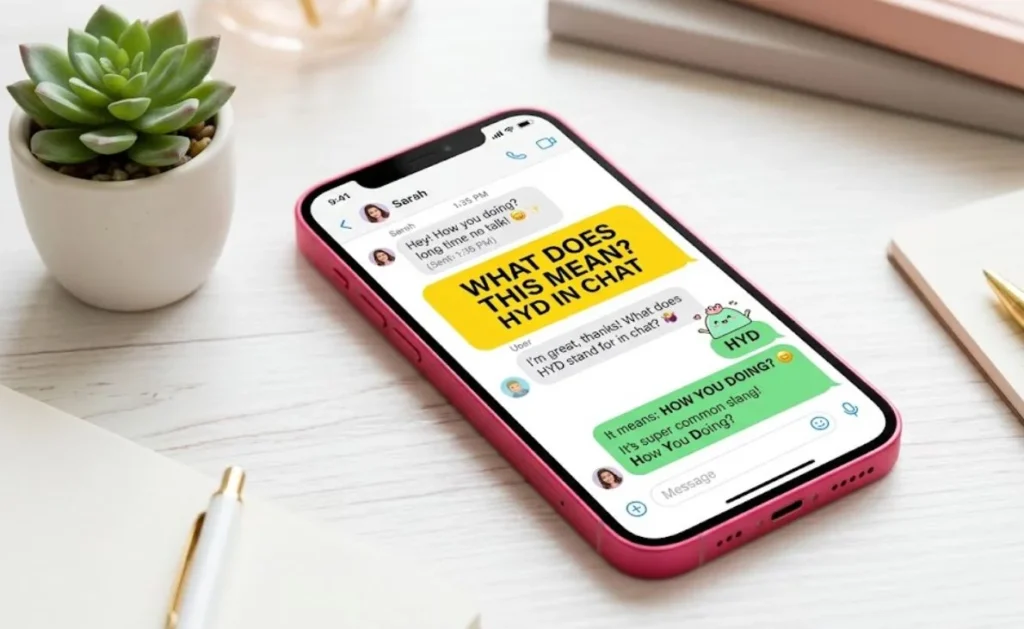
At its core, HYD is a direct acronym for a very common question:
- How
- You
- Doing?
It is the digital equivalent of asking “How are you?” or “How’s it going?” but with a much more relaxed, informal vibe.
Here are a few quick examples of how it looks in the wild:
“Hey! HYD? Haven’t seen you since the weekend!”
“Long time no talk, HYD?“
“HYD? Heard you were feeling a bit under the weather.”
Origin & Background
The beauty of HYD lies in its simplicity. It didn’t emerge from a boardroom or a marketing agency; it grew organically from the early days of Internet Relay Chat (IRC) and SMS texting. Back when we had character limits on texts and had to press the “7” key four times just to type an “S,” brevity wasn’t just a style—it was a necessity.
As social media platforms like Instagram, TikTok, and Snapchat took over, the culture of “brevity” stayed. HYD became a staple because it removes the formality of a full sentence. It feels less like an interview and more like a casual tap on the shoulder. Culturally, it aligns with the “low-stakes” communication style of Gen Z and Millennials, where checking in should feel effortless rather than a chore.
Real-Life Conversations
To truly understand the “flavor” of HYD, you have to see it in action. Context is everything. Here are a few realistic scenarios that show how the tone shifts depending on who is typing.
1. The WhatsApp Check-in (Friends)
Person A: “Yo! HYD? Haven’t seen any gym selfies lately lol.”
Person B: “Haha, I’ve been buried in work man. Doing okay though, just tired!”
2. The Instagram DM (Casual/Flirty)
Person A: “That sunset photo you posted was insane. HYD?”
Person B: “Right?! It was even better in person. I’m great, just enjoying the vibes. You?”
3. The TikTok Comment (Community)
Person A: “Your latest vlog helped me so much.”
Person B: “That makes me so happy to hear! HYD today? Hope you’re having a good one.”
4. The Quick Text (Supportive)
Person A: “Hey, I know you had that big presentation today. HYD?”
Person B: “Glad it’s over! It went better than expected. Thanks for checking in.”
Emotional & Psychological Meaning
Why do we use “HYD” instead of “How are you?” The psychology behind it is fascinating. In modern linguistics, we call this phatic communication—language that isn’t necessarily about exchanging information, but about maintaining social bonds.
Using “HYD” signals that you are in a “casual” zone. It lowers the barrier to entry for the recipient. If someone asks “How are you?” in a formal email, you might feel pressured to give a polished answer. If someone sends “HYD?”, it feels okay to reply with a simple “Good, u?” or even a more honest “Ugh, stressed.”
In my own experience, I’ve found that “HYD” is often used as a “test of availability.” It’s a way of saying, “I’m thinking about you and I’m open to talking if you are.” It reveals a modern desire for connection that doesn’t demand too much energy from either party.
Usage in Different Contexts
Understanding where to use HYD is just as important as knowing what it means.
Social Media
On platforms like TikTok or Twitter, HYD is often used in “stories” or public posts to engage an audience. A creator might post a photo with the caption “HYD today?” to encourage comments and build community.
Friends & Relationships
This is the “home base” for HYD. It’s perfect for starting a conversation with a crush, a best friend, or a sibling. It’s affectionate but keeps things light.
Work / Professional Settings
Proceed with caution. In a formal email to a CEO, HYD is a no-go. However, in internal team chats like Slack or Discord, it’s becoming more common among peers who have a friendly rapport. Just make sure the company culture supports it!
Casual vs. Serious Tone
While HYD is usually casual, it can be used seriously if followed by more text. For example: “I heard the news about your dog. HYD? Really sorry to hear that.” Here, the acronym provides a soft opening to a sensitive topic.
When NOT to Use It
As an educator, I always emphasize that slang has boundaries. You should avoid HYD in the following situations:
- Grief or Major Crisis: If someone has suffered a significant loss, a three-letter acronym can feel dismissive or lazy. Use full words to show respect.
- Job Interviews: Even if the recruiter seems “cool,” stay professional.
- First-Time Introductions: Unless you are in a very specific niche community, “HYD” can come off as a bit too “forward” if you’ve never spoken before.
- Legal or Medical Correspondence: Keep it formal and clear.
Common Misunderstandings
The biggest misunderstanding is that “HYD” requires a medical report of your current health. Most of the time, it’s just a greeting.
Another common error is confusing it with HYF (How You Feeling) or HBU (How About You). While they are related, HYD is specifically about your general state of being at that moment. Don’t take it too literally—if a casual acquaintance asks “HYD?”, they usually aren’t looking for a list of your physical ailments!
Comparison Table: HYD vs. Similar Slang
| Expression | Meaning | Tone | Best Used With… |
| HYD | How you doing? | Casual/Friendly | Friends, Peers |
| SUP | What’s up? | Very Informal | Close Friends |
| HBU | How about you? | Reactive | Anyone (as a reply) |
| WBY | What about you? | Reactive | Similar to HBU |
| WRU | Where are you? | Locational | Logistics/Planning |
Key Insight: While “Sup” is a general acknowledgment of someone’s presence, “HYD” is a genuine (though brief) inquiry into their current mood or life status.
Variations & Types
Language is fluid, and HYD has several “cousins” you should know:
- HYD Today: A more specific check-in.
- HYD? (with no other text): A “ping” to see if you’re active.
- Howya doing: A phonetic, more “voice-like” variation.
- HYD lately: Asking about a broader timeframe.
- HYD holding up: Used when the person knows you’re stressed.
- HYD feeling: Specifically about health or emotions.
- HYD man/girl: Adding a gendered or friendly identifier.
- HYD fr: (How you doing for real?)—Asking for the honest truth.
- HYD fam: Used within a very close-knit group.
For those looking to expand their digital vocabulary further, you can explore more English idioms and expressions to improve your conversational flow.
How to Respond When Someone Uses It
Your response should match the energy of the sender.
- Casual: “Good! Just chilling. You?”
- Funny: “Surviving on coffee and spite. HYD?”
- Mature: “Doing well, thank you. Just finished a big project, so I’m feeling relieved.”
- Respectful: “I’m great, thanks for asking! Hope everything is going well on your end too.”
Regional & Cultural Usage
- Western Culture: HYD is ubiquitous in the US, UK, and Canada. It’s the standard digital “How are you?”
- Asian & Middle Eastern Culture: While English slang is popular globally, these cultures often prefer more formal greetings unless they are part of the younger, Westernized tech generation.
- Generational Differences: For Gen Z, HYD is almost a default setting. For Millennials, it’s a convenient tool. For Baby Boomers, it might still require a bit of explanation!
If you’re interested in how global English influences travel and culture, checking out resources like Visit London can show you how local slang and formal English coexist in major world hubs.
Is It Safe for Kids?
Yes, HYD is 100% safe. It contains no profanity and has no hidden “dark” meanings. It is one of the “cleanest” pieces of internet slang available. Parents don’t need to worry if they see this in their child’s messages—it’s just a sign they are staying social.
FAQs
1. Is HYD rude?
Not at all, provided it’s used in an informal setting. In a casual chat, it shows you’re being friendly.
2. Can I use HYD in a professional email?
It’s best to avoid it. Stick to “I hope you’re doing well” or “How are things?” for professional correspondence.
3. Does HYD mean “How’s your day?”
While it’s often used that way, the literal acronym is “How you doing?” but the sentiment is the same.
4. How do I pronounce HYD?
You don’t usually say the letters out loud; you say the full phrase “How you doing?” If you must say the acronym, you’d just spell it out: H-Y-D.
5. What is the difference between HYD and SUP?
“Sup” is more of a “Hello,” while “HYD” is a question that actually invites an answer about your well-being.
Conclusion
At the end of the day, “HYD” is more than just three letters—it’s a small but powerful way we stay connected in an increasingly digital world. It proves that even when we are short on time, we aren’t short on care.
The next time you see “HYD” pop up on your screen, don’t overthink it. Take it as a compliment that someone wants to check the pulse of your day.
Whether you respond with a “living the dream” or a “hanging in there,” you’re participating in the beautiful, evolving dance of modern human connection. So, go ahead—send that “HYD” to a friend you haven’t spoken to in a while. You might be surprised at the conversation it starts.