Decoding the Silent Language of Connection
Communication is moving faster than ever. One second you are typing a full paragraph, and the next, you are staring at a two-letter reply like “mh” wondering if you just got ghosted or if you’ve unlocked a new level of intimacy.
If you have seen “mh” pop up in your DMs or WhatsApp chats, you aren’t alone in your confusion. It is one of those versatile, low-effort, high-impact terms that can mean anything from “I’m listening” to “I’m definitely flirting with you.” Understanding these nuances is the difference between a smooth conversation and an awkward silence.
MH – The Quick Meaning
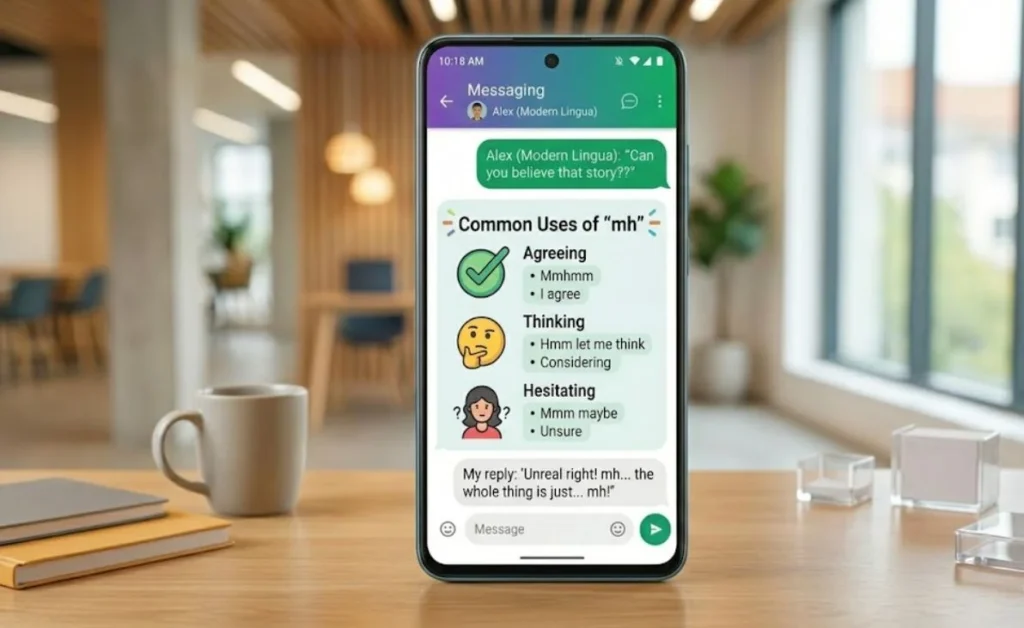
At its core, MH is a written representation of a humming sound. It is the digital version of saying “Mm-hmm” or “Mmhmm.” It is a vocalization of agreement, acknowledgement, or deep thought.
- Agreement: “Yes, I hear you.”
- Contemplation: “Let me think about that.”
- Affirmation: “I agree with what you just said.”
Example 1:
“Do you want to grab tacos later?”
“mh, sounds like a plan.”
Example 2:
“I think we should probably start the project early.”
“mh, I was thinking the same thing.”
Origin & Background
Unlike many acronyms that stand for specific words (like BRB or LOL), “MH” is onomatopoeic. It captures a physical sound we make in real-life conversations to show we are present without interrupting the speaker.
It gained massive traction on platforms like Tumblr and Twitter (X) before becoming a staple in TikTok comments. In the early days of the internet, people used “mmhmm,” but as mobile keyboards evolved, the shorter “mh” became the go-to for quick, effortless validation.
Culturally, it reflects the “low-stakes” communication style of Gen Z and Millennials. It allows the sender to maintain a “cool” or “relaxed” vibe while still being responsive.
Real-Life Conversations
To really get a feel for how “mh” fits into your life, let’s look at how it plays out in different digital spaces.
WhatsApp (The Casual Planner)
Person A: I’m thinking of heading to the gym around 6 PM today. Want to join?
Person B: mh, let me check my schedule. I might be finishing work late.
Instagram DMs (The Flirty React)
Person A: (Sends a photo of a sunset) This view reminded me of our trip.
Person B: mh… it was such a vibe. We need to go back soon.
TikTok Comments (The Agreement)
User 1: This recipe works so much better if you add the garlic at the end!
User 2: mh, facts. I tried it yesterday and it’s a game changer.
Emotional & Psychological Meaning
There is a psychological weight to “mh.” It acts as a “minimal encourager.” In psychology, these are short utterances that let a person know you are paying attention, encouraging them to keep sharing.
When someone uses “mh,” they are offering you a “digital nod.” It creates a sense of safety in the conversation. However, it can also be a “holding pattern”—a way for someone to stay in the loop without having to commit to a long response.
A Personal Scenario:
I remember texting a friend who was going through a tough breakup. I didn’t have the “perfect” advice, and honestly, anything I said felt too small.
Instead of staying silent, I used “mh” and “mhmm” as she vented. It wasn’t about being lazy; it was about holding space for her words without making the moment about my opinion.
Usage in Different Contexts
Social Media
On platforms like TikTok or Reels, “mh” is used to agree with a point or acknowledge a “hot take.” It’s the digital equivalent of nodding along to a podcast.
Friends & Relationships
This is where “mh” gets nuanced. Between close friends, it’s a shorthand for “I’m with you.” In a romantic context, a lowercase “mh” can feel cozy and intimate, while a “Mh.” with a period might feel cold or dismissive.
Work / Professional Settings
Caution is advised here. Using “mh” in a Slack channel or an email to your boss can come across as unprofessional or even rude. It’s better to use “Understood” or “I agree.”
When NOT to Use It
While it’s a great filler, “mh” has its limits.
- Serious Conflicts: If someone is pouring their heart out about a grievance, “mh” can feel like you aren’t taking them seriously.
- Formal Emails: Never use this with a client. It lacks the authority and clarity needed for business.
- High-Stakes Questions: If someone asks, “Do you love me?” or “Am I getting fired?”, replying with “mh” is a recipe for disaster.
Common Misunderstandings
The biggest issue with “mh” is Tone Loss. Because you can’t hear the pitch of the hum, the receiver might misinterpret it.
- The “I’m Bored” Interpretation: If the conversation is lagging, “mh” can look like the sender is losing interest.
- The “I’m Judging” Interpretation: Sometimes, “mh” can feel like a skeptical “Oh, really?”
Always look at the surrounding words to gauge the intent.
Comparison Table: Slang vs. Meaning
| Slang | Meaning | Tone |
| MH | Mmhmm / Yes / I hear you | Neutral / Thoughtful |
| K | Okay (Short) | Often seen as passive-aggressive |
| Wrd | Word / I agree | Confident / Street-casual |
| Nvm | Never mind | Dismissive / Frustrated |
| Bet | Yes / For sure | Energetic / Agreeable |
Key Insight: While “K” often ends a conversation, “MH” usually keeps it breathing. It’s a bridge rather than a wall.
Variations & Types of MH
- Mh-hm: The classic “yes” or “I agree.”
- Mh?: A questioning hum, meaning “What was that?” or “Really?”
- Mhhhh: Suggests deep thinking or being impressed.
- Mh…: Indicates hesitation or “I’m not so sure about that.”
- MH!: An enthusiastic “Yes!” or a “Finally!”
- mhmm: A more standard, slightly more formal version of the hum.
- mhh: Often used when someone is savoring a thought (or a food reference).
- mh k: A slightly dismissive “Yeah, okay.”
- Mh-mh: Usually means “No” (the two-tone “uh-uh” sound).
How to Respond When Someone Uses It
- Casual: “Glad we’re on the same page!”
- Funny: “Don’t ‘mh’ me, I know you love this idea 😂”
- Mature: “I appreciate you listening. What do you think though?”
- Respectful: “Let me know if you need more time to think about it.”
Regional & Cultural Usage
- Western Culture: Primarily used as a filler or a low-energy agreement in text.
- Asian Culture: In many digital spaces, short vocalizations are common to show politeness and “active listening,” similar to the Japanese concept of Aizuchi.
- Global Internet: It is a universal “vibe” check. Regardless of language, the “m” sound is almost globally recognized as a sound of internal processing.
- Generational: Gen Z uses it as a “minimalist” tool. Millennials might find it a bit too short and prefer “Mmhmm.”
Is It Safe for Kids?
Yes. “MH” is completely safe. It contains no hidden inappropriate meanings or “double entendres.” It is simply a linguistic shortcut. However, as with all texting terms, it’s good for parents to understand the context so they can distinguish between a teen being “chilled out” and a teen being “dismissive.”
To understand more about digital safety and modern linguistics, check out the resources at Common Sense Media.
FAQs
Q: Is MH an acronym for something?
A: Rarely. While some might use it for “My Heart” in very specific romantic contexts, 99% of the time it is just the sound “Mmhmm.”
Q: Does MH mean “Maybe”?
A: Not directly. However, “mh…” with an ellipsis often implies hesitation, which can be interpreted as a “maybe.”
Q: Is it rude to reply with just “mh”?
A: It depends on the person. With a best friend, it’s fine. With someone you just started dating, it might come across as dry.
Q: How is it different from “K”?
A: “K” is a hard stop. “MH” is a soft continuation.
Q: Should I capitalize it?
A: “mh” (lowercase) is more common and feels more relaxed. “MH” (uppercase) can feel a bit more startling.
Final thought
At the end of the day, “mh” is a small part of the beautiful, messy, and evolving way we communicate. It captures a human sound in a digital box, allowing us to “nod” across miles of fiber-optic cables.
Whether you are using it to show a friend you are listening or just to save time during a busy day, remember that context is king.
Use it to build bridges, not to avoid talking. Now that you know the secret behind the hum, you can navigate your next chat with total confidence. Happy texting!