Understanding the Nuance Behind the Phrase
earliest convenience meaning, You have likely encountered the phrase “at your earliest convenience” in an email, a text, or perhaps a formal letter. It sounds professional and polite, but it often carries a weight that can feel slightly ambiguous. Is it a genuine request for time, or is it a soft way of demanding immediate action?
People search for this term because they want to strike the right balance between being respectful of someone’s schedule and ensuring their own needs are met. Navigating this fine line is essential in modern communication. It bridges the gap between pure social interaction and professional expectations.
At Your Earliest Convenience – Quick Meaning
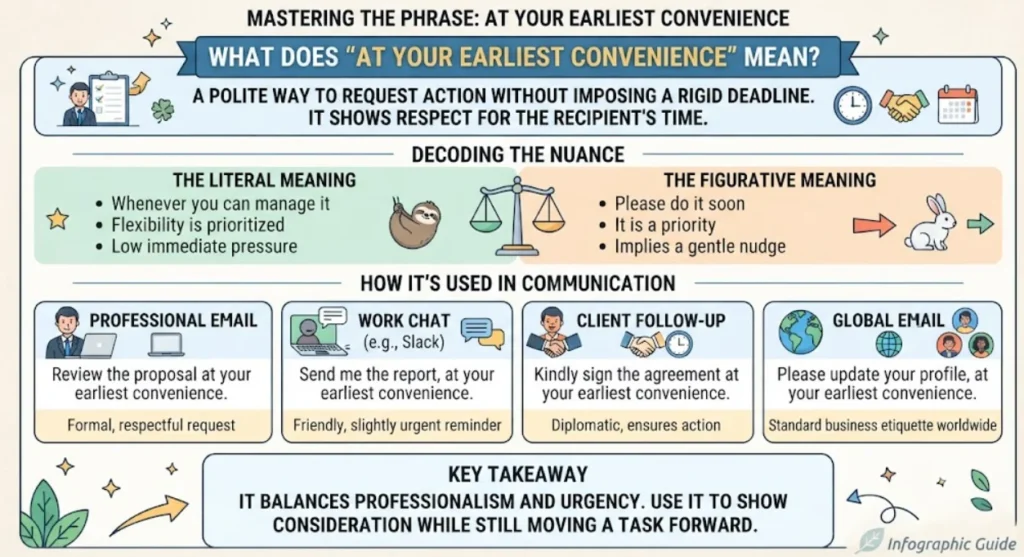
At its core, this phrase acts as a diplomatic way to ask someone to do something as soon as they are able to, without imposing a hard deadline. It implies that you value the other person’s time while still highlighting that the task is important.
- Flexibility: It acknowledges that the recipient has other priorities.
- Professionalism: It removes the bluntness of saying “do this right now.”
- Urgency: It serves as a gentle reminder that the matter requires attention.
Examples of Usage
“Please review the attached project proposal at your earliest convenience.”
“Kindly update your contact information at your earliest convenience so we can ship your order.”
Origin & Background
The phrase is rooted in formal correspondence traditions of the 19th and early 20th centuries. Back then, written communication was deliberate, slow, and highly codified. Using phrases that demonstrated high levels of etiquette was a mark of education and social standing.
Cultural Evolution
As we moved into the digital age, the phrase migrated from handwritten letters to emails. It acted as a social lubricant in workplaces where managers wanted to maintain authority while remaining polite.
In the era of instant messaging, the term has taken on a slightly ironic undertone. Because we expect immediate replies to texts, using this traditional phrase can sometimes signal that the sender is trying to remain calm even when they are actually quite pressed for time.
Real-Life Conversations
Modern communication happens across many platforms. Seeing the phrase in different contexts helps clarify its emotional intent.
Person A: Hey, did you get a chance to look at the wedding guest list?
Person B: Not yet, sorry! I’ve been swamped.
Person A: No worries! Just let me know at your earliest convenience so I can finalize the printing.
Instagram DMs
Person A: Love your art style! Are you taking commissions?
Person B: I am! I’ll send over my rate sheet at my earliest convenience. Keep an eye on your inbox!
TikTok Comments
User 1: Can you make a video explaining this trend?
User 2: I’ll look into it and get back to you at my earliest convenience.
Text Messages
Person A: Mom, can you send me that recipe for the lasagna?
Person B: Sure thing, darling. I’ll text it over at my earliest convenience when I’m back from the store.
Emotional & Psychological Meaning
This phrase creates a “polite buffer.” It allows the requester to maintain a sense of control without being overbearing. Psychologically, it appeals to the recipient’s sense of autonomy. By giving them “convenience” as the metric for time, you are signaling trust.
A Personal Scenario
I remember working with a difficult client who demanded updates every hour. One day, I replied by saying, “I will have that report to you at your earliest convenience.” It shifted the dynamic instantly. It wasn’t an act of defiance, but a gentle reminder that quality work requires focus, not just speed. The client actually settled down after that.
Usage in Different Contexts
How you use this phrase depends entirely on the situation.
Professional Settings
In the office, it is a staple for requesting documents or approvals. It works because it avoids the aggression of a deadline while still marking the task as pending.
Social Media & Casual Relationships
Using this with friends can sound overly formal or even sarcastic. If you tell your friend, “Please text me back at your earliest convenience,” they might think you are upset with them. Use it sparingly in casual life unless you want to emphasize a sense of distance or specific seriousness.
When NOT to Use It
Avoid using this phrase if you are dealing with a crisis. If a pipe is bursting or a deadline is literally five minutes away, saying “at your earliest convenience” sounds dismissive or detached. In those cases, be direct.
Cultural Sensitivity
In cultures that prioritize high-context communication, this phrase can sometimes be interpreted as “I am disappointed you haven’t done it yet.” Always consider the relationship dynamic before defaulting to formal language.
Common Misunderstandings
The biggest mistake people make is reading it as a “whenever you feel like it” invitation. It is not an invitation to procrastinate. It is a request for priority within a reasonable timeframe. People often mistake the polite tone for a lack of importance.
Literal vs. Figurative
- Literal: I truly do not care when you do this, as long as it gets done.
- Figurative: I need this now, but I am being polite about it.
Comparison Table
| Expression | Intensity | Best Used For |
| At your earliest convenience | Moderate | Formal requests |
| ASAP | High | Urgent tasks |
| When you get a chance | Low | Casual favors |
| By EOD | Specific | Clear deadlines |
Key Insight
The effectiveness of this phrase lies in its ambiguity. It forces the recipient to judge the importance of the task themselves, which can either foster responsibility or cause frustration depending on the setting.
Variations / Types
- At your earliest opportunity: Slightly more urgent than convenience.
- As soon as you are able: A very soft, empathetic variation.
- At your convenience: Often implies that the requester has zero rush.
- When you have a moment: Very casual, used for minor favors.
- Please prioritize at your discretion: Puts the power back in the recipient’s hands.
- As time permits: Often used in academic or creative environments.
- At your earliest, let me know: Used when a reply is needed to move forward.
- Whenever you can manage: Very gentle, often used when the recipient is known to be busy.
How to Respond When Someone Uses It
If someone sends this to you, they are likely expecting a response.
- Casual: “Got it, I’ll get that to you by this afternoon!”
- Funny: “I’ll make it my top priority right after I finish my coffee!”
- Mature: “I’ve noted this down and will prioritize it today.”
- Respectful: “Thank you for the note. I’ll ensure this is handled for you shortly.”
Regional & Cultural Usage
In the West, particularly in the US and UK, it is seen as standard business etiquette. In some Asian business cultures, however, “earliest convenience” might be viewed as too vague. Providing a specific time frame is often preferred to demonstrate respect for the hierarchy. Generational gaps also exist; Gen Z often perceives the phrase as slightly “corporate” and prefers more direct, human-to-human language.
Is It Safe for Kids?
Yes, it is perfectly safe. However, children rarely use it in their peer-to-peer interactions. It is a great phrase to teach them when they need to practice writing formal emails for school or future job applications.
FAQs
Is it rude to say at your earliest convenience?
It is not rude; in fact, it is specifically designed to be the opposite of rude. It is a hallmark of professional politeness.
Does it mean I have to do it now?
No, but it does mean it should be moved toward the top of your to-do list.
Can I use it in a text message?
You can, but it may make you sound quite formal or slightly sarcastic, depending on your usual tone with that person.
How is it different from ASAP?
ASAP demands immediate action. “At your earliest convenience” gives the recipient the agency to fit the task into their schedule.
Should I use it with my boss?
It is a safe, respectful way to follow up on a request if you are not sure about the urgency.
Conclusion
Language is a bridge, and phrases like “at your earliest convenience” are the stones that keep that bridge stable. While it might seem like a simple bit of corporate jargon, it carries a deep history of respect and patience. By using it intentionally, you acknowledge the complexity of other people’s lives while still moving your own goals forward. Speak with clarity, write with kindness, and never underestimate the power of a well-placed, polite request.