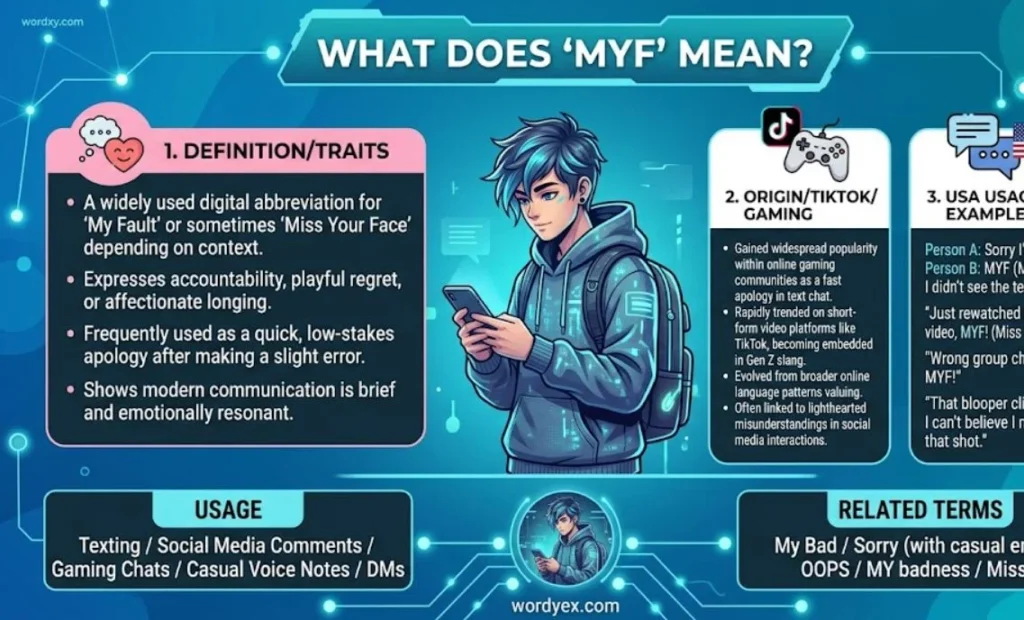
What is the MYF meaning in texting?
myf meaning, MYF stands for “Miss Your Face” in casual text messages, serving as a warm, affectionate shorthand to express that you miss someone deeply. In gaming circles and quick chats, it also acts as informal slang for “My Fault.”
Why do people use MYF in online conversations?
- Instant affection: Replaces traditional text greetings with a warm, personal term of endearment for close friends and family.
- Low-stakes accountability: Offers a quick, two-second digital apology during gaming or fast-paced group texts.
- Platform-friendly shorthand: Fits naturally into short-form communication on TikTok, Instagram DMs, iMessage, and Snapchat.
What Does MYF Mean?
In modern American digital communication, MYF is an acronym most commonly decoded as “Miss Your Face”. It functions as a warm, cozy, and lighthearted term of endearment sent to friends, family members, or romantic partners when physical distance keeps you apart. It carries a playful emotional weight that feels more personal than a standard “I miss you.”
Alternatively, in gaming circles, fast-paced comment sections, and casual group chats, MYF stands for “My Fault”. In this context, it serves as a rapid-fire, low-stakes apology when someone makes a slight blunder, drops a game round, or misreads a message.
Why Modern Texting Driven by Slang Matters
Language moves at the speed of light across modern screens, and keeping up with evolving shorthand can feel like learning a second language on the fly. You are scrolling through TikTok comments, opening an Instagram DM, or looking at a group text, only to spot a random three-letter string like MYF. It instantly halts your reading flow. You pause and wonder whether someone is apologizing to you or sending you a sweet gesture.
Understanding these subtle digital cues isn’t just about knowing acronyms—it is about keeping your digital relationships smooth, genuine, and clear. Misinterpreting a warm gesture for an apology or vice versa can lead to awkward moments. Exploring current terms across platforms like Wordyex helps bridge that communication gap, keeping your everyday messaging effortless, natural, and up to date.
MYF – Quick Meaning
At its core, MYF delivers direct emotions in three short letters. It condenses long emotional statements into snappy messages that fit naturally into today’s fast-forward lifestyle.
- Primary Meaning: “Miss Your Face” (Used for affection, longing, and warmth)
- Secondary Meaning: “My Fault” (Used for quick accountability, casual apologies, and gaming errors)
- Tone: Friendly, affectionate, playful, or lighthearted
- Primary Platforms: iMessage, WhatsApp, TikTok, Instagram DMs, Snapchat
“Haven’t seen you all summer! MYF so much!”
“Ah, wrong group chat. MYF!”
“Counting down the days until coffee this weekend! MYF!”
Origin & Background
The phrase “miss your face” originally emerged in spoken American English in the early 2000s as a quirky, affectionate twist on the traditional “I miss you.” Instead of expressing a vague sentiment, highlighting someone’s “face” added a visual, physical grounding to the affection. It visualizes the actual person you are missing, making the statement feel infinitely warmer and more intimate.
As mobile phones shifted from physical T9 keypads to smartphone touchscreens, text compression took over. Users began shrinking three-word phrases into neat three-letter acronyms. On platforms like Tumblr, early Twitter, and SMS networks, “Miss Your Face” turned into MYF alongside staples like ILY (I Love You) and IMY (I Miss You).
In recent years, platforms like TikTok and online multiplayer gaming environments gave MYF a second life as “My Fault.” Streamers needed a way to type a quick “my fault” in fast chat screens without stopping their gameplay. Today, both meanings live side-by-side across American internet culture.
Real-Life Conversations
Seeing how MYF works in actual day-to-day scenarios shows how smooth and adaptable it can be across different relationship dynamics.
Text Message Between Best Friends
Maya: Hey girl! Just saw that cute sweater you posted. We need an emergency thrifting day soon!
Chloe: Omgg yes please! My schedule is finally opening up next week. MYF! 💖
Maya: MYF too! Let’s get coffee on Tuesday!
TikTok Comment Section
Jake: Bro really missed that entire easy shot at the end of the clip 💀
Tyler B: MYF man! My mouse slipped right when I clicked 😭
Jake: All good, we still got the win!
Instagram DM Between Couples
Lucas: Morning babe! Hope your presentation goes amazing today. Wish I was there to celebrate with you after!
Sophia: Thank you so much! Counting down the hours until Friday night. MYF so much! 🥹
Lucas: MYF more. You’re going to crush it!
WhatsApp Group Chat
David: Wait, did someone forget to send the location link for tonight’s dinner?
Ethan: Ah that was on me, I thought Alex sent it! MYF guys, dropping it here now 📍
David: Sweet, thanks!
Why is it Viral in American Culture?
American digital culture thrives on casual warmth paired with maximum efficiency. We want our digital interactions to feel deeply personal without typing out long, formal paragraphs every single time. MYF captures that sweet spot perfectly.
It breaks through the stiffness of everyday text communication. Sending “I miss you” can sometimes feel overly dramatic or heavy depending on the stage of a friendship. Dropping a quick “MYF” keeps things light, playful, and genuine. It communicates genuine care while maintaining a relaxed, casual vibe that fits right into daily texting habits.
Emotional & Psychological Meaning
From a psychological perspective, phrases like “miss your face” speak directly to human visual memory. When we miss someone, our brains do not just recall their name—we picture their expressions, their smile, and their presence. Saying “MYF” acknowledges that visual connection directly.
It reveals a broader modern trend in how we build emotional bonds online. In an era where much of our interaction happens through screen avatars, photos, and video calls, referencing someone’s face anchors the friendship back in real life. It tells the other person, “I miss the physical reality of hanging out with you.”
Think back to a time when you moved to a new city or started a busy job. A friend you used to see every week sends a brief text: “Hey! Busy month, but MYF!” That three-letter message instantly closes the distance gap. It reassures you that the bond remains strong, even when schedules get unbelievable.
Usage in Different Contexts
Understanding where MYF fits helps you use it naturally without creating confusing moments.
Social Media
On platforms like Instagram, TikTok, and Snapchat, MYF is frequently dropped in comment sections or posted under stories. It serves as a public or semi-public display of affection between friends reactivating a connection.
Friends & Relationships
This is where MYF shines brightest. It works exceptionally well with close friends, long-distance partners, family members you haven’t seen in a while, or romantic interests you are actively dating.
Work & Professional Settings
Keep MYF out of professional emails, Slack channels, or client communications. Even in casual workplaces, using shorthand like MYF can come across as overly informal or confusing to colleagues who aren’t familiar with current text lingo. Stick to clear, standard phrasing like “Hope you’re having a great week” instead.
Casual vs. Serious Tone
MYF is inherently casual. If someone is going through a difficult life event or a major hardship, skip the acronyms and write out a full, thoughtful message. Save MYF for upbeat, friendly, and affectionate check-ins.
When NOT to Use It
While MYF is versatile, there are key situations where dropping this abbreviation is inappropriate or misaligned with the room.
- Professional Inquiries: Do not use it with managers, clients, or recruiters.
- Serious Emotional Debriefs: Avoid using it when dealing with deep personal loss or serious conflicts where full words demonstrate true care.
- First-Time Acquaintances: Sending “MYF” to someone you met five minutes ago can feel a bit too forward or confusing.
- High-Stakes Apologies: If you made a serious error, typing “MYF” (as “My Fault”) comes across as dismissive rather than accountable. Write a proper apology instead.
Common Misunderstandings
The biggest point of confusion around MYF stems from its dual meaning. Because it can mean either “Miss Your Face” or “My Fault,” context is everything.
If someone sends a text saying, “Sorry for missing the call earlier, MYF,” they are taking responsibility, not declaring affection. Conversely, if someone writes, “Can’t wait for our trip next weekend, MYF!” they are expressing sweet anticipation.
Another common mistake is treating it literally. Nobody is implying they only miss your actual facial features—it is a playful figure of speech representing your whole personality and presence.
Slang Comparison
To see how MYF compares with similar digital expressions across texting platforms, take a look at this breakdown:
| Slang Term | Full Meaning | Primary Vibe | Best Used With |
| MYF | Miss Your Face / My Fault | Playful affection or casual ownership | Friends, partners, gamers |
| IMY | I Miss You | Direct, standard emotional check-in | Anyone close to you |
| LYMY | Love You, Miss You | High affection, warm and sweet | Close friends, family, partners |
| MYSM | Miss You So Much | Emphasized longing and care | Long-distance partners, besties |
| NBD | No Big Deal | Relaxed dismissal of an issue | Casual group chats, peers |
Key Insight: While terms like IMY offer a straightforward emotional statement, MYF adds a layer of warm intimacy and playful personality that makes digital messages feel far more human.
10 Variations and Related Slang Expressions
Digital slang constantly evolves into new combinations. Here are ten closely related variations you will run into online:
- MYF SF: “Miss Your Face So Much” — Adds extra emotional weight to your text.
- IMY: “I Miss You” — The classic, traditional standard for missing someone.
- IMYSM: “I Miss You So Much” — Used when standard missing just isn’t enough.
- LYMY: “Love You, Miss You” — Combines affection and longing in one quick line.
- MYSM: “Miss You So Much” — A direct, warm alternative to IMYSM.
- WYF: “Where’s Your Face?” — A playful ask demanding to video chat or hang out.
- SYF: “See Your Face” — Used when planning an upcoming meetup (“Can’t wait to SYF!”).
- MB: “My Bad” — The classic equivalent to the secondary meaning of MYF.
- TFY: “Thinking Of You” — A gentle, caring phrase used during quiet moments.
- HYB: “How You Been?” — A natural follow-up phrase often paired with MYF.
How to Respond When Someone Uses It
Getting a text with MYF is a great sign that someone cares about you or values keeping things clear and friendly. Here is how to reply depending on the vibe you want to set:
Casual Replies
- “MYF too! We need to catch up properly soon!”
- “Aww, MYF! How have you been?”
- “Same here! Let’s get food this week!”
Funny Replies
- “My face misses you too! It’s been sitting here waiting for coffee.”
- “I know, my face is pretty hard to forget 😎 Miss you!”
- “Sending a selfie right now so you don’t forget it!”
Mature Replies
- “Thank you! I’ve been thinking about you as well. Let’s set aside time to connect soon.”
- “I really appreciate that. Hope life has been treating you well lately!”
Respectful Replies (If used as “My Fault”)
- “No worries at all, all good!”
- “You’re fine, don’t sweat it!”
- “All good, thanks for letting me know!”
Regional & Cultural Usage
The way MYF is used varies across different cultures, regions, and generations.
Western Culture
In North America and parts of Western Europe, personal expression in informal texts is highly valued. Acronyms like MYF fit comfortably into daily language because affectionate, direct communication among peers is common and encouraged.
Asian & Middle Eastern Cultures
In many Asian and Middle Eastern cultures, direct warmth is often shown through actions, hospitality, or thoughtful gestures rather than abbreviated text phrases. While younger generations in urban hubs adopt western text lingo readily, standard expressions or polite phrasing are still preferred in broader communication.
Global Internet Usage
Across international English-speaking online spaces, MYF is widely understood within social media communities. Gaming servers, international TikTok circles, and fandom groups use it as a universal shorthand to maintain fast-paced, friendly connections.
Generational Differences (Gen Z vs. Millennials)
Millennials were instrumental in popularizing “Miss Your Face” during the early days of texting and social media. Gen Z continues to use it, but they also frequently lean into the “My Fault” meaning in gaming environments, livestreams, and quick text exchanges.
Is It Safe for Kids?
Yes, MYF is completely safe for children, teens, and young adults. It contains zero vulgarity, hidden double meanings, or inappropriate connotations. It is a clean, positive expression of affection or a polite acknowledgment of a quick mistake. Parents can feel completely comfortable seeing their kids use or receive this shorthand in texts and group chats. To verify official language resources and linguistic standards, you can always consult reputable references like the Library of Congress.
FAQs
What does MYF stand for in text messages?
MYF primarily stands for “Miss Your Face,” used to show affection to friends or loved ones. It can also mean “My Fault” in casual or gaming chats.
Is MYF a romantic term?
It can be romantic, but it is overwhelmingly used between close friends and family members. It expresses affection without necessarily being flirtatious.
How do you pronounce MYF out loud?
People rarely say “MYF” out loud as a single word. Instead, they read it out as its full phrase, saying “Miss your face,” or spell out the individual letters: M-Y-F.
Is MYF still popular in 2026?
Yes, MYF remains a popular shorthand across texting platforms, Instagram DMs, TikTok comments, and casual online games.
What is the difference between IMY and MYF?
IMY stands for “I Miss You,” which is standard and direct. MYF stands for “Miss Your Face,” which feels more informal, warm, and playful.
Can MYF mean something professional?
In specific aviation contexts, MYF is the IATA airport code for Montgomery Field in San Diego. However, in daily text messages, it almost always refers to “Miss Your Face” or “My Fault.”
Final Thought
Navigating modern text slang doesn’t have to feel like decoding a secret cipher. Acronyms like MYF are small emotional bridges designed to bring people closer together in an increasingly fast digital landscape. Whether you are sending a warm check-in to an old friend or dropping a quick note in a group chat, using MYF keeps your communication authentic, relaxed, and deeply human. Next time someone you care about pops into your head, drop them a quick text—they will love seeing it.