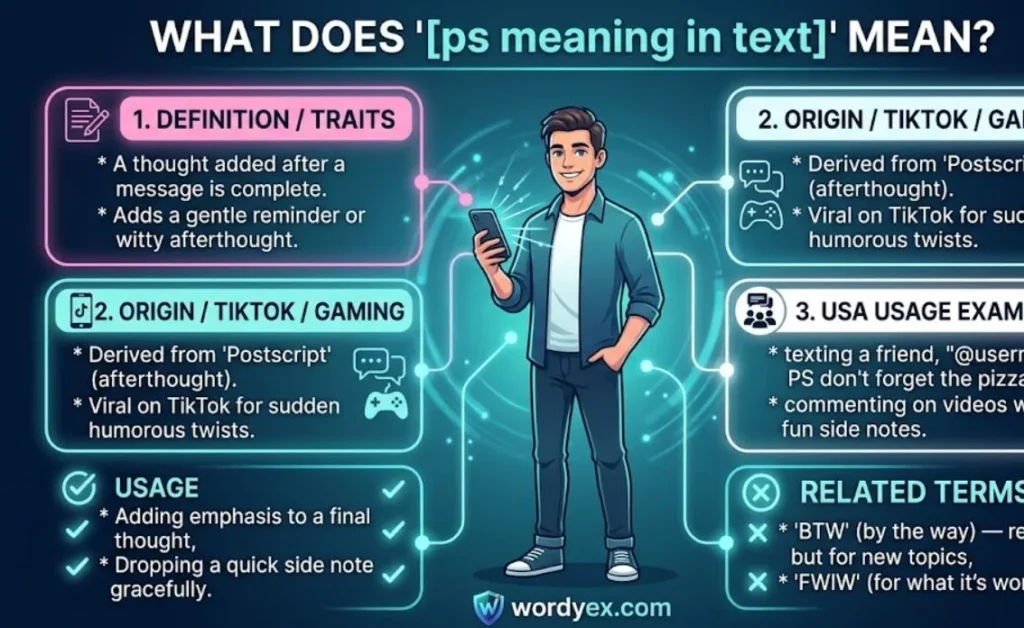
What does PS mean in text?
ps meaning in text, PS stands for postscript (from Latin postscriptum, meaning “written after”). In text messaging, social media, and emails, this shorthand indicator marks a short afterthought, witty side note, or key reminder added at the end of a completed message.
Why use PS in digital communication?
- Captures immediate attention: Readers naturally scan the bottom of messages, making a postscript ideal for highlighting critical updates or deadlines.
- Adds personality and tone: Serves as a digital aside for jokes, side comments, or soft follow-ups without restructuring your main text.
- Saves time: Allows you to tack on extra thoughts cleanly instead of editing or rewriting previous paragraphs.
What Does PS Mean?
PS in digital communication stands for Postscript, which comes from the Latin phrase postscriptum, meaning “written after”. In text messages, social media posts, and emails, PS is used to add an extra thought, a key reminder, a witty side note, or a final call to action after the main message is complete.
Strong Introduction
Have you ever been scrolling through a text thread, reading an Instagram caption, or opening a work email and spotted a quick “PS” right at the bottom? You probably knew instinctively that it meant “one last thing,” but if you’ve ever paused to wonder why we still use this traditional phrase in a world dominated by instant messaging and backspace buttons, you are not alone.
People frequently search for the true meaning of PS today because digital habits have transformed how we communicate. Decades ago, if you forgot a crucial detail while writing a letter by hand, you couldn’t just tap a screen to insert a new line—you had to tack on a postscript at the bottom. Today, even though we can edit our messages instantly, PS remains wildly popular across TikTok, iMessage, and corporate email threads. It resolves the problem of wanting to emphasize a point without cluttering the main message, giving your final sentence a sudden burst of focus and personality.
PS – Quick Meaning
At its core, PS acts as a visual signpost saying, “Hey, don’t miss this!” It isolates a thought from the main body of text to ensure the recipient pays special attention to it.
- Primary Definition: An added sentence or short paragraph placed at the end of a message to highlight an afterthought, joke, or important update.
- Purpose: To grab attention, change the tone, add humor, or deliver a gentle reminder without rewriting the rest of the text.
- Format: Written as PS, P.S., or PS: at the bottom of a message.
“Sounds good, see you at 7 PM! PS: Bring your jacket because it’s freezing outside.”
“Thanks for sending over the project files! P.S. The new designs look incredible.”
“I’ll grab the coffee on my way over. PS Don’t forget to feed the cat!”
Origin & Background
The history of PS stretches back over five centuries, long before smartphones or personal computers existed. The abbreviation originates from the Latin term postscriptum—where post means “after” and scriptum means “written”. In the 1500s, when ink on paper was the only form of distant communication, writing a letter was a permanent, meticulous process. If a writer finished their signature and suddenly remembered an important detail, rewriting the entire parchment was impractical and expensive. Adding a “PS” at the very bottom allowed them to append extra information cleanly.
As communication transitioned to modern messaging, PS evolved from a functional necessity into a powerful stylistic tool. On platforms like TikTok, X (formerly Twitter), and Instagram, users no longer need PS to correct forgotten details—they use it intentionally for dramatic effect, dry humor, or secondary callouts. What started as a mechanical workaround for quill-and-ink writers is now one of the internet’s favorite ways to deliver a punchline or highlight an essential takeaway.
Real-Life Conversations
Here is how people across the USA naturally use PS in daily digital conversations:
Scenario 1: WhatsApp Chat
John: Hey man, are we still meeting up for gym at 6?
Tony: Yeah, I’m heading out now.
John: Cool, see you in 10!
Tony: PS: Don’t forget your lifting straps this time haha.
Scenario 2: Instagram DM
Sarah: Thanks for sending that recipe! I made it for dinner tonight and it turned out amazing.
Emma: Yay! I’m so glad you liked it!
Sarah: P.S. Your dog in the background of that story was hilarious today 😭
Scenario 3: TikTok Comments
Marcus: The transition in this video is out of control, how long did this take to edit?
Creator: Took about 4 hours in total!
Marcus: Worth every second! PS what song is playing in the background?
Scenario 4: Casual Text
Chloe: I left the house keys on the kitchen counter for you.
Alex: Got them! Thanks Mom.
Chloe: You’re welcome! PS: Please do the dishes before you leave for practice!
Why Is It Viral?
In modern American culture, PS remains constantly relevant because of how our brains process information online. Eye-tracking and digital reading studies show that online readers tend to skim through long bodies of text, but their eyes naturally land on two places: the opening lines and the postscript at the very end. Creators, marketers, and daily texters leverage this psychological habit to make sure their most humorous or vital point doesn’t get buried.
Emotional & Psychological Meaning
Using PS in text messaging communicates a unique psychological layer that regular prose lacks. When you place a thought behind a PS, you subtly signal to the reader that this specific piece of information sits outside the main conversation—making it feel more intimate, urgent, or playful.
It acts as a digital “aside,” similar to an actor turning to speak directly to the audience on stage. It can soften a direct request, add warmth to a brief response, or deliver a dry sarcastic remark without ruining the tone of the preceding text.
I remember texting a colleague last year to confirm a schedule change for a major presentation. The text was formal and professional, but at the end, I added: “PS: I owe you a coffee for spotting that slide typo!” That single line instantly stripped away the rigid corporate tone and built real workplace rapport. That is the psychological magic of PS—it creates human connection in an otherwise cold digital space.
Usage in Different Contexts
| Context | Purpose of PS | Tone |
| Social Media | Highlighting a side joke, asking a question, or linking a product | Casual, energetic, engaging |
| Friends & Dating | Flirting, gentle teasing, or dropping an unexpected detail | Playful, affectionate, lighthearted |
| Professional Emails | Emphasizing deadlines, attached files, or secondary reminders | Polite, structured, focused |
| Family Texts | Adding last-minute household updates or affectionate notes | Practical, warm, direct |
When NOT to Use It
While PS is extremely versatile, there are specific situations where using it can backfire or seem inappropriate:
- Delivering Bad News: Never put critical or sensitive news in a postscript (e.g., “Thanks for dinner! PS: I think we should break up”). It makes serious topics feel trivial or dismissive.
- Overly Formal Documents: In legal contracts, formal academic papers, or official policy documents, use proper structural paragraphs or addendums instead of informal abbreviations.
- Excessive Repetition: Stacking multiple postscripts (PS, PPS, PPPS) in a standard text message can make your writing look disorganized or chaotic.
- Critical Safety Warnings: If information affects immediate physical safety, put it at the very top of your message where it cannot be missed.
Common Misunderstandings
The most frequent misunderstanding surrounding PS is that people assume it means “Personal Statement” or “Please See.” While those guesses sound logical, the official Latin definition remains postscriptum (“written after”).
Another common point of confusion is how to handle a second postscript. Many modern texters mistakenly write PSS (thinking it means “Post Script Script”), but the grammatically correct form is PPS, which stands for post-postscriptum (“after the postscript”).
Comparison Table
| Term / Expression | Meaning | Best Used For |
| PS (Postscript) | An added thought at the end of a message | Highlighting a key point or funny note |
| PPS (Post-Postscript) | A secondary thought added after the first PS | Adding a second afterthought playfully |
| Btw (By the way) | Changing the subject or adding related info | Inserting extra context mid-conversation |
| FYI (For your information) | Sharing useful details without needing a reply | Informational updates in work or life |
Key Insight
Understanding the distinction between these expressions allows you to guide the reader’s attention smoothly, ensuring your messages feel structured yet completely natural. If you want to expand your knowledge of modern digital shorthand, check out our detailed guide on internet abbreviations at WordyEx to master modern language seamlessly.
Variations / Types of PS
Depending on how and where you write, PS appears in several standard variations:
- P.S. — The traditional format with periods, commonly preferred in formal writing and US style guides.
- PS — The modern, streamlined version without periods, widely used in texts and casual emails.
- PS: — Formatted with a colon to immediately lead into a clear call-to-action or reminder.
- PPS — Post-postscript, used when you have a second thought following your initial PS.
- PPPS — Post-post-postscript, occasionally used in humorous or dramatic long-form messages.
- PS. — A hybrid style occasionally seen in fast mobile texting.
- ps — Lowercase variant popular in ultra-casual Gen Z text conversations.
- P.S… — Written with an ellipsis to build suspense before dropping a secret or joke.
- #PS — Used as a social media hashtag to anchor a postscript note on public posts.
How to Respond When Someone Uses It
When someone drops a PS in your inbox, here is how you can tailor your response based on the mood:
- Casual Replies: “Haha got it, thanks for the reminder!” or “Good catch, see you soon!”
- Funny Replies: “PS: I was already planning on doing that anyway 😜” or “PPS: You forgot to answer my first question!”
- Mature Replies: “Thank you for pointing that out, I’ve noted it down.”
- Respectful Replies: “Appreciate the heads up! I’ll make sure that gets taken care of right away.”
Regional & Cultural Usage
While PS is globally recognized, cultural and regional nuances dictate how it gets used:
- Western Culture (USA & UK): Extremely common across both personal and professional communication. In American marketing and business correspondence, PS is heavily utilized to boost conversion rates and highlight core offers.
- Asian Culture: Frequently used in English digital communications across tech hubs. In professional settings, it is treated with higher formality compared to casual US texting.
- Middle Eastern Culture: Commonly adopted in bilingual English-Arabic digital chats, serving as a clean way to separate secondary notes from primary translated text.
- Generational Differences (Gen Z vs. Millennials): Millennials often use P.S. with traditional punctuation in emails and texts. Gen Z tends to write ps in all lowercase without punctuation, treating it as an aesthetic text-flourish or a sarcastic tag at the end of TikTok captions.
Is It Safe for Kids?
Yes, PS is 100% safe for kids, teenagers, and users of all ages. It is a purely functional literary abbreviation with zero inappropriate, offensive, or explicit connotations. Parents and educators can comfortably encourage young writers to use it in both digital chats and school writing assignments. To learn more about standard English abbreviations, you can review the authoritative guidelines provided by the Merriam-Webster Dictionary.
FAQs
What does PS mean in text messages?
In text messages, PS stands for “Postscript”. Texters use it to add a quick afterthought, side note, or important reminder at the end of a message.
Is it PS or P.S.?
Both formats are correct. “P.S.” is traditional and preferred in formal writing, while “PS” is the modern standard for fast digital communication and texting.
What comes after PS if I have another thought?
If you want to add another note after your first PS, write PPS, which stands for post-postscriptum. Avoid writing “PSS,” as that is grammatically inaccurate.
Can I use PS in a professional email?
Yes! PS is widely accepted in business emails as long as the tone remains polite. It is an effective way to highlight a deadline or attach an essential file link.
Does PS mean “Public Announcement” or “Personal Statement”?
No, those are common misconceptions. In written communication, PS always derives from the Latin postscriptum (“written after”).
Final Thought
Language is constantly shifting, but the endurance of PS proves that great communication tools never truly go out of style. Whether you are typing out a quick text to a friend, posting a recap video on social media, or finalizing a work email, using a postscript gives your words structure, emphasis, and personality. Don’t be afraid to drop a clean “PS” into your next conversation—it is a timeless, confident way to make sure your most important thoughts get the spotlight they deserve!