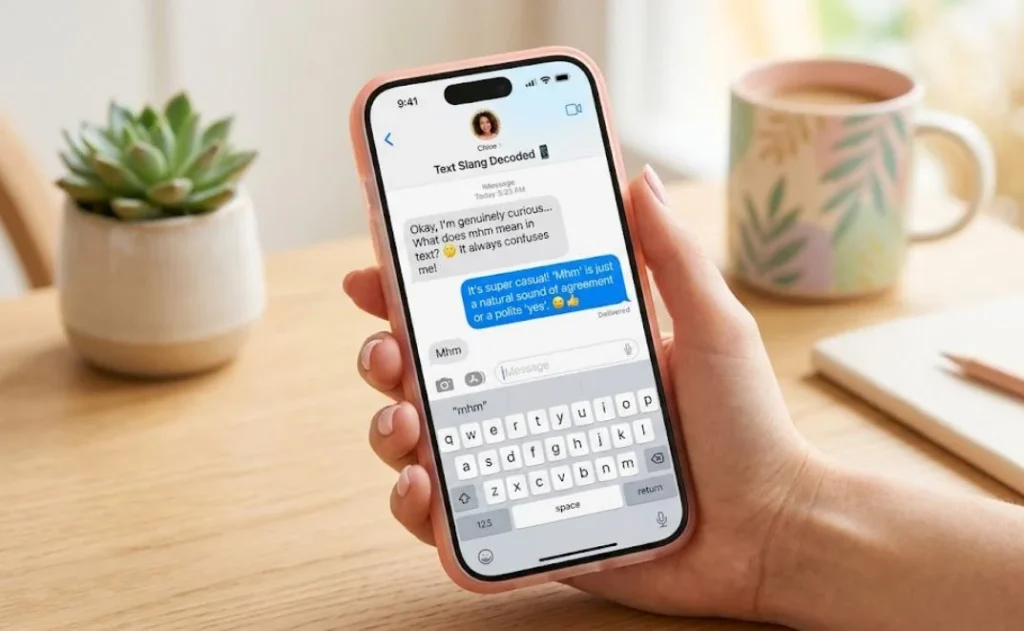
Decoding What “Mhm” Means in Your DMs
what does mhm mean in text, We’ve all been there. You send a long, thoughtful message, perhaps sharing a bit of your soul or a detailed plan for the weekend, and the response you get back is a three-letter wall: “Mhm.”
It feels heavy and light at the same time. Is it a brush-off? Is it a supportive nod? In the fast-paced world of digital communication, where tone of voice is replaced by character counts, “mhm” has become one of the most versatile, and occasionally frustrating—terms in our vocabulary.
Understanding what “mhm” means in text isn’t just about a dictionary definition; it’s about reading the digital room. People search for this because the emotional stakes of a text conversation often hinge on these tiny, non-verbal fillers.
Whether you’re navigating a new crush or a group chat with friends, knowing the nuance behind these three letters can save you from a lot of unnecessary “overthinking.”
What Does Mhm Mean in Text – The Quick Meaning
At its core, mhm is the digital equivalent of a hummed “yes” or a physical nod. It is a paralinguistic affirmation—a sound we make to show we are listening without interrupting the flow of the conversation.
- Agreement: A casual way to say “yes” or “I agree.”
- Acknowledgement: Letting the sender know you’ve read and understood the message.
- Confirmation: Validating a statement or a fact.
Real-World Snippets:
- “Are we still meeting at 8?” — “Mhm, see you then!”
- “That movie was way too long, right?” — “Mhm. Totally dragged in the middle.”
Origin & Background
“Mhm” didn’t start on a smartphone. It’s an onomatopoeia—a word that phonetically imitates a sound. Long before the internet, humans used this low-frequency hum in face-to-face conversations to provide “backchanneling.” This is a linguistic term for the little noises we make to prove we haven’t zoned out while someone else is talking.
As we moved from rotary phones to AOL Instant Messenger and eventually to WhatsApp and TikTok, “mhm” migrated with us. On social media, its meaning has evolved from a simple “yes” to a tool for expressing everything from deep empathy to “I’m bored, please stop talking.” It’s a staple of Gen Z and Millennial digital dialect because it mimics the rhythm of real human speech better than a formal “Yes.”
Real-Life Conversations
To truly get a feel for the “vibe” of this word, let’s look at how it plays out in different digital environments.
The WhatsApp Plan-Maker
- Person A: “I was thinking we hit the taco spot first, then maybe grab drinks at that rooftop bar?”
- Person B: “Mhm, sounds like a solid plan.”
The Instagram DM Deep-Dive
- Person A: “I feel like she’s been acting really distant lately, like she’s mad but won’t say why.”
- Person B: “Mhm… I’ve noticed that too. It’s super awkward.”
The TikTok Comment Thread
- User 1: “This recipe is life-changing if you add extra garlic.”
- User 2: “Mhm 👏 facts.”
The Casual Text Check-in
- Person A: “You still coming over tonight?”
- Person B: “Mhm.”
Emotional & Psychological Meaning
Psychologically, “mhm” is a “low-effort, high-signal” response. When we use it, we are choosing to maintain the connection without taking over the spotlight. It expresses attentiveness. In a world where everyone is waiting for their turn to speak, a well-placed “mhm” signals that you are actually holding space for the other person’s thoughts.
However, there is a subtle power dynamic involved. Because it’s so short, it can sometimes feel dismissive. If someone is used to high-energy responses (“YES!! OMG!”), a simple “mhm” can feel like a cold shower.
The Personal Scenario: I remember texting a friend about a major career win. I sent a paragraph of excitement, and he replied with “Mhm, nice.” My heart sank. I thought he was jealous or bored. Later, over coffee, I realized he was just exhausted and typing with one hand while holding a grocery bag. This taught me that “mhm” is often a reflection of the receiver’s current environment, not necessarily their feelings toward the sender.
Usage in Different Contexts
Social Media
On platforms like TikTok or X (Twitter), “mhm” is often used as a “period” at the end of a point. It’s the digital “And that’s that.” It’s frequently paired with emojis to clarify the mood.
Friends & Relationships
This is where it gets tricky. Between close friends, it’s shorthand for “I’m with you.” In romantic contexts, use it carefully. A “mhm” during an argument can be seen as “fine, whatever,” which is a one-way ticket to a bigger fight.
Work / Professional Settings
Generally, avoid “mhm” in professional emails or Slack channels with supervisors. It can come across as too casual or even lazy. Stick to “Yes,” “Confirmed,” or “That works for me.”
Casual vs. Serious Tone
In a casual chat, “mhm” is breezy. In a serious conversation about feelings, it can serve as a supportive “I hear you, please continue,” acting as a psychological safety net for the speaker.
When NOT to Use It
There are moments when “mhm” is the wrong tool for the job.
- During a Crisis: If a friend is sharing something tragic, “mhm” is far too brief. It lacks the warmth needed for true empathy.
- Formal Requests: If your boss asks, “Can you finish the report by 5?”, replying with “mhm” is risky. It lacks the definitive “will do” that professional accountability requires.
- When Clarity is Needed: If someone asks a complex “either/or” question, “mhm” creates confusion. “Do you want pizza or sushi?” — “Mhm” helps no one.
- Cultural Sensitivity: In some high-context cultures, brevity is seen as a lack of respect.
For more deep dives into how we talk today, check out our guide on internet slang meanings to keep your vocabulary sharp.
Common Misunderstandings
The biggest mistake people make is reading “mhm” as a sarcastic “sure.” While it can be sarcastic, it usually isn’t. The confusion stems from the lack of “prosody”—the rhythm and pitch of our voice.
Another misunderstanding is the “Mhm vs. Mm-mm” confusion. In text, “mhm” is positive. “Mm-mm” is negative. Missing a single ‘h’ can change your “yes” to a “no,” which is why paying attention to the spelling matters more than you might think.
Comparison Table: The “Yes” Spectrum
| Expression | Meaning | Vibe |
|---|---|---|
| Mhm | Agreement / Listening | Casual & Neutral |
| Yup/Yep | Stronger Confirmation | Cheerful & Active |
| K | Acknowledged | Dismissive / Brief |
| Sure | Reluctant Agreement | Passive |
| Totally | Enthusiastic Agreement | High Energy |
Export to Sheets
Key Insight: While “mhm” is the most neutral form of agreement, its power lies in its invisibility. It keeps the conversation moving without adding unnecessary noise.
Variations & Types of “Mhm”
- Mhmm: The extra ‘h’ adds a layer of warmth or “I’m really listening.”
- Mhm…: The ellipsis suggests hesitation or that you’re thinking about it.
- Mhm!: The exclamation mark turns a passive nod into an active “I totally agree!”
- Mhm?: Used as a question, meaning “Is that so?” or “Go on?”
- Mh-hm: A more rhythmic version, often used to mirror the spoken sound exactly.
- Mmm-hmm: Emphasizes that you are considering the information deeply.
- Mhm k: A slightly sassier version, often indicating you agree but aren’t thrilled.
- MHM: All caps indicates strong, loud agreement or “Preach!”
How to Respond When Someone Uses It
If you get a “mhm” and aren’t sure where to go next, try these:
- Casual: “Cool, so then I was thinking…” (Just keep the story going).
- Funny: “Wow, don’t say too much at once! 😂”
- Mature: “I know that was a lot to take in, let me know what you think when you’ve had a second.”
- Respectful: “Thanks for listening. It means a lot to vent.”
Regional & Cultural Usage
- Western Culture: Predominantly used as a neutral “backchannel” or casual “yes.”
- Asian & Middle Eastern Cultures: While “mhm” is understood globally due to American media, traditional etiquette often favors more explicit verbal cues of respect (like “Yes, I understand”) over informal hums.
- Generational Divide: Gen Z uses “mhm” almost like a punctuation mark. Millennials might use it more sparingly. To a Boomer, receiving a “mhm” might feel like the digital equivalent of being ignored.
According to Oxford Languages, the evolution of such onomatopoeic fillers is a key part of how modern English adapts to digital-first environments.
Is It Safe for Kids?
Absolutely. “Mhm” is one of the safest terms on the internet. It carries no inherent profanity or inappropriate connotations. The only “danger” is the potential for a misunderstanding with a parent or teacher who might find the response a bit too informal for their liking.
FAQs
Does “mhm” mean “yes”? Yes, in 99% of cases, it is a casual way of agreeing or saying “yes.”
Is “mhm” rude? It depends on the context. If used as a one-word reply to a long, emotional message, it can feel dismissive. In a casual chat, it’s perfectly fine.
How is “mhm” pronounced? It’s pronounced exactly like it’s spelled—a two-syllable hum with the emphasis usually on the second “hm” (like uh-huh but with closed lips).
What is the difference between “mhm” and “uh-huh”? They are nearly identical. “Uh-huh” is slightly more vocalized, while “mhm” is a hummed version.
Should I use “mhm” in an interview follow-up? No. Stick to professional language like “I agree,” “Certainly,” or “That is correct.”
Conclusion
At the end of the day, “mhm” is a small word that does a big job. It bridges the gap between our spoken voices and our typed words, giving us a way to nod through the screen. While it can sometimes feel ambiguous, it’s usually a sign of a comfortable, low-pressure connection.
The next time you see those three letters pop up in your notifications, don’t panic. Take it as a sign that you’re being heard. And the next time you’re typing a reply, feel free to use it—just maybe throw in an emoji if you want to make sure your “yes” is felt as much as it is read. Use your digital voice with confidence!