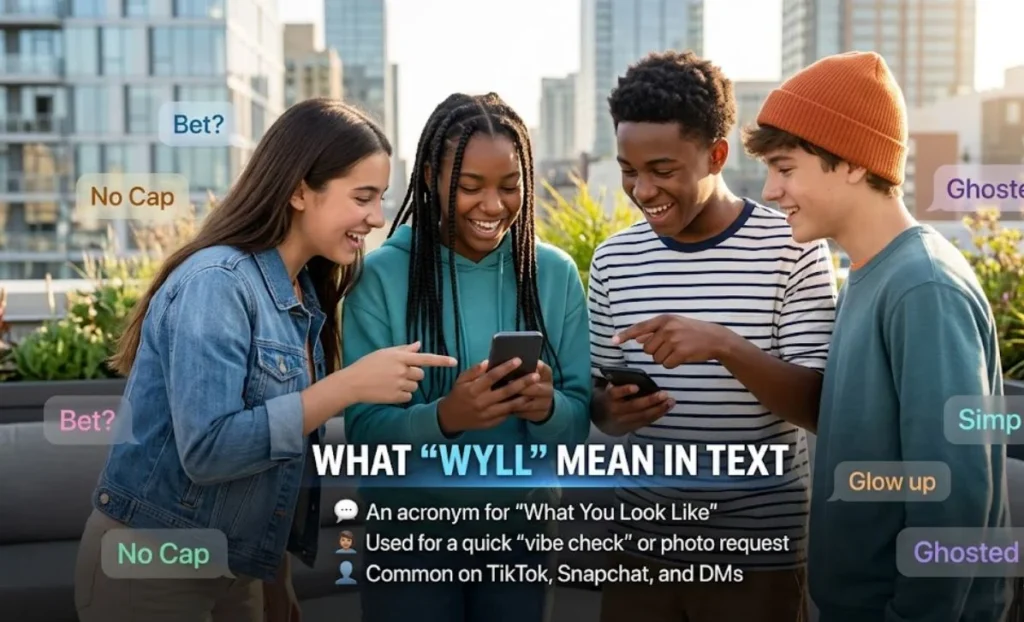
Decoding the Internet’s Favorite Personality Check
Have you ever been deep in a conversation on TikTok or Snapchat, only to have the other person drop a four-letter word that isn’t in the dictionary? Seeing “wyll” pop up in your notifications can feel like hitting a wall if you aren’t familiar with modern digital shorthand.
You might have stared at your screen wondering if it was a typo for “will” or a name you’d forgotten. Don’t worry; you aren’t falling behind.
The digital landscape moves fast, and keeping up with how we talk to each other is a full-time job.
People search for this term because it has become a fundamental “vibe check” in online interactions. It solves the confusion of anonymity, acting as a quick bridge between a faceless username and a real person.
What Wyll Mean in Text – Quick Meaning
At its core, wyll stands for “What You Look Like.”
It is a direct, no-frills request for a visual representation of the person on the other end of the chat. It isn’t just about vanity; it’s about establishing a physical presence in a digital space.
- The Request: “So, wyll?”
- The Goal: A selfie, a video, or even just a photo of your current outfit.
- The Vibe: Low-pressure, casual, and incredibly common in early-stage conversations.
“I’ve been talking to this guy from the comments for an hour and finally asked, ‘wyll?'”
“He sent me a ‘wyll’ text, so I had to find a mirror immediately.”
Origin & Background
The term “wyll” didn’t come from a textbook; it evolved in the fast-paced ecosystems of Snapchat and TikTok around 2023. As video-sharing became the primary way we communicate, text-based descriptions of ourselves started to feel outdated.
Historically, we’ve always had ways to ask this. In the early days of the internet, people used “A/S/L” (Age/Sex/Location). Later, it became “Send a pic?” But “wyll” is different. It’s softer and more integrated into the “aesthetic” culture of Gen Z.
The shift from “will” to “wyll” is a classic example of linguistic branding. By changing the spelling, users created a specific, un-searchable term that belongs strictly to social media culture. It signifies that you are part of the “in-group” who understands current trends.
Real-Life Conversations
To truly understand the weight of this term, you have to see it used in context. These aren’t just words; they are social cues.
The Instagram DM Interaction
Person A: “I really love your taste in music. That last story was fire.”
Person B: “Thanks! I’ve been obsessed with that album lately.”
Person A: “Same. Anyway, wyll? I feel like we’d vibe.”
Person B: (Sends a casual mirror selfie with a peace sign)
The TikTok Comment Thread
Person A: “I’m literally the main character in this scenario.”
Person B: “Big claims! Wyll though? Prove the energy.”
Person A: “Go check my page, I just posted a fit check.”
The Late-Night Text Message
Person A: “I’m so bored, just sitting here watching Netflix.”
Person B: “Wyll? Show me the cozy setup.”
Person A: (Sends a photo of their feet on the coffee table with the TV in the background)
The Snapchat Quick-Add
Person A: “Added you from the search.”
Person B: “Cool. Wyll? Don’t want to talk to a ghost.”
Person A: (Sends a quick snap of their face)
Emotional & Psychological Meaning
There is a fascinating layer of psychology behind “wyll.” It’s an expression of digital curiosity. In an era where we can be anyone online, asking “wyll” is a search for authenticity. It reveals our innate human need to connect a voice to a face.
When someone asks “wyll,” they are often testing the waters of a relationship. It expresses a desire to move from “abstract chat” to “concrete connection.” It’s a moment of vulnerability for the person being asked—you are stepping out from behind the curtain.
I remember talking to a fellow writer for weeks before they asked “wyll.” Even as a communication expert, I felt that tiny spark of nerves. It reminded me that despite all our technology, we still just want to be seen and recognized by the person on the other side.
Usage in Different Contexts
Social Media:
On platforms like TikTok and Instagram, it is almost mandatory. It’s used to build a following, verify identities, and engage with “mutuals.” It’s the primary way people initiate “face reveals.”
Friends & Relationships:
Among friends, it’s a way to share a moment. If you say you’re at a concert, a friend might reply “wyll” to see your outfit or your view. In dating, it’s the standard “vibe check” before a first date.
Work & Professional Settings:
Strictly avoid this. Using “wyll” in a professional Slack channel or email is a major faux pas. It is far too intimate and casual. In a work setting, use “Would you mind sharing a headshot?” or “Can we jump on a brief video call?”
Casual vs. Serious Tone:
In a casual tone, “wyll” is playful. In a more serious conversation, it can come across as shallow if timed poorly. If someone is sharing something deep, don’t interrupt with “wyll.”
When NOT to Use It
Context is everything. You should avoid using “wyll” if:
- The conversation is professional: It will make you look immature.
- The other person is distressed: It shows a lack of empathy.
- You’ve never spoken before: Sending a “wyll” as an opening line is often seen as “creepy” or overly demanding.
- Cultural Sensitivity: In some conservative cultures, asking for a photo of a stranger is considered highly disrespectful.
Common Misunderstandings
The most common mistake is the “Literal Confusion.” Many people think the person is asking “Will?” as in a future action. This leads to awkward exchanges like:
Person A: “Wyll?”
Person B: “Will I what?”
There is also a Tone Confusion. Some people take “wyll” as a demand for a “hot” photo, when usually the asker just wants to see a normal, everyday version of you. It’s about identity, not necessarily a beauty pageant.
If you are looking to improve your overall digital vocabulary and avoid these pitfalls, checking out more guides at Wordyex can help you navigate the ever-changing world of modern English.
Comparison Table
| Term | Meaning | Context |
| Wyll | What you look like | Quick, casual, personality-driven |
| Fit Check | Show the outfit | Fashion and style focused |
| Face Reveal | Showing face for the first time | Often used by creators or gamers |
| A/S/L | Age/Sex/Location | Ancient internet history (Avoid using) |
| PFP | Profile Picture | Refers to the static icon on an account |
Key Insight: While “wyll” is a question, it functions more like a social invitation. It invites the other person to share a piece of their reality, making the digital space feel a little more human and a little less like a screen.
Variations & Types
- Wyll?: The standard curiosity check.
- Wyll rn: “What do you look like right now?” (Asking for a candid photo).
- Wyll in that: Asking to see you wearing a specific item of clothing.
- Wyll today: Seeing your look for a specific event or day.
- Wyll IRL: Asking for an unedited, real-life photo rather than a filtered one.
- Wyll lowkey: A shy way of asking for a photo.
- Wyll? (Video version): Often implies wanting a short video clip instead of a photo.
- Wyll for the group: Asking a new member of a group chat to introduce themselves visually.
How to Respond When Someone Uses It
The Casual Reply:
“Just me in my pajamas with a coffee. [Attach Photo]”
The Funny Reply:
“Imagine a very tired raccoon. That’s the vibe today.”
The Mature Reply:
“I’m not really comfortable sharing photos yet, but I’m enjoying the chat!”
The Respectful Reply:
“Here’s a snap from my hike earlier! Your turn—wyll?”
Regional & Cultural Usage
Western Culture:
In the US, UK, and Australia, it is a staple of Gen Z communication. It’s treated with a high degree of informality.
Global Internet Usage:
Because of the dominance of English-speaking social media, “wyll” has spread to non-English speaking countries, particularly among gamers on Discord and fans on Twitter (X).
Generational Differences:
- Gen Z: Uses it as naturally as breathing.
- Millennials: Often find it a bit blunt and prefer “Do you have a photo?”
- Gen Alpha: Already starting to create their own variations of the term.
Is It Safe for Kids?
“Wyll” is not a “bad word,” but it is a tool for sharing images. For parents, the concern shouldn’t be the word itself, but the context.
If a child is being asked “wyll” by a stranger, it is a red flag. It’s important to teach kids that they should only share photos with people they know in real life and that they are never “mean” for saying no to a photo request.
FAQs
Q: Is “wyll” a typo for “will”?
A: No. While it looks similar, it is a specific acronym for “What You Look Like.”
Q: Why do people use this instead of just asking for a picture?
A: Digital language favors speed. “Wyll” is four letters; “What do you look like?” is 21 letters.
Q: Does “wyll” mean I have to send a nude photo?
A: Absolutely not. In 99% of cases, it just means a regular selfie or a “fit check.” If someone pressures you for more, that is a boundary issue, not a language one.
Q: Can I use “wyll” on a dating app?
A: Yes, but use it sparingly. It’s often better to ask a more creative question to show personality.
Q: What if I don’t want to send a photo?
A: Simply say, “I’m a bit camera shy today” or “I’d rather wait until we know each other better.”
Conclusion
At the end of the day, “wyll” is a small window into how we’ve changed as communicators. We crave connection, but we also value efficiency. By using a single word to ask “What you look like,” we are trying to find a middle ground between the coldness of a screen and the warmth of a face-to-face meeting.
Don’t be afraid of the slang. Embrace it as a way to understand the world around you a little better. Whether you choose to use it or not, knowing what it means gives you the confidence to navigate the digital world without hesitation.
Language is meant to connect us, not divide us. So the next time you see “wyll” pop up, take it for what it is: a simple, modern invitation to be seen.