What Does fw Mean?
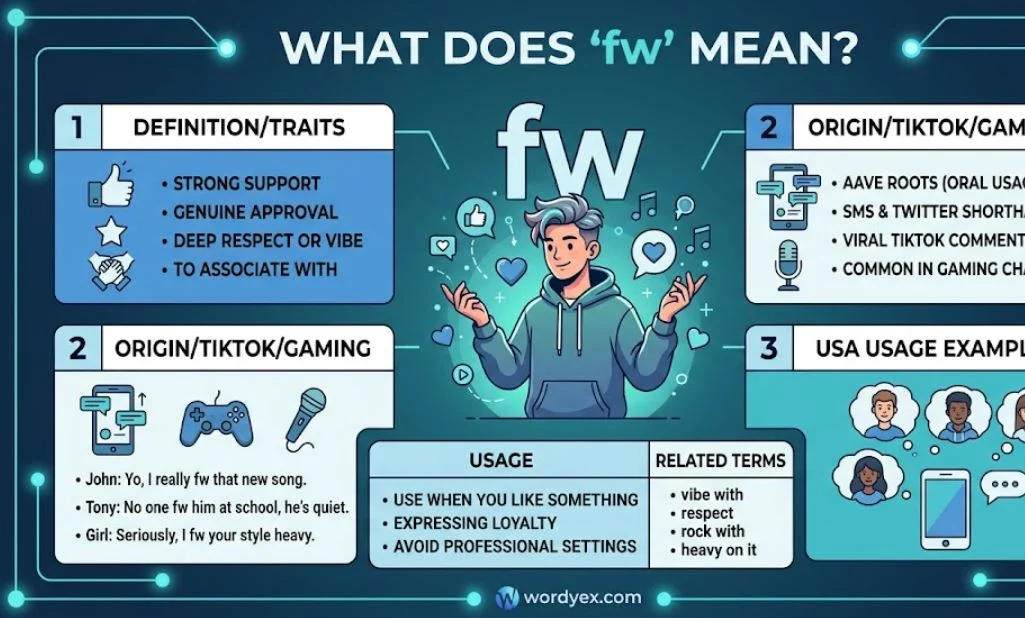
In modern text conversations and social media feeds, the abbreviation fw most commonly stands for the slang phrase “fuck with.” When someone uses this expression online, they are usually signaling that they strongly like, respect, support, or vibe with a particular person, song, fashion style, or idea.
Alternatively, depending on where you see it, the letters can also mean “forward” in a traditional email thread or business text environment. For the vast majority of trending social media conversations, however, it serves as a quick shorthand to express genuine appreciation or social alignment.
Strong Introduction
Digital communication moves at a breakneck pace, and staying caught up with the latest vocabulary can sometimes feel like trying to decode a completely foreign language. If you have recently spotted the lowercase initials popping up in your Instagram direct messages, TikTok comment sections, or family group chats, you are far from alone in wondering what is going on.
People frequently search for this specific term because its literal interpretation sounds vastly different from how it functions in everyday digital culture. The phrase sounds inherently aggressive or confrontational to the uninitiated, which creates a massive hurdle for parents, older professionals, or anyone trying to navigate modern social dynamics without causing a misunderstanding.
By unpacking this short acronym, you solve the persistent confusion between professional messaging etiquette and raw urban slang. Understanding this nuance allows you to read between the lines of internet subcultures, ensuring you never misinterpret a genuine compliment as an insult or a professional request as casual banter.
fw – Quick Meaning
At its core, this trending term is a versatile piece of vocabulary that changes shapes based entirely on who is typing it. In casual spaces, it means you approve of something or find someone highly relatable.
- It means to deeply enjoy, resonate with, or support an individual, brand, or creative piece of media.
- It can mean to hang out with, associate with, or actively include someone in your social circle.
- In negative contexts, it indicates a total refusal to engage with or tolerate certain behaviors.
- In professional corporate environments, it indicates a forwarded email or text thread.
“I really fw the new album she dropped last night, the production is absolutely insane.”
“Don’t fw him today, he had a terrible morning and needs some space.”
“FW: Updated Q3 Marketing Strategy and Budget Adjustments.”
Origin & Background
While it might seem like this expression materialized overnight on short-form video platforms, its roots actually stretch deep into the history of American regional speech and early internet culture. The un-abbreviated phrase has been a staple of African American Vernacular English for decades, long before smartphones existed. In its original oral form, it carried heavy cultural weight, representing a seal of authenticity, street respect, or deep communal alignment.
As cell phones took over the world and character limits forced typing shortcuts, the phrase naturally condensed into two letters during the early days of Twitter and SMS messaging. It gave users a quick way to bypass profanity filters while retaining the exact emotional punch of the original phrase.
The explosion of algorithmic feeds on platforms like TikTok and Instagram pushed the acronym directly into global internet usage, turning a localized piece of dialect into a universal standard for digital approval. Today, it has evolved from underground music circles straight into the mainstream vocabulary of high schoolers and college students across the United States.
Real-Life Conversations
To fully grasp how seamlessly this term integrates into daily American life, it helps to see it deployed across various messaging platforms.
Marcus A: Yo, are you going to invite Liam to the pickup game this weekend?
Julian B: Yeah, for sure. I really fw Liam, he always plays hard and never complains about fouls.
Chloe A: Hey, did you see the vintage leather jacket Sarah posted on her story?
Maya B: Omg yes, I fw that aesthetic so heavy! I need to find out where she bought it.
Jordan A: This creator is honestly so underrated, their skits make me laugh every single time.
Taylor B: Real, I fw this content heavy. Deserves way more views.
Tyler A: Hey man, are you still cool with the design team or are there issues?
Austin B: Nah, I don’t fw the new management style at all, so I might look for a new role soon.
The massive popularity of this term in American culture stems from its unique ability to compress complex social validation into a micro-expression. It gives young adults a low-effort way to signal loyalty, taste, and belonging without sounding overly formal or trying too hard.
Emotional & Psychological Meaning
Beneath the surface layer of text shorthand lies a fascinating psychological tool that reflects how modern humans seek connection. Using this acronym expresses a distinct blend of validation, tribal belonging, and emotional protection. By telling someone you vibe with them using slang, you are offering low-stakes intimacy that bypasses the awkwardness of formal praise.
It reveals that modern digital communication values speed and implicit understanding over long-winded explanations. It creates an instant insider-versus-outsider dynamic, allowing individuals to identify peers who share their specific cultural wavelength.
I remember watching a close friend navigate an incredibly tense creative presentation a few months back. After an hour of brutal critique from stakeholders, a junior designer texted him a single line: “Don’t stress, the real ones fw your vision.” You could visibly see the relief wash over his face; that tiny piece of slang instantly validated his efforts and pulled him out of a spiral of self-doubt.
Usage in Different Contexts
Navigating when and where to drop this acronym requires a keen eye for social boundaries, as the environment dictates how the recipient processes the message.
On platforms like TikTok, Instagram, and X, the term is the ultimate currency for taste-making. You will see it constantly under music releases, streetwear lookbooks, and alternative art posts to quickly say, “This aligns with my personal brand.”
Among close peers, it serves as a foundational building block for establishing loyalty and romantic interest. Telling a partner or a close friend that you appreciate them in this manner adds a layer of modern endearment that feels intensely authentic and grounded.
This is where you must exercise extreme caution. Unless you are strictly using it as the standard corporate abbreviation for “Forward” in an email subject line, keep it completely out of your workspace. Using the slang version with a supervisor or client will almost certainly be viewed as highly unprofessional or deeply confusing.
The term effortlessly toggles between a lighthearted compliment and a dead-serious boundary. Saying you like a new sneaker brand is purely casual, but telling someone you no longer interact with them because of a broken boundary sets a firm, unyielding social limit.
When NOT to Use It
While mastering modern vocabulary is a fantastic asset, knowing when to put those words away is even more critical for maintaining clear relationships. Avoid using the slang form of this term during highly sensitive family discussions, formal academic writing, or when communicating with individuals who are entirely unfamiliar with digital culture.
Because the underlying phrase contains a curse word, using it carelessly around individuals who value traditional manners can accidentally cause offense. It is also wise to refrain from deploying it in spaces where clear, precise, and literal language is required to avoid unnecessary emotional friction or misinterpretation.
Common Misunderstandings
The single biggest mistake people make with this acronym is assuming it always carries a negative, hostile, or mischievous intent. Because the literal root phrase can mean to intentionally aggravate, mess with, or prank someone, outsiders often assume a text containing it is a sign of an brewing conflict.
In reality, the modern online definition has completely flipped to favor positivity, support, and deep respect. Confusing the literal definition with its figurative, trend-driven application can lead to completely reading a text message wrong, causing panic where there should actually be celebration.
Comparison Table
| Expression | Core Meaning | Primary Platform | Tone Level |
| fw | To like, respect, or align with something | TikTok, Texting | Casual, Youthful |
| Heavy on it | Strong agreement or emphasis | Instagram, X | Passionate, Supportive |
| Not it | Disapproval or bad taste | Universal | Critical, Dismissive |
| Forward | Passing along a digital message | Outlook, Gmail | Corporate, Formal |
Key Insight: The meaning of modern acronyms is never set in stone, but rather acts like a liquid that fills the specific container of the conversation it is poured into.
Variations & Types
To avoid any confusion while reading or typing, it is helpful to recognize the distinct variations of this acronym that populate the internet.
- fw (Liking/Approving): The classic slang usage meaning you find something cool or highly agreeable.
- Don’t fw (Disliking/Avoiding): A clear declaration that you do not support, like, or want to be around a person or concept.
- fw (Email Forward): The traditional corporate label automatically generated when someone shares a message chain.
- fwb (Friends with Benefits): A closely related but completely distinct acronym denoting a casual romantic arrangement.
- fwiw (For What It’s Worth): Another common text shortcut that people often visually confuse with the primary term.
- fwme (Mess with Me): A variation used when inviting someone to challenge, play with, or tease you in a digital space.
- fwt (Fuck With That): A specific variation used to emphasize a physical object or specific statement rather than a person.
- fwtm (Fuck With The Movement): A common variation online used to express strong loyalty to a specific group, brand, or creator.
- fwu (Fuck With You): Directly targeting the recipient to let them know they have your full respect or romantic attention.
How to Respond When Someone Uses It
Receiving a message containing this slang can leave you scratching your head on how to reply without sounding outdated.
If a friend says they like your new shoes, a simple “Haha thanks, I appreciate you!” keeps the energy perfectly balanced and natural.
When someone praises your style or taste, you can playfully text back, “I knew you had immaculate taste, that is why we hang out.”
If used in a deeper social context to signal loyalty, responding with “That means a lot coming from you, I value our connection too” strengthens the bond beautifully.
When an older colleague uses the initials in a work email to mean forward, respond with a clean, professional “Thank you for passing this information along, I will review it shortly.”
Regional & Cultural Usage
Language is inherently cultural, and how this acronym is perceived changes quite drastically as it crosses borders and generations.
In the United States, it is widely accepted as a standard marker of youth culture, heavily tied to music, digital trends, and urban vernacular.
In localized messaging spaces throughout Asia, the acronym is almost exclusively recognized in its formal corporate context for forwarding work files, or completely missed by non-native speakers.
Similar to other international spaces, unless an individual is deeply embedded in Western social media algorithms, the term holds zero slang value and can lead to immediate confusion.
Across international gaming hubs and global meme circles, the term acts as a universal bridge for English-speaking youth to show quick solidarity without language barriers.
While Gen Z and Gen Alpha use the term to rapidly sort their social preferences, Millennials and older generations frequently default to the classic email definition, creating a noticeable communication gap during cross-generational conversations.
To explore more helpful breakdowns of trending phrases that shape our daily digital dialogue, you can read our comprehensive culture insights on WordyEx, where we break down the evolution of modern communication. For a wider linguistic history of how street speech transforms into digital shorthand over time, you can dive into the evolving archives at Dictionary.com to track language patterns.
Is It Safe for Kids?
If you are a parent tracking your teenager’s digital footprint, seeing this acronym shouldn’t cause immediate alarm. While the explicit phrase it stands for contains a curse word, the actual day-to-day usage among kids is almost always entirely harmless, focusing on music, video games, and harmless school friendships. The primary goal is simply setting clear boundaries so they understand that while it is perfectly fine for private text threads, it should never cross over into formal environments.
FAQs
What does fw stand for in text messages?
In the vast majority of casual text messages, it stands for “fuck with,” which is a slang phrase used to show that you like, support, or closely associate with someone or something.
Is the acronym fw rude or inappropriate?
The acronym itself isn’t intentionally rude, but because it abbreviates a profanity, it is considered highly inappropriate for formal, academic, or professional environments.
Does fw mean forward in emails?
Yes, when you see it at the beginning of an email subject line, it is a standard business abbreviation indicating that the message has been forwarded from another sender.
What is the difference between fw and fwb?
While the primary term means to like or vibe with something, adding the extra letter changes the acronym to stand for “friends with benefits,” which describes a casual relationship.
Why is this slang term so viral on TikTok?
It is popular because it allows users to quickly express intense interest or validation in the comment section using only two letters, matching the fast-paced nature of the platform.
How do you know which meaning of fw to use?
Look closely at the setting; if you are on a corporate email app, it means forward, but if you are reading an Instagram caption or casual text, it is slang for approval.
Final Thought
At the end of the day, language is a living, breathing entity that constantly redefines itself to serve the needs of the people using it. Embracing terms like this isn’t about forcing yourself to change how you speak overnight, but rather about building the empathy and awareness needed to understand the digital world around you. By recognizing these subtle shifts in tone and context, you can navigate your daily conversations with total confidence, bridging cultural gaps and staying genuinely connected to the people who matter most.