What does nty mean in text?
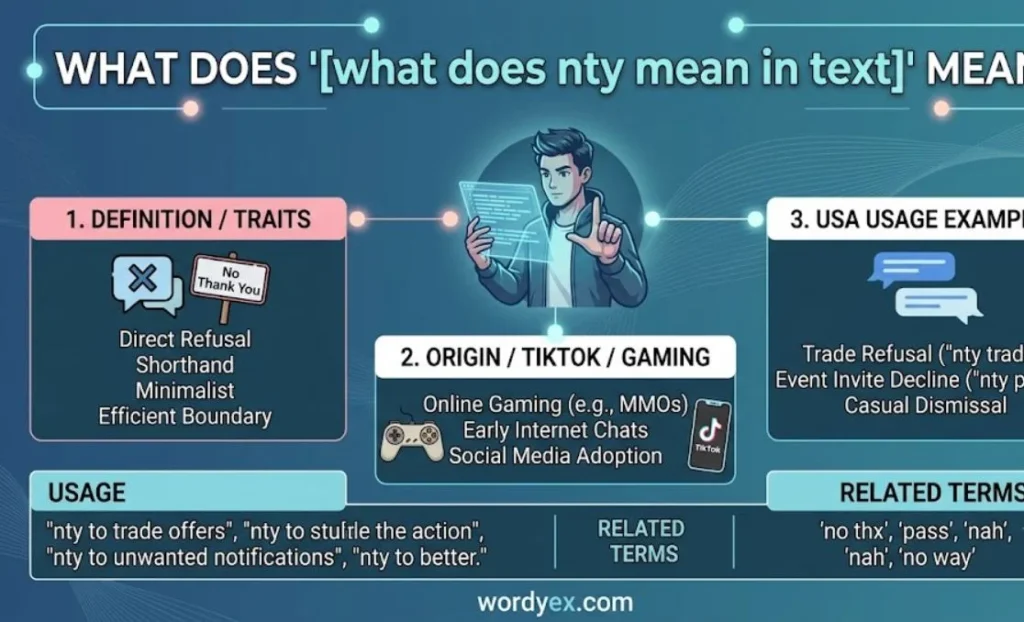
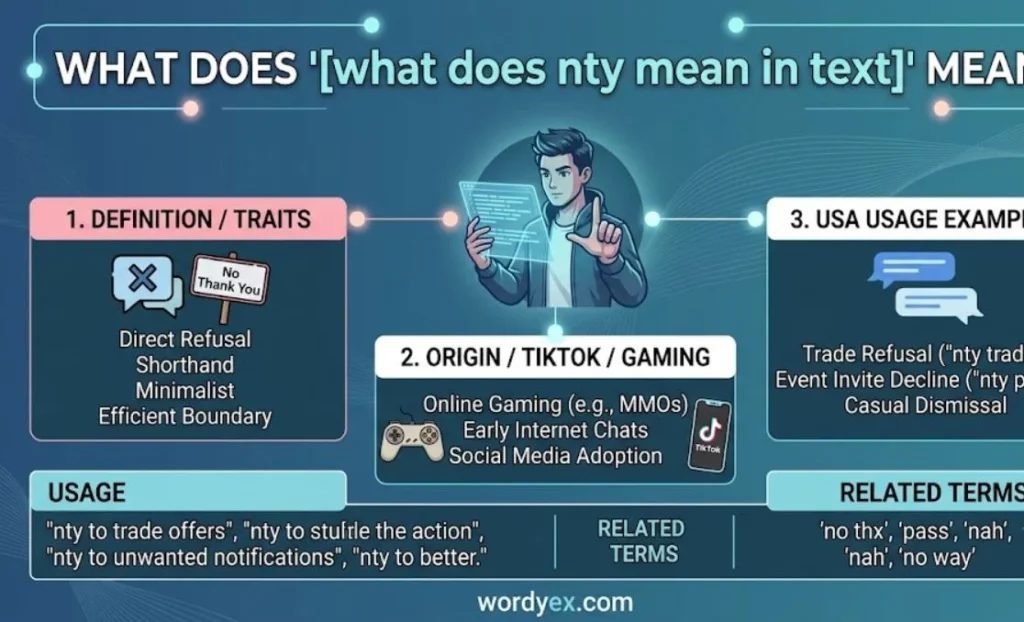
In digital communication, the trending slang acronym nty stands for “no thank you.” It functions as a rapid, text-based shorthand and chat abbreviation used to quickly decline an offer, trade proposal, or invitation across social media, texting, and online gaming platforms.
Why do people choose to use nty in chat?
- Conversational efficiency: It allows users to instantly establish an online boundary using only three lowercase letters instead of typing full sentences.
- Gaming utility: Originally popularized in multiplayer gaming, it provides a fast way to reject item trades without interrupting live gameplay action.
- Low emotional investment: It replaces formal performance politeness with a neutral, casual digital refusal that prevents drawn-out text negotiations.
Decoding the Quick Shift in Modern Texting
Ever opened a text message or scrolled through a comment section only to find a three-letter acronym that felt like a sudden door closing? You are definitely not alone. In the lightning-fast landscape of digital communication, phrases that used to require a polite tone and complete sentences are now distilled into tiny packages of letters. One of the most common, yet frequently misunderstood, examples anchoring this trend is “nty.”
People find themselves searching for this specific term because the boundary between brevity and politeness has become incredibly blurry. When someone sends a quick text, the recipient is left to decode the underlying mood. Did they say it with a smile, or are they brushing me off? Understanding these subtle shifts helps us navigate our daily interactions without unnecessary anxiety or digital friction.
Nty – Quick Meaning
At its core, “nty” is the ultimate minimalist refusal. It compresses a standard, polite social boundary into a lowercase fragment designed for speed.
- It means “no thank you” in almost every digital arena.
- It acts as a direct, no-nonsense rejection of a proposal or trade.
- It eliminates the need for formal pleasantries when time or attention is limited.
“Hey, do you want to grab the extra tickets to the game tonight?”
“nty, already got plans!”
“Can I add you to this group chat for the weekend project?”
“nty, my schedule is completely maxed out right now.”
Origin & Background
While it feels like an invention of the modern smartphone era, the root of “nty” stretches back to early internet relay chats (IRC) and vintage multiplayer online gaming communities. In high-stakes gaming environments where every millisecond matters, typing out full phrases could literally cost your character its life. Players needed a way to instantly decline item trades or party invitations without taking their fingers off the movement keys.
As platforms like TikTok, Discord, and Snapchat became the virtual living rooms of Gen Z and Gen Alpha, this gaming shorthand spilled over into mainstream American culture. The cultural influence of short-form video content accelerated its adoption. Suddenly, a term used to reject an in-game sword trade became the standard way to turn down a Friday night party invitation or an unwanted product pitch in an Instagram DM. Over the years, the meaning hasn’t changed, but its social weight has evolved from a practical gaming utility into a casual, everyday boundary marker.
Real-Life Conversations
TikTok Comments
Mason: Who actually thinks this fashion trend looks good? 💀
Chloe: nty to the whole aesthetic, honestly. It looks like a retro mistake.
Instagram DMs
Austin: Yo, I have a few extra spots open for my weekend marketing webinar. Only $20 if you want in!
Emma: nty, I’m taking a break from screen time this weekend. Thanks though.
WhatsApp Group Chat
Liam: Anyone want to split a giant mushroom and anchovy pizza for the watch party?
Sophia: nty!!! stringently anti-anchovy over here lol.
iMessage Text
Ryan: Hey Sarah, my sister is selling her old couch for cheap if you’re still looking for apartment furniture?
Sarah: nty, I actually just ordered a new sectional yesterday! Appreciate you thinking of me though.
Why is it Viral?
The explosive popularity of this acronym in American culture boils down to our collective craving for conversational efficiency. Modern life moves fast, and our screens are constantly flooded with notifications, pitches, and invites. Typing a full sentence can feel like an unnecessary chore when a simple, three-letter acknowledgment gets the job done instantly. It allows the sender to establish a firm boundary without opening the door to an extended, drawn-out debate.
Emotional & Psychological Meaning
Psychologically, using “nty” signals a desire to maintain distance while acknowledging the interaction. It is a fascinating hybrid of boundary-setting and casual indifference. When we write out “no thank you,” we are investing a small amount of emotional labor into softening the blow of a refusal. By dropping the vowels and keeping it entirely lowercase, the sender removes that emotional cushion.
From my years tracking how language shifts online, I recall an instance where a colleague texted me a brief “nty” regarding a collaborative project idea. My initial reaction was a slight sting—it felt cold. But when we spoke later, I realized there was absolutely no malice intended. They were simply overwhelmed with tasks and viewed the acronym as a neutral, efficient tool. This highlights the core emotional reality of modern text slang: it represents a cultural shift where efficiency is frequently prioritized over traditional performance politeness.
Usage in Different Contexts
Social Media
On public platforms like TikTok or X, the term is frequently used as a rhetorical tool. It allows users to dismiss an idea, a public opinion, or a bizarre viral trend with a sense of witty detachment. It functions almost like a visual eye-roll.
Friends & Relationships
Among close friends, the acronym is completely harmless. It serves as a rapid-fire way to decline minor daily offers without any hidden tension. However, in romantic relationships, overusing such brief terms can sometimes signal emotional withdrawal or a lack of effort.
Work & Professional Settings
This is where the term can cause major issues. Sending “nty” to a supervisor or a client is widely considered unprofessional. In corporate environments, the expectation for complete sentences and explicit respect remains firmly intact. If you want to dive deeper into how professional language contrasts with casual internet culture, exploring communication frameworks on wordyex.com offers great strategies for balancing your digital tone.
Casual vs. Serious Tone
The term thrives in casual spaces. The moment an interaction becomes serious, sensitive, or emotionally charged, switching to shorthand can seem dismissive. For example, rejecting a casual lunch offer with “nty” is totally fine, but using it to respond to a deep, heartfelt apology will likely worsen the conflict.
When NOT to Use It
There are critical moments where using this acronym can seriously backfire. If someone is sharing difficult personal news or offering sincere condolences, replying with three letters is deeply inappropriate. It lacks the empathy required for meaningful human connection.
Furthermore, when interacting with individuals from older generations or different cultural backgrounds who aren’t deeply embedded in American internet spaces, the phrase can easily cause confusion. It can be misinterpreted as an error or an insult. True communicative competence means knowing when to drop the shortcuts and invest the time to write exactly what you mean.
Common Misunderstandings
The most frequent mistake people make when encountering “nty” is assuming the sender is angry or upset. Because digital text lacks facial expressions and vocal inflections, absolute brevity is often misread as hostility.
Another common error is confusing it with other three-letter combinations like “not,” “gty” (grateful to you), or assuming it is a typo for something else entirely. It is a literal statement of refusal, not an invitation to bargain or negotiate further.
Digital Refusals Compared
| Expression | Core Meaning | Tone & Vibe | Best Use Case |
| nty | No thank you | Casual, brief, direct | Quick text messages and casual online trades |
| No thanks | No thank you | Standard, neutral, polite | Everyday speech and semi-formal emails |
| Pass | I will decline this | Blunt, informal, decisive | Group decisions or choosing games |
| No way | Absolutely not | Energetic, intense, extreme | Complete rejection of a wild suggestion |
| Nah | No | Laid-back, conversational | Relaxed chats with close friends |
Key Insight
While all of these terms achieve the exact same functional goal—saying no—the variation you choose acts as an emotional volume slider. Shifting from a standard written refusal to a lowercase acronym fundamentally alters how approachable you seem to the person on the other side of the glass.
Variations & Types
NTY (All Caps)
An emphasized, loud refusal. Using uppercase letters signals that the user wants to set a very firm, unyielding boundary immediately.
nty sorry
A softened version of the acronym. Adding a brief apology helps take the potential sting out of the abrupt shorthand.
nty lol
A lighthearted, playful rejection. The addition of “lol” ensures the recipient knows there are no hard feelings involved.
nty vm
Short for “no thank you very much.” This variation attempts to inject a tiny bit of traditional gratitude back into the brief format.
ew nty
A visceral expression of disgust. This is commonly seen in social media comment sections when reacting to strange recipes or bad takes.
nty bro
A casual, fraternal variation. Typically used between guys or friends to keep the rejection feeling completely relaxed and brotherly.
yeah nty
An ironic or sarcastic refusal. It mimics a moment of consideration before delivering a definitive, firm no.
nty next
Inspired by pop culture trends, this variation indicates that the person is completely ready to move on to the next option without looking back.
How to Respond When Someone Uses It
Casual Replies
- “All good, catch you later!”
- “No worries, completely understand.”
- “Sounds good, thanks for letting me know.”
Funny Replies
- “Ouch, rejected in three letters! 💀”
- “Not even worth a full sentence? Fair enough! 😂”
- “My offer was flawless, but I’ll accept defeat.”
Mature Replies
- “I appreciate the quick response. Let me know if things change.”
- “Thanks for being direct about your availability.”
- “Understood. We can revisit this later if it makes sense.”
Respectful Replies
- “Thank you for your time anyway!”
- “No problem at all, hope you have a great week.”
- “Perfectly fine, thank you for considering the invite.”
Regional & Cultural Usage
Western Culture
In the United States and Canada, the phrase perfectly matches the fast-paced, individualistic style of digital life. Efficiency is highly valued, and setting quick boundaries through text is considered a normal aspect of daily life.
Asian Culture
In many traditional Asian communication styles, direct refusals are frequently avoided to preserve social harmony and avoid causing loss of face. Consequently, using a stark acronym like “nty” can feel uncomfortably blunt or disrespectful unless it is used exclusively between very close, younger friends.
Middle Eastern Culture
Similar to Asian styles, Middle Eastern communication often relies heavily on warmth, hospitality, and elaborate expressions of politeness. A three-letter refusal can strip away the hospitality that forms the foundation of everyday social interactions.
Global Internet Usage
Across global platforms like Discord and Reddit, the term functions as a universal dialect. It crosses international borders easily because online gaming and social media have created a shared global slang system that operates independently of local geography.
Generational Differences
For Gen Z and Gen Alpha, acronyms are a natural native language. They don’t read negativity into brevity. Millennials, however, often view it as a bit cold, preferring a slightly softer delivery. Meanwhile, Baby Boomers might not recognize the acronym at all, often mistaking it for a typing mistake. This gap highlights how rapidly the language of our culture is evolving, a phenomenon extensively documented by communication studies at major research institutions like the Pew Research Center.
Is It Safe for Kids?
From a digital safety standpoint, the acronym is entirely safe. It does not contain any hidden mature themes, explicit language, or dangerous double meanings. It is a simple tool for refusing things. Parents should only be aware that kids might use it to be dismissive or a bit sassy with family members, making it a great conversation starter about adjusting our tone for different audiences.
FAQs
Is nty rude to use in a text message?
It is not inherently rude, but it depends heavily on your audience. Between close friends or online gaming peers, it is seen as completely normal and efficient. However, sending it to a boss, a teacher, or an older relative can easily be interpreted as dismissive or impolite.
What is the difference between nty and no thanks?
The difference lies entirely in the tone and the amount of effort invested. “No thanks” is a standard, polite phrase suitable for daily conversations. “Nty” is an ultra-brief digital shorthand that strips away formal politeness to prioritize speed and efficiency.
Can I use nty in a work email?
No, it is highly recommended to avoid using this acronym in any professional environment. Corporate communication requires a baseline of formal professionalism. Using casual texting slang can make you look unprofessional or indifferent to your job.
Where did the slang term nty come from?
The term originated in early internet chat rooms and online gaming communities. Gamers needed a rapid way to reject in-game trades or group invites without slowing down their gameplay, and the phrase eventually spread to mainstream social media platforms.
Does nty mean anything else?
In the vast majority of text conversations, it strictly means “no thank you.” In rare, specialized professional fields, it might stand for specific technical terms like “Network Termination Unit,” but context will always make the meaning clear.
Final Thought
Navigating the world of modern text slang doesn’t have to feel like decoding a foreign language. At the end of the day, terms like “nty” are just reflection points for how our culture adapts to a fast, screen-first world. It is a helpful tool for quick boundaries, provided we use it with the right people at the right time. Language is all about connection, so feel free to use shortcuts when you need them—just remember to bring back your full voice when the moment truly matters.