What Does TT Mean?
What does tt meaning in text represent?
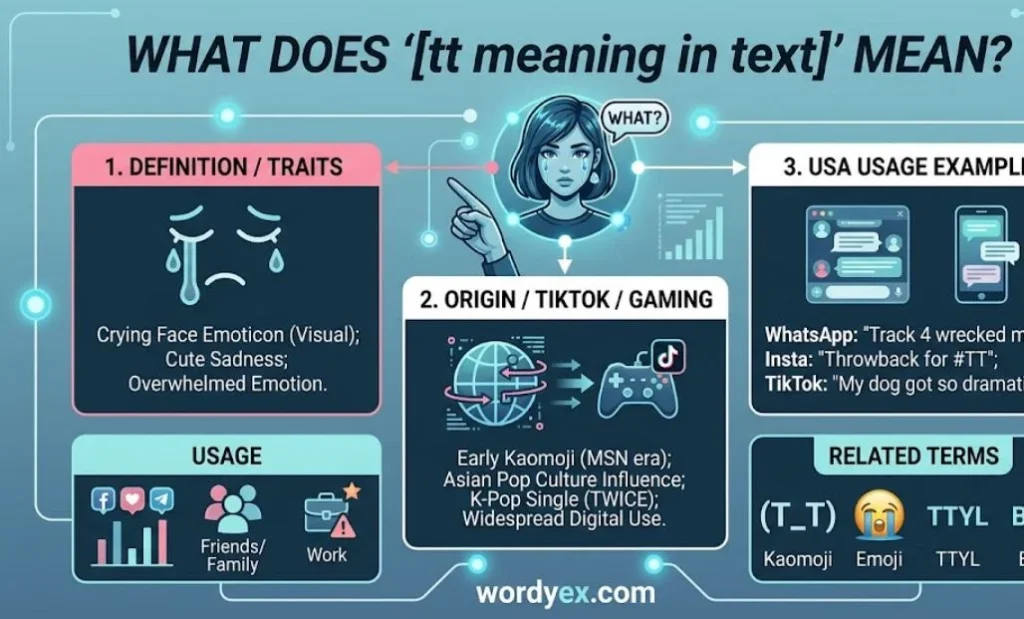
In digital communication, “TT” most commonly represents a crying face emoticon where the top bars form closed eyes and vertical stems represent streaming tears. Depending on context, this popular text slang also serves as shorthand for “Transformation Tuesday” or “Talk To.”
Why do people use TT in online messaging?
- Expresses Hyperbolic Empathy: Allows users to show lighthearted sadness, cute disappointment, or overwhelmed emotion without sounding overly serious.
- Streamlines Trend Sharing: Acts as a universal hashtag on short-form video platforms and social feeds to showcase personal growth and glow-ups.
- Speeds Up Casual Chat: Functions as a convenient two-letter texting abbreviation for fast-paced group chats and instant messaging.
Have you ever scrolled through a comment section, opened a group chat, or glanced at a video caption only to spot two capital Ts sitting next to each other and thought, wait, what are they actually saying? You are not alone. Text speak moves at lightning speed, and two simple letters can carry radically different meanings depending on who is typing them and where they are posted.
Understanding these subtle shifts in digital dialect saves you from awkward misunderstandings and keeps your online interactions seamless. Whether you are trying to decode a late-night message from a friend, analyze a viral trend, or simply stay current with evolving modern slang, getting a firm grip on what TT means will instantly boost your digital literacy.
TT Meaning in Text – Quick Meaning
At its core, “TT” serves three main purposes in American text culture today:
- Visual Crying Symbol: Two T’s side-by-side resemble a pair of eyes with tears streaming down from the horizontal bars (T.T or TT). It signifies sadness, overwhelmed joy, or dramatic empathy.
- Transformation Tuesday: A popular social media hashtag and concept where users post progress photos, fitness journeys, or lifestyle upgrades.
- Talk To / Text To: A quick functional shorthand used in administrative or casual messaging (e.g., “TT you later”).
“I just finished watching the season finale TT”
“Check out my 3-year fitness journey! #TT”
“Got to run into a meeting, TT you in an hour.”
Origin & Background
The acronym TT carries a rich, multi-layered history that spans across global internet culture, Asian pop media, and early text messaging formats.
Before smartphones and high-resolution emojis took over our screens, early internet users relied heavily on kaomoji—Japanese text-based emoticons. The combination “T.T” or “TT” was crafted to visually mimic a face with streaming tears, where the top horizontal strokes represent closed or crying eyes, and the vertical stems represent lines of tears running down a face. This visual shorthand blew up globally during the MSN Messenger and AOL Instant Messenger eras of the early 2000s and never truly disappeared.
The slang received a massive global pop-culture boost in late 2016 when the mega-popular K-pop girl group TWICE released their hit single titled “TT.” The song, accompanied by a signature point dance mimicking crying eyes with fingers shaped like T’s, went massively viral on YouTube and early short-form video platforms. This solidified TT as an iconic symbol for dramatic, cute, or lighthearted sadness across mainstream youth culture.
As platforms like Instagram, TikTok, and X (formerly Twitter) evolved, TT picked up additional functional meanings in the United States. It became the default abbreviation for “Transformation Tuesday,” a recurring weekly trend where creators document personal growth, glow-ups, or home renovations. In fast-paced texting environments, it simultaneously survived as a low-effort way to say “Talk To,” showing how digital slang adapts to fit the platform it lives on.
Real-Life Conversations
To see how TT functions in everyday American text exchanges, check out these realistic conversational scenarios across different platforms.
WhatsApp Chat
Maya: Did you listen to the new album yet?
Jordan: Yes! Track 4 completely wrecked me TT
Maya: Right?! I’ve had it on repeat all morning.
Instagram DM
Sarah: Honestly cannot believe it’s been five years since we graduated.
Alex: Look at this throwback pic I found! Thinking of posting it for TT.
Sarah: Oh my gosh, please do! We looked so different back then.
TikTok Comment Section
Liam: My dog dropped his toy under the couch and sat there waiting for me to get it TT
Chloe B: The dramatic sigh at the end broke my heart! Give him his toy!
Standard Text Message
David: Hey, I’m pulling up to the venue now. Traffic was terrible.
Taylor: All good! Grab us a spot near the back, TT you when I walk in.
Why is this simple two-letter term so viral across the USA? American digital culture thrives on speed, visual shorthand, and community trends. Whether people are expressing exaggerated emotions in a comment section or participating in a weekly hashtag trend, TT offers a quick, universally understood shortcut that fits right into fast-scrolling feeds.
Emotional & Psychological Meaning
Beyond its literal definitions, using TT reveals a lot about how modern text communication handles emotion and intimacy.
When someone types “TT” to convey crying, it rarely signifies profound grief. Instead, it expresses a specific brand of modern emotional exaggeration—what sociolinguists often call “hyperbolic empathy.” It allows the sender to show that they are touched, overwhelmed, cute-sad, or mildly frustrated without introducing heavy, somber energy into a light conversation.
It creates a soft, approachable tone. Typing “I am so sad” feels formal and intense. Dropping a quick “TT” softens the impact, signalling to the reader that while you feel impacted, you are maintaining a playful, conversational atmosphere.
During my early years analyzing digital trends, I remember getting a message from a colleague that simply read: “The coffee machine broke down again TT.” That simple visual shorthand turned a minor workplace annoyance into a moment of shared, lighthearted camaraderie. It builds a quick psychological bridge between speakers through shared visual slang.
Usage in Different Contexts
Understanding how TT shifts across environments ensures you always hit the right note.
Social Media
On platforms like TikTok, Instagram, and X, TT shines as either a visual reaction in comments or a trend tag in captions. You will see it constantly under emotional video edits, cute animal clips, or relatable storytelling posts. When written as #TT, it almost always refers to Transformation Tuesday content.
Friends & Relationships
In casual chats with peers, friends, and romantic partners, TT functions freely as an emotional modifier or an administrative shortcut. It adds warmth to casual check-ins and keeps the conversational momentum going without needing explicit emoji searches.
Work & Professional Settings
Exercise caution here. In professional Slack channels, emails, or client communications, using “TT” to mean crying or Transformation Tuesday can come across as unprofessional or confusing to older colleagues. However, using it briefly as “Talk To” (e.g., “TT you at the stand-up meeting”) is generally acceptable in fast-moving tech or creative environments, though spelling out the full phrase remains safer.
Casual vs. Serious Tone
TT belongs almost exclusively to casual, lighthearted, or mildly dramatic conversations. If a conversation turns toward genuinely heavy topics—such as a real-world loss, serious bad news, or a deep personal conflict—swapping out sincere words for slang like TT can feel dismissive or insincere.
When NOT to Use It
While TT is versatile, knowing when to leave it out is just as critical for clear, respectful communication.
- In Formal Business Emails: Avoid using slang in cover letters, executive updates, or formal client proposals.
- During Genuine Emotional Crises: If someone shares painful personal news, responding with “TT” feels cold and trivializing.
- With Audiences Unfamiliar with Internet Slang: Older relatives or non-tech-savvy contacts may mistake “TT” for a typo or misunderstand your intent entirely.
- In Legal or Legal-Adjacent Documents: Keep all written contracts, reports, and official notices strictly professional.
For a deeper dive into decoding confusing messaging shortcuts, you can explore our complete breakdown of modern text slang and meanings to master everyday digital communication.
To learn more about the linguistic evolution of emoticons into modern text slang, check out the historical archives provided by the Linguistic Society of America.
Common Misunderstandings
The biggest source of confusion surrounding TT stems from context collapsing. Because the abbreviation holds multiple meanings, readers sometimes misinterpret the sender’s core message.
People frequently mistake the emotional crying meaning (“TT”) for an actual administrative command, or vice versa. If someone texts “Call me later TT,” a receiver might worry something terrible happened, when the sender simply meant “Talk To.”
Another common mix-up involves tone reading. Because emoticons like TT originate in casual internet culture, older readers might take the “crying” aspect literally, assuming deep distress over a minor inconvenience. Clear context within the surrounding sentence usually resolves these mix-ups instantly.
Comparison Table
| Term / Slang | Primary Meaning | Emotional Tone | Best Used For |
| TT | Visual crying / Transformation Tuesday / Talk To | Lighthearted, expressive, fast | Social media, casual texting, friend groups |
| T.T | Kaomoji crying face | Cute, dramatic sad, overwhelmed | Gaming chats, online forums, anime fandoms |
| TTYL | Talk To You Later | Neutral, informative, polite exit | Text messaging, ending conversations |
| 😭 (Loudly Crying Emoji) | Extreme sadness OR extreme laughter | Intense, dramatic, loud | Social media comments, peak comedic reactions |
| BRB | Be Right Back | Practical, brief | Instant messaging, gaming, work chats |
Key Insight: While traditional acronyms like TTYL focus purely on functional speed, TT bridges the gap between functional shorthand and visual emotional expression.
Variations & Types of TT
Depending on the community, formatting, or platform, you will encounter several distinct variations of TT:
- TT (Crying): The standard lowercase or uppercase text version used in comments and chats to show cute sadness.
- T.T / T_T: The classic kaomoji format featuring periods or underscores to represent the nose or mouth between crying eyes.
- #TT: Social media hashtag shorthand specifically representing Transformation Tuesday.
- TTYL: “Talk To You Later,” the expanded traditional ancestor of the short “TT” exit phrase.
- TTR: “Time To Read” or “Time To Respond,” frequently used in work-adjacent messaging channels.
- TTYS: “Talk To You Soon,” a warmer alternative to standard exit acronyms.
- TTN: “Talk To Night,” a night-specific variation used in casual late text strings.
- T&T: “Tips & Tricks,” commonly seen in educational reels, tutorials, and DIY social media captions.
- TT (TikTok shorthand): Sometimes used casually by creators as a direct abbreviation for the TikTok platform itself.
How to Respond When Someone Uses It
Not sure how to reply when TT pops up in your inbox? Here are tailored responses based on the vibe you want to give off.
Casual Replies
- “Haha I know right! total nightmare.”
- “No worries at all, talk soon!”
- “Sending good vibes your way!”
Funny Replies
- “Don’t cry! I’ll buy you a coffee to fix it.”
- “Who do I need to fight over this? 😂”
- “Drama queen level 100 detected!”
Mature Replies
- “I understand that’s frustrating. Let me know if I can help.”
- “Sounds good, catch up with you later today.”
- “Thanks for the update, appreciate it.”
Respectful Replies
- “I completely see where you’re coming from.”
- “Take all the time you need!”
- “Talk to you soon, have a great rest of your afternoon.”
Regional & Cultural Usage
The way TT is used varies significantly across cultures, generations, and geography.
In Western Culture (USA & Europe), TT leans heavily into social media trends like Transformation Tuesday and fast-paced messaging shortcuts. While the crying face meaning is widely recognized by younger demographics, emojis like the crying-laughing face or loudly crying face still dominate basic SMS text feeds.
In Asian Culture (East & Southeast Asia), T.T / T_T holds deep historical roots as a primary kaomoji. Thanks to the massive global spread of K-pop, anime, and gaming culture, the visual interpretation of TT remains dominant, carrying a cute, expressive tone deeply integrated into everyday digital communication.
In Middle Eastern Digital Culture, internet users frequently blend global English slang like TT with regional languages in social media comment sections, using it primarily as a visual emotional reaction to viral video content.
Across Generational Differences, Gen Z and younger Millennials predominantly use TT as a visual emoticon or TikTok trend reference. In contrast, older Millennials and Gen X are far more likely to interpret TT purely as functional shorthand for “Talk To” or confuse it with traditional acronyms like TTYL.
Is It Safe for Kids?
Yes, TT is completely safe for kids, teens, and young adults. It carries no inherently explicit, offensive, or inappropriate connotations. It is a harmless piece of digital shorthand used for emotional expression, social trends, or basic communication speed.
As with all online interactions, the broader context of the conversation matters most, but the term itself poses zero safety concerns for young users navigating social media or texting.
FAQs
What does TT mean in text from a girl?
When a girl sends TT in a text, it usually represents a crying face showing cute sadness, feeling overwhelmed by something sweet, or dramatic empathy. Context will tell you if she means “crying” or “talk to.”
Is TT an emoji or an acronym?
TT functions as both. It acts as a text-based visual emoticon (mimicking streaming tears) and as an acronym (standing for Transformation Tuesday or Talk To).
What does TT mean on TikTok?
On TikTok, TT usually refers to a crying reaction in video comment sections or stands for the hashtag trend Transformation Tuesday in video captions.
Is T.T different from TT?
They mean the exact same thing when expressing a crying face. Adding periods (T.T) or an underscore (T_T) simply emphasizes the visual kaomoji style showing a nose or mouth between the eyes.
Can TT mean Talk To You Later?
While TTYL is the standard full acronym for “Talk To You Later,” many people use TT as a ultra-shortened version meaning simply “Talk To” or “Text To.”
What does TT mean in gaming chats?
In multiplayer gaming, T.T is used in text chat to express disappointment, mourning a defeated teammate, or reacting lightheartedly to a lost match.
Final Thought
Digital slang isn’t just about saving keystrokes—it’s about connecting with people in a language that feels immediate, personal, and attuned to modern culture. Whether you use TT to show a little dramatic empathy over a mild inconvenience, tag your personal progress on social media, or wrap up a quick text chat, you now have the full context to use it naturally. Language evolves rapidly, but staying curious and confident keeps you smoothly connected across every screen you use.