What Does tqbfjotld Mean?
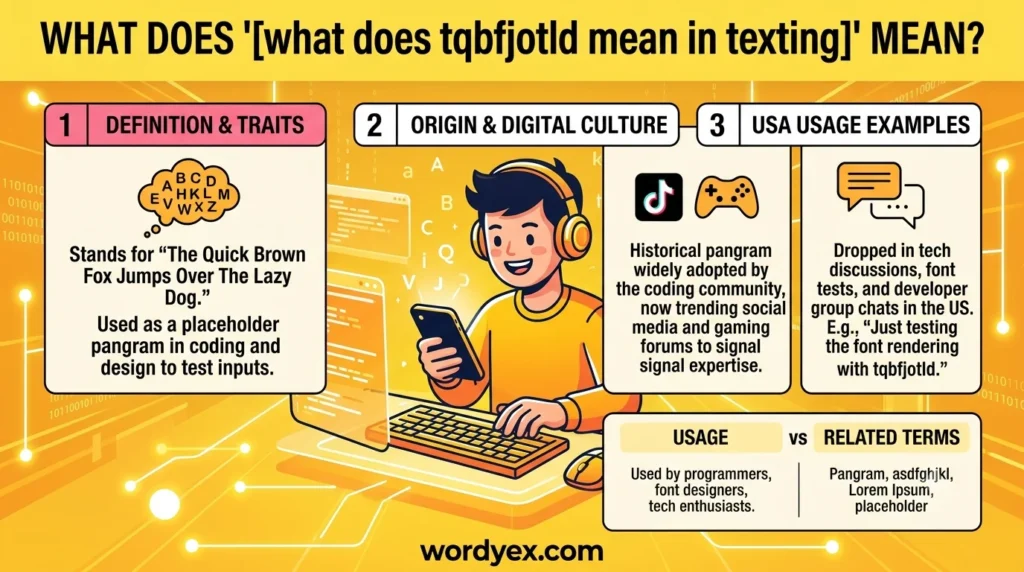
tqbfjotld is the digital text abbreviation for “The Quick Brown Fox Jumps Over The Lazy Dog,” a famous English pangram containing every letter from A to Z. It is widely used as a trending slang tool to test custom keyboards, fonts, and screen layouts.
Why use this classic pangram in digital communication?
- Complete Character Testing: It allows hardware enthusiasts and developers to instantly verify . All twenty-six English letters render correctly on custom displays.
- Typing Speed and Accuracy: Mobile device users employ the abbreviation as a baseline benchmark to evaluate touch screen responsiveness and tactile switch performance.
- Secure Passphrase Blueprint: Security-conscious individuals utilize the sequential lettering structure as a highly memorable, uncrackable foundation for complex digital passwords.
- Cultural Tech Identity: Dropping the acronym in messaging apps acts as a modern insider handshake within elite graphic design, typographic, and custom mechanical keyboard subcultures.
If you have ever stared at a random string of lowercase letters on your phone screen and wondered if your friend was having a literal keyboard smash, you are not alone. Modern texting culture moves at a lightning pace, and keeping up with the latest digital codes can feel like learning an entirely new language. Seeing this specific sequence pop up in a group chat or a direct message usually means someone is testing out a new phone setup, messing with custom fonts, or playing a subtle insider joke with fellow tech heads. It represents a bridge between old-school typing tradition and modern digital culture.
tqbfjotld – Quick Meaning
At its core, this string of text is a complete functional tool compressed into a single acronym. Because it contains every character of the English alphabet, typing it out or sending it in a text serves very practical purposes in the modern mobile era.
- It represents the classic English pangram containing all twenty-six letters.
- It is used as a benchmark for testing new physical or digital touch keyboards.
- It acts as a baseline placeholder for previewing custom typography styles on mobile screens.
- It serves as a popular mnemonic device for building strong, memorable passphrases.
“Just finished rebuilding my mechanical keyboard, tqbfjotld feels so smooth on these new linear switches.”
“Testing out the new iOS beta font rendering. Send me tqbfjotld so I can see if the kerning is messed up.”
Origin & Background
The roots of this expression stretch far back into the nineteenth century long before smartphones or cellular networks existed. The earliest recorded appearance of the complete phrase dates back to an 1885 edition of The Boston Journal.
where it was recommended as a foundational practice sentence for writing students due to its unique linguistic property of utilizing every letter.
As the industrial revolution introduced typewriters to offices across the United States, the phrase became the golden standard for testing equipment functionality and manufacturing precision.
If a typewriter could successfully print that single sentence without jamming, it proved that every single mechanical key lever was perfectly aligned and operational.
Western Union later adopted it to test Telex and TWX data communication systems, ensuring that long-distance digital transmissions did not drop any characters along the wire.
When computer operating systems emerged, developers integrated the sentence into font viewers.
which is why Microsoft Windows and Apple macOS users still see it when previewing typefaces today.
In the current social media landscape, the acronym form has taken on a life of its own on platforms like TikTok and specialized Reddit communities.
Gen Z and millennial mechanical keyboard hobbyists, graphic designers, and tech enthusiasts.
It began compressing the phrase into a rapid-fire abbreviation to show off their custom setups, transforming a centuries-old test line into a badge of modern digital literacy.
Real-Life Conversations
Seeing how this term functions in standard daily interactions helps illustrate its place in modern American communication. Here are a few common ways this acronym appears across different messaging platforms.
WhatsApp Message
John: Hey man, did you get that new custom e-ink phone you ordered?
Tony: Yeah it just arrived! Setting up the display settings right now. tqbfjotld looks incredibly crisp on this screen, the refresh rate is wild.
Instagram DM
Marcus: Look at this new font I designed for the streetwear brand launch.
Devon: That looks clean! Hit me with tqbfjotld in the group chat so I can see how the lowercase letters look next to each other.
TikTok Comment
Chloe: My fingers literally cannot type on these tiny new screens.
Sam: tqbfjotld is the ultimate test. If you can type that sequence without hitting a typo, you have officially mastered the screen size.
Text Message
Alex: I need a new password for my bank account that I won’t forget but is impossible to hack.
Ryan: Try using a passphrase method. Start with tqbfjotld and swap out a few letters for numbers based on your layout. It will be uncrackable.
This trending abbreviation has gained massive traction because it speaks directly to the growing subcultures of keyboard customization and digital aesthetic design that dominate platforms like wordyex.com where language trends are cataloged daily.
Emotional & Psychological Meaning
Using a highly specialized acronym like this carries a subtle layer of psychological signaling. It immediately establishes a sense of technical competence and insider knowledge. When someone drops this sequence into a conversation, they are often expressing a desire for precision, order, and functional perfection. It acts as a digital comforting tool for people who value clean design and optimal device performance.
In a broader sense, the word reflects how modern communication strips away unnecessary friction. Instead of typing out a long sentence, compressing it into a nine-letter string shows a desire for maximum efficiency. It turns a historical literacy tool into a playful secret handshake among people who spend their lives looking at screens, making digital spaces feel a little more connected and personalized.
To look at a personal scenario, imagine spending hours meticulously building a custom mechanical keyboard, lubing every individual switch to achieve the perfect acoustic pop. Sending that specific sequence to a friend is a way of sharing a proud moment of craftsmanship. It conveys a deep sense of satisfaction that everything is working exactly as intended.
Usage in Different Contexts
The appropriateness of this term relies heavily on the environment and the audience receiving the message.
In social media spaces like Reddit, Discord, and TikTok, the acronym is a standard badge of entry for design and hardware communities. It fits naturally in captions, tech reviews, and aesthetic desk setup videos where viewers instantly recognize the reference.
Among close friends and relationships, it functions as a quirky insider joke or a practical tool. If a couple is testing out a new messaging app or troubleshooting a broken phone screen, sending the acronym is a quick, comprehensive way to verify that all inputs are working properly without typing a random jumble of nonsense.
In professional settings such as graphic design agencies, software development firms, or IT support roles, the phrase itself is ubiquitous, but using the shortened text version should be reserved for informal internal communication. A developer might toss it into a Slack message to a teammate while debugging an input field, but it should be avoided when presenting final font layouts to external corporate clients.
When NOT to Use It
While highly useful in tech and design circles, there are distinct boundaries where using this acronym can lead to absolute confusion or feel entirely out of place.
Do not send this abbreviation during high-stakes emotional conversations or serious life updates. If a family member sends a heartfelt text about a difficult situation, responding with a testing acronym will appear deeply dismissive and emotionally vacant. It completely shatters the empathy required in serious interpersonal connections.
Additionally, avoid using it with individuals who are not deeply embedded in internet culture or digital workspaces. Older generations or casual device users will likely interpret the string as an accidental pocket dial or a broken touch screen, forcing you to spend extra time explaining the historical mechanics of nineteenth-century typography rather than keeping the conversation flowing naturally.
Common Misunderstandings
The most frequent misunderstanding surrounding this acronym is the assumption that it is a random keyboard smash meant to signal frustration or anger. Because strings of random consonants like “asdfghjkl” are traditionally used online to express stress or being overwhelmed, many casual texters mistake this specific sequence for a declaration of panic.
Another point of confusion is its literal interpretation. People unfamiliar with the historical background might assume the sender is talking about actual wildlife or a lazy pet, completely missing the structural utility of the sentence. Understanding that it is a tool for character coverage rather than a literal narrative is essential for clear interpretation.
Comparison Table
| Term | Primary Meaning | Best Used For | Tone |
| tqbfjotld | The Quick Brown Fox Jumps Over The Lazy Dog | Testing keyboards, fonts, and inputs | Technical, Quirky, Efficient |
| asdfghjkl | Home row keyboard smash | Expressing overwhelming emotion or frustration | Chaotic, Dramatic, Casual |
| Lorem Ipsum | Standard Latin placeholder text | Formatting layout blocks in graphic design | Formal, Professional, Structural |
| Qwerty | Standard Western keyboard layout | Discussing typing styles or hardware configurations | Neutral, Informative, Factual |
Key Insight
While general keyboard smashes convey pure chaotic emotion, this specific acronym is a calculated, structured tool that represents functional completeness and technical mastery over digital inputs.
Variations & Types
Depending on the specific community or historical preference, you may encounter different forms or alternatives to this classic text string.
- TQBFJOTLD: The all-caps version, often used to test how capital letters render in heavy bold display fonts.
- The Quick Brown Fox: A truncated version used when the receiver already knows the context and a full letter test is not required.
- Sphinx of black quartz, judge my vow: A popular alternative pangram used by designers who prefer a darker, more gothic tone for testing fonts according to historical Wikipedia entry on pangrams.
- Pack my box with five dozen liquor jugs: A shorter alternative pangram favored for its efficiency in testing minimal screen layouts.
- tqbfjotld123: The standard acronym appended with numerical sequences to test both alphabetic and numeric inputs simultaneously.
- tqbfj: An ultra-shortened variation used purely as a quick nod to the phrase within elite mechanical keyboard circles.
- The Lazy Dog: A backend-focused variation used casually to reference the completion of a long layout test.
- Holoalphabetic text: The formal linguistic classification for these types of all-inclusive alphabetical sentences.
How to Respond When Someone Uses It
Your response to this acronym depends entirely on why the person sent it to you in the first place.
Casual Replies
- “Haha classic, everything looking crisp on that new screen?”
- “The ultimate test! Did it pass the vibe check?”
Funny Replies
- “Stop attacking that poor lazy dog, he’s just trying to nap.”
- “My phone exploded just trying to read that sentence.”
Mature Replies
- “The text rendering looks perfectly aligned. The font choice is excellent for readability.”
- “Input looks solid, no dropped characters or weird spacing issues detected.”
Respectful Replies
- “Nice setup, the new layout seems to be functioning flawlessly.”
- “Appreciate the quick test, everything is clear on my end.”
Regional & Cultural Usage
The cultural footprint of this term varies significantly depending on geography and generational shifts.
In Western digital culture, particularly within the United States, the phrase is a bedrock element of tech history. Almost anyone who has worked in design, printing, or computer engineering recognizes it instantly. It carries a heavy sense of nostalgic utility that has seamlessly transitioned into modern internet slang.
In Asian and Middle Eastern cultures where the primary languages utilize entirely different script systems like Kanji, Hangul, or Arabic characters, the acronym holds far less cultural relevance. While local developers and designers use it strictly when working with English-localized software, they have their own unique regional sentences designed to test the complex brush strokes and character variations native to their respective alphabets.
From a generational standpoint, a distinct divide exists. Gen Z and younger millennials view the acronym as a trendy aesthetic shorthand connected to mechanical keyboard builds and minimalist desk setups. Older generations recognize the full sentence from old school typing classes on actual typewriters but are often completely mystified when it is compressed into a rapid-fire text abbreviation.
Is It Safe for Kids?
This acronym is entirely safe for children to use and encounter online. It contains no inappropriate themes, offensive language, or hidden negative connotations. Because its entire historical purpose is rooted in language education, literacy, and technical testing, it is actually a fantastic tool for young learners to practice their typing accuracy and explore the mechanics of the English language.
FAQs
What does the abbreviation tqbfjotld stand for in a text message?
It stands for “The Quick Brown Fox Jumps Over The Lazy Dog,” which is a famous sentence that contains every single letter of the English alphabet.
Why do people send tqbfjotld instead of typing normal words?
People use it as a shorthand to quickly test font appearances, display clarity, or keyboard responsiveness without needing to type out the entire long sentence.
Is tqbfjotld a sign of an angry keyboard smash?
No, unlike random keyboard smashes that express frustration, this is a deliberate acronym used for functional testing and tech humor.
Can I use tqbfjotld as a password?
The raw acronym can serve as a base, but it is highly recommended to add unique capitalizations, numbers, and symbols to ensure it becomes a highly secure passphrase.
Where did the quick brown fox phrase originally come from?
The phrase originated in the late nineteenth century as a handwriting practice sentence in the United States before becoming the standard test line for typewriters and computers.
Final Thought
Navigating the ever-evolving world of digital slang can feel like a daunting task, but discovering the rich history behind a term like this reveals just how interconnected our modern text habits are with the past. It turns an ordinary technical test into a playful expression of style and precision. The next time you see this unique sequence pop up on your screen, you can smile knowing exactly what it means, confident in your ability to keep pace with the vibrant, fast-moving landscape of American digital culture.